JVC
From Phonographs to the VHS System
Forgotten Companies · 1927–1976
Archived on
Associated With
Victor Company of Japan, later part of JVCKENWOOD - creator or operator, brand
Defining Feature
Development and 1976 introduction of the VHS home-video format
Status
Active - JVC continues as a brand and business within JVCKENWOOD
Overview
JVC began in Yokohama in 1927 as the Japanese arm of the Victor Talking Machine Company.
Its early manufacturing included phonographs and records. Over the following decades, the company moved through recorded sound, radio and television as its work expanded from audio into visual technology.
In 1976 JVC introduced the first VHS-format video recorder. VHS subsequently became a global home-video standard.
Why It Mattered
JVC's VHS system extended the company's visual-technology work into home video recording and replay.
Company Foundations
- JVC began in Yokohama in 1927 as a subsidiary of the U.S. Victor Talking Machine Company.
- Its early manufacturing work included phonographs and records.
VHS Development
- JVCKENWOOD's technology record dates JVC's development of VHS to 1976.
- JVC's corporate history identifies the 1976 machine as the first VHS-format video recorder.
Format Reach and Later Video Work
- JVCKENWOOD identifies VHS as a global home-video standard.
- JVC's later video work included the 1984 GR-C1 VHS home video camera.
Sources & Records
- JVC — company history — Documents the 1927 Yokohama origins, early recording business and 1976 VHS recorder.
- JVCKENWOOD — roots of visual technology — Dates VHS development to 1976 and the GR-C1 home video camera to 1984.
Gallery
Credit
JVC Company of America advertising artwork; scan reproduced in an eBay listing by Keystone Vintage Shop; scan contributor not identified.
Licence
Historical Ephemera
Displayed for commentary, criticism, research and historical documentation where permitted by applicable law. No permission for reuse is granted.
Caption
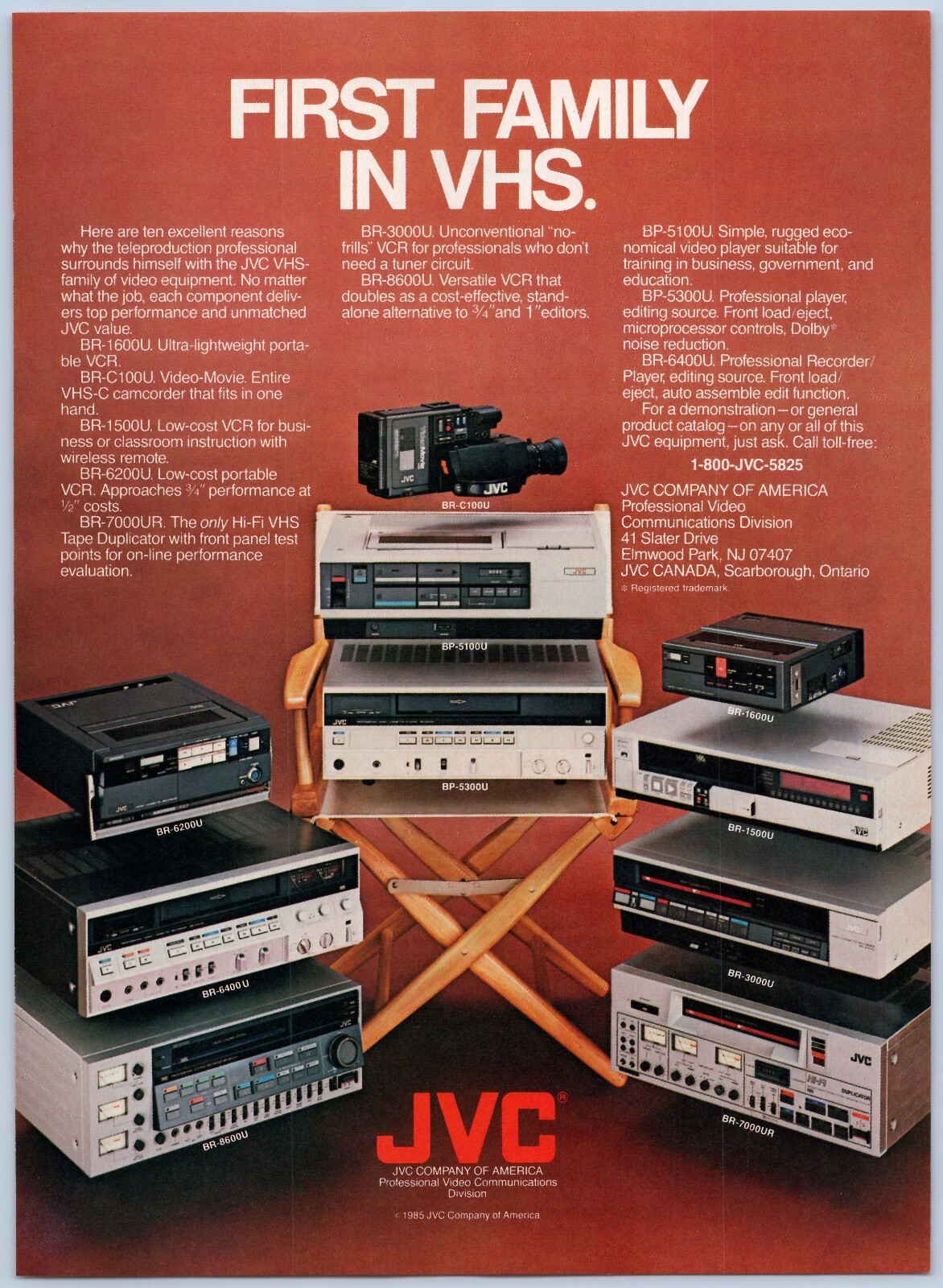
JVC's 'First Family in VHS' advertisement presents a whole recording system, showing how the videocassette format was marketed through an expanding range of equipment.