PalmPilot
A Pocket Organizer Built Around Synchronisation
Forgotten Technology · 1996
Archived on
Associated With
Palm Computing Division of U.S. Robotics - creator or operator
Defining Feature
A shirt-pocket handheld that synchronised personal data with a desktop computer
Status
Preserved - Original PalmPilot hardware is preserved in institutional collections
Overview
The PalmPilot arrived in 1996 as a pocket-sized organiser that kept everyday information close at hand.
It carried contacts, appointments, tasks and notes, accepting handwriting through a touch screen. Placing the device in its included cradle synchronised that information with a desktop computer.
Rather than imitating a full desktop computer, it concentrated on daily organisation and specialised handheld applications. It also saw rapid early adoption.
Why It Mattered
The PalmPilot made digital organisation more practical away from a desk. By combining touch-screen input, handwriting recognition and desktop synchronisation, it showed how a personal digital assistant could support everyday organisation.
Everyday Information
- The PalmPilot tracked contacts, notes, to-do items and events.
- It supported specialised applications on a general-purpose handheld computer.
Pocket Hardware and Synchronisation
- The physical design was small enough for a shirt pocket.
- An included cradle synchronised information with a desktop computer.
Documented Early Adoption
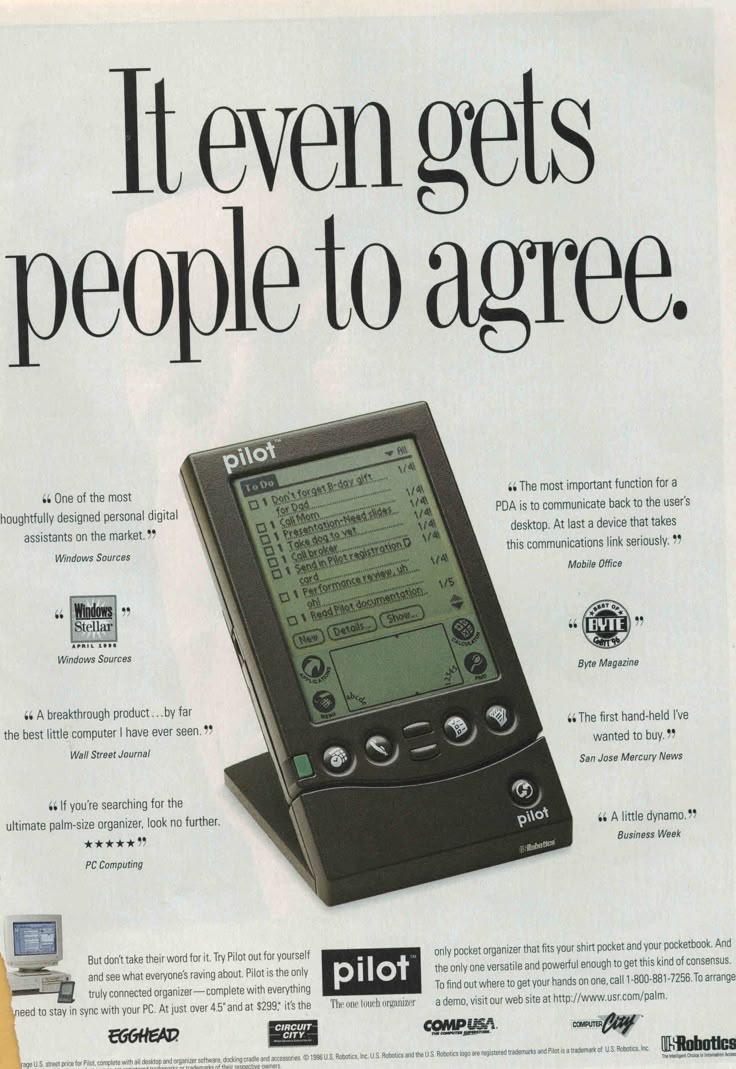
- A 1996 U.S. Robotics advertisement is held by the Computer History Museum.
- The museum records about one million PalmPilots sold in the first 18 months.
Sources & Records
- Computer History Museum — PalmPilot handheld — Documents its organiser functions, pocket-sized design and desktop synchronisation cradle.
- Computer History Museum — 1996 PalmPilot advertisement — Catalogues the contemporary advertisement and reports about one million sales in the first 18 months.
Gallery
Credit
U.S. Robotics Pilot advertisement, © 1996 U.S. Robotics; reproduced via Marc Leff / LinkedIn; scan contributor unidentified
Caption
This U.S. Robotics Pilot advertisement pairs the handheld and its synchronisation cradle with the headline “It even gets people to agree.”