Kowloon Walled City
From Qing Garrison to Urban Park
Forgotten Places · 1847–1994
Archived on
Associated With
Qing government - creator or operator
Defining Feature
A granite-walled garrison later overbuilt with high-rise tenements
Status
Demolished - cleared in 1994; the Yamen and South Gate remnants are preserved
Overview
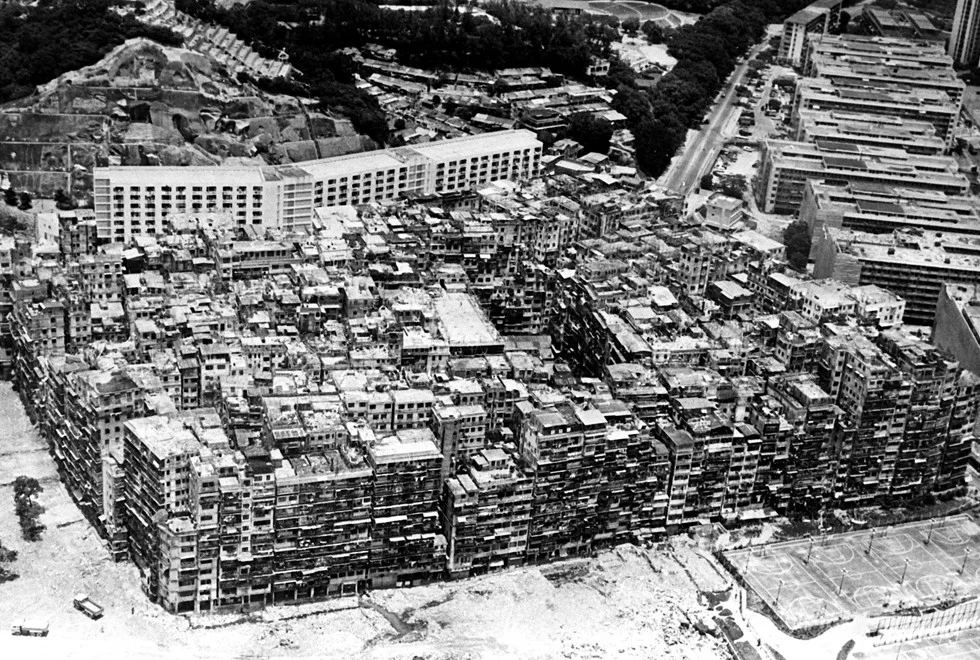
Kowloon Walled City grew from a Qing coastal garrison into a tightly packed settlement of connected towers.
After the Second World War, high-rise tenements spread across the former military site. Homes, workshops, shops, clinics and passages filled almost every available space within the settlement.
Demolition was announced in 1987 and completed in 1994. The park built in its place retains the former Yamen and remnants of the South Gate.
Why It Mattered
The Walled City became both a real community and a symbol onto which outsiders projected fear, disorder and fascination. Its preserved structures, photographs and residents’ memories now convey the extraordinary density of a settlement that has otherwise disappeared.
Garrison Origins
- The Qing government built the garrison town in 1847 to reinforce coastal defence.
- The original complex included granite walls, six watchtowers, four gateways and a Yamen.
Wartime Transformation
- The granite walls were removed during the Japanese occupation.
Park and Monuments
- The restored Yamen and South Gate remnants were declared monuments in 1996.
Sources & Records
- Hong Kong Home Affairs Department — Kowloon Walled City Park — Documents the garrison, postwar tenements, 1994 demolition and preserved monuments.
- Hong Kong Antiquities and Monuments Office — former Yamen — Explains the original military site and records the 1987 demolition announcement and 1996 monument designation.
Gallery
Credit
South China Morning Post archive photograph; individual photographer not identified.
Licence
Historical Ephemera
Displayed for commentary, criticism, research and historical documentation where permitted by applicable law. No permission for reuse is granted.
Caption
Kowloon Walled City's tightly packed buildings reveal the density that made the enclave so distinctive, with everyday life accommodated in a remarkably confined urban space.