The Princes in the Tower
Disappearance Amid a Contested Succession
Forgotten Mysteries · 1483
Archived on
Region
United Kingdom
Associated With
Edward V - elder prince; Richard of Shrewsbury - younger prince
Defining Feature
The unresolved disappearance of Edward V and Richard, Duke of York from public view
Status
Unresolved - the brothers’ fate and the identity of the 1674 remains are unconfirmed
Overview
Edward V and his younger brother disappeared from public view in 1483 while staying in the Tower of London.
After their father Edward IV died, the brothers were placed in the Tower, then a royal residence used for coronation preparations. Their uncle took the crown as Richard III amid a contested succession.
The boys became known as the Princes in the Tower. Their fate remains unresolved, despite later accounts, supposed remains and centuries of interpretation. Paintings and drama gave the story familiar images without supplying a conclusive ending.
Why It Mattered
An unresolved disappearance became part of how a royal succession was remembered. Later paintings and stories gave the brothers recognisable faces and imagined scenes of vulnerability or betrayal. Those works helped sustain the princes’ place in public memory, even though their emotional force could not establish what happened to them.
Last Recorded Presence
- Historic Royal Palaces cites a Great Chronicle entry describing the boys playing in the Tower garden on 16/06/1483 as their last recorded sighting in its account.
- Dominic Mancini wrote an account in 12/1483; Historic Royal Palaces identifies his work and the Great Chronicle as important documentary evidence.
- Placement in the Tower was not, by itself, proof of a plan to harm them: it also functioned as a royal residence and coronation setting.
Succession and Resistance
- Richard, Duke of Gloucester, served as Lord Protector before being crowned Richard III on 06/07/1483.
- The 1484 statute Titulus Regius ratified Richard III’s title and advanced the political claim that Edward IV’s children were illegitimate; it does not establish the brothers’ fate.
- The National Archives records resistance to Edward V’s displacement, including a 1483 plot intended to free the brothers.
Remains and Later Memory
- Children’s remains found at the Tower in 1674 were reburied at Westminster Abbey in 1678, in an urn designed by Sir Christopher Wren and made by Joshua Marshall.
- The remains were examined in 1933 but not conclusively identified; Westminster Abbey describes them as assumed or supposed to be Edward V and Richard.
- The urn remains in the north aisle of Henry VII’s Chapel. Millais’s 1878 painting is a later artistic interpretation, not a witnessed reconstruction.
Sources & Records
The Princes in the Tower: murdered or survived?
Explains the 1483 succession and disappearance, the Tower’s royal role and the limits of later interpretations.
Westminster Abbey — Edward V & Richard Duke of York
Documents the supposed remains, their reburial and later examination without establishing the boys’ fate.
Titulus Regius — Parliament Rolls translation
Records the political justification for Richard III’s title in 1484; it does not resolve the disappearance.
Gallery
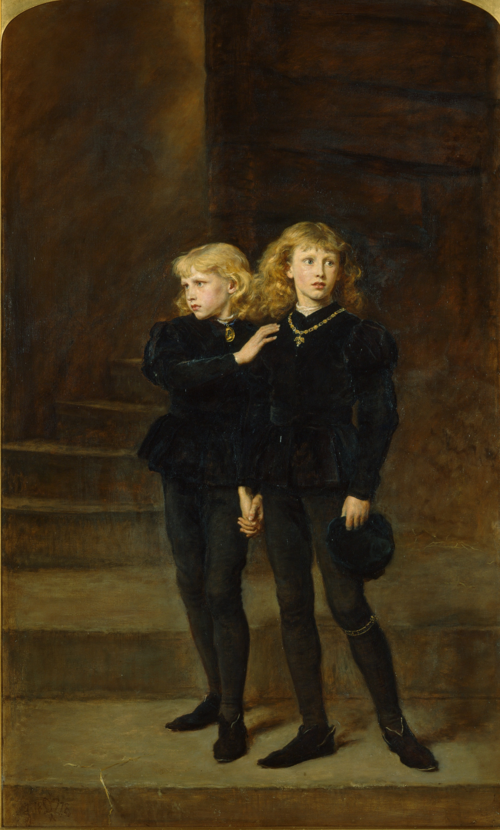
Credit
John Everett Millais, 1878; Royal Holloway collection / Wikimedia Commons
Licence
The source records this image as public domain. No copyright licence is required for the photograph; other rights may apply.
Caption
Millais painted the princes in 1878, almost four centuries after their disappearance. Their vulnerability became part of the story’s visual afterlife.
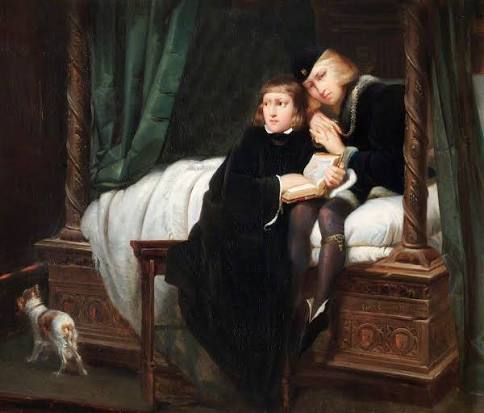
Credit
Art UK
Licence
Historical Ephemera
Displayed for commentary, criticism, research and historical documentation where permitted by applicable law. No permission for reuse is granted.
Caption
The boys’ vulnerability became central to later portrayals. Such intimate scenes shaped popular memory without resolving their fate.
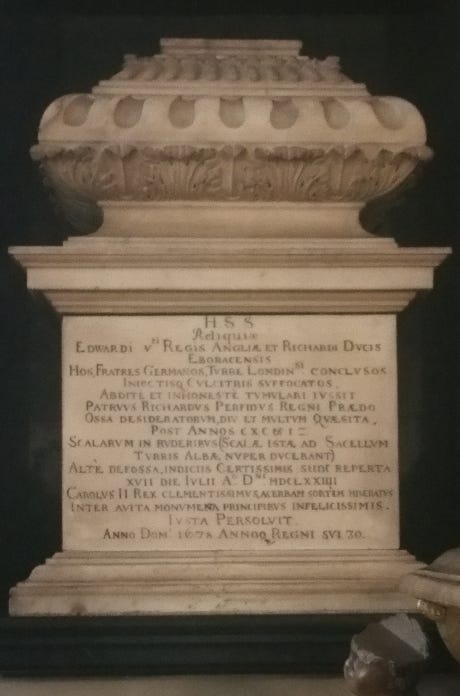
Credit
Elizabeth St.John | Writing Time - Substack
Licence
Historical Ephemera
Displayed for commentary, criticism, research and historical documentation where permitted by applicable law. No permission for reuse is granted.
Caption
The memorial gives supposed remains a place in the royal story. The identity of the bones associated with the princes remains unresolved.