World Refugee Year
A Global Campaign for Refugee Aid and Resettlement
Forgotten History · 1959–1960
Archived on
Region
Australia; United Kingdom; United States
Associated With
United Nations - international sponsor; Timothy Raison - co-originator; Christopher Chataway - co-originator; Trevor Philpott - co-originator; Colin Jones - co-originator
Defining Feature
A temporary global mobilisation to increase refugee assistance, funding and opportunities for voluntary repatriation, local integration and resettlement
Status
Historical event - finite international campaign
Overview
World Refugee Year brought countries together to raise money and expand opportunities for displaced people.
Backed by the United Nations, the 1959–1960 campaign encouraged extra contributions alongside ordinary refugee aid. Governments and voluntary organisations supported housing, employment, training and routes to resettlement, while publicity and postage stamps carried the appeal to a wider public.
Participation reached 97 countries and territories. National campaigns followed different calendars, and some continued beyond the main year; the initiative supported practical changes without ending the wider causes of displacement.
Why It Mattered
The appeal linked public fundraising to concrete opportunities: housing, training and resettlement. Some admissions widened to people previously excluded because of age, illness or disability. Stamps and publicity brought the campaign into everyday circulation, giving a temporary international initiative a presence beyond relief organisations and government offices.
Proposal and United Nations Endorsement
- Timothy Raison, Christopher Chataway, Trevor Philpott and Colin Jones originated the proposal and promoted it through a 1958 Crossbow article commonly identified as “A Plan to Save the Refugees”.
- The UN General Assembly endorsed the campaign through resolution 1285 (XIII), adopted on 05/12/1958.
- Resolution 1390 (XIV), adopted on 20/11/1959, reaffirmed international support while the campaign was underway.
- The stated aims included additional funding and opportunities for voluntary repatriation, resettlement or integration, chosen freely by refugees.
International Organisation and Participation
- The preliminary UN retrospective recorded participation by 97 countries and territories, with national committees established in 39 of them.
- The Geneva-based International Committee incorporated roughly 75–80 international non-governmental organisations, with the variation reflecting reports from different stages.
- Claude de Kemoularia served as the Secretary-General’s Special Representative; his offices distributed documentary, visual and film material, including 35 newsletters and 11 supplements.
- Contemporary UN reports credited the campaign with housing, employment and training assistance, and with opening resettlement opportunities to some refugees previously excluded because of age, illness or disability.
Funding and Postal Campaign
- By late 10/1960, the Secretary-General reported more than US$80 million paid or pledged above normal annual refugee contributions; a separate table using information available on 30/09/1960 totalled US$74,756,032 and included cash and contributions in kind.
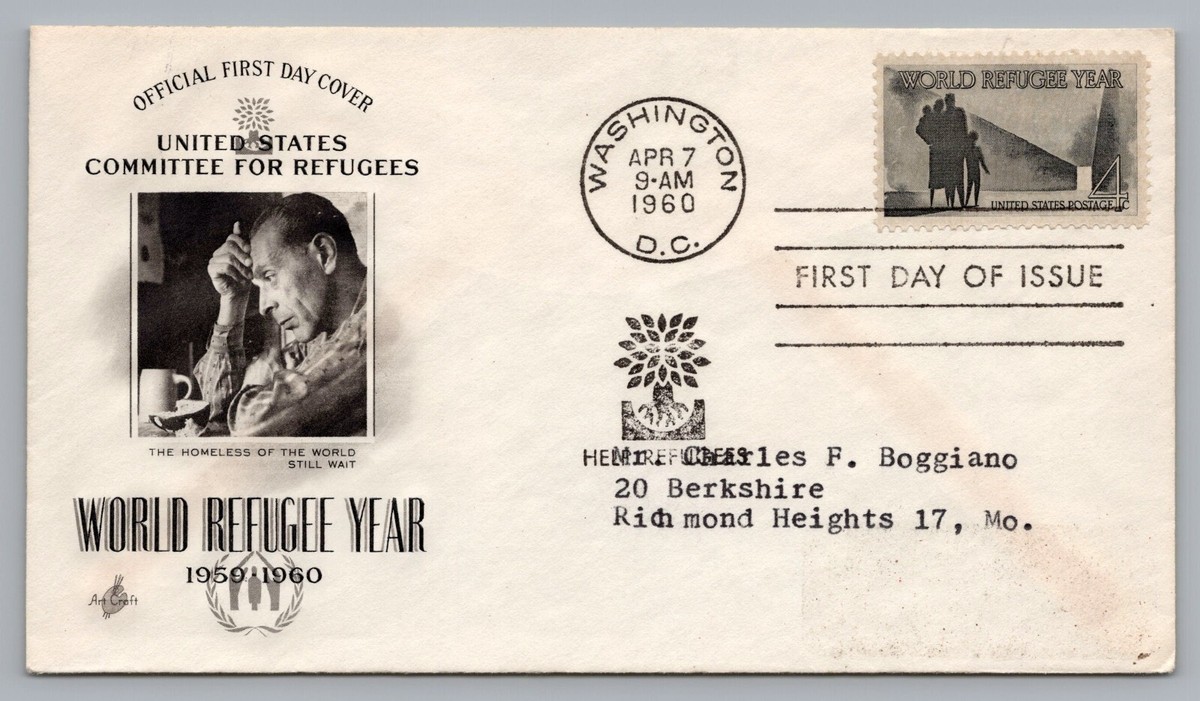
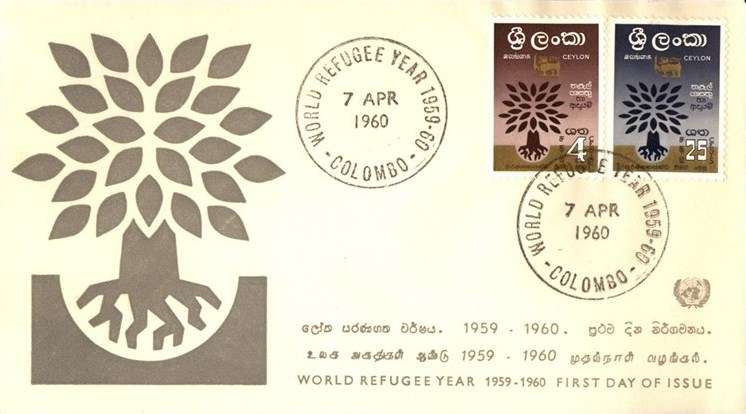
- On 07/04/1960, approximately 70 governments or postal administrations joined a coordinated stamp issue prepared by UNHCR and UNRWA.
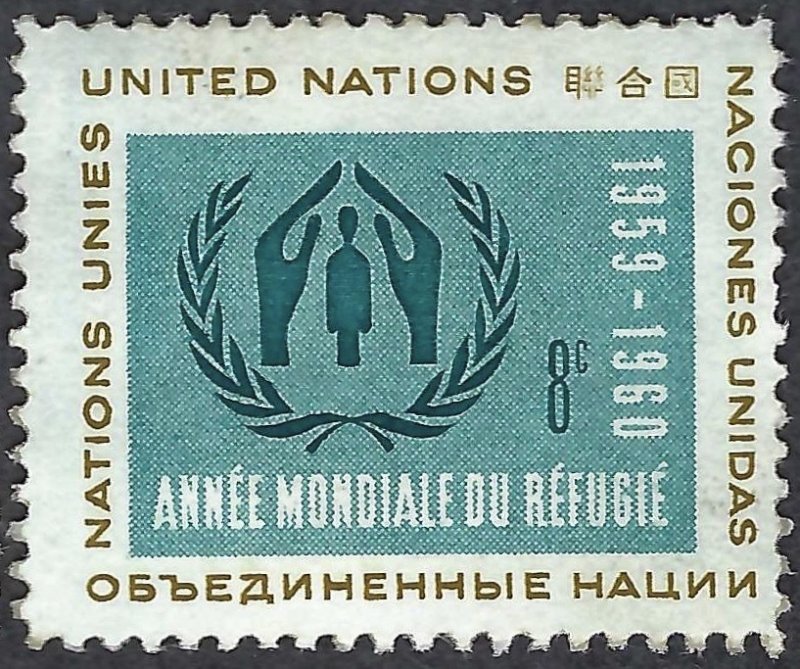
- The stamps did not use one uniform design; recurring imagery included an uprooted oak tree, protective hands and refugees moving towards safety.
Sources & Records
World Refugee Year — General Assembly resolution 1285 (XIII)
Establishes UN endorsement and the campaign’s aims of additional aid and freely chosen solutions for refugees.
Assistance to Refugees: Report of the Secretary-General, A/4546
Documents participation, organisation, fundraising and practical assistance during the campaign.
Report of the United Nations High Commissioner for Refugees, A/4378/Rev.1
Documents the joint UNHCR–UNRWA postage-stamp initiative and simultaneous international issue.
World Refugee Year — General Assembly resolution 1502 (XV)
Records the UN’s assessment at the end of the main campaign and its call for continued assistance.
Gallery
Credit
eBay copy; original creator not identified
Licence
Historical Ephemera
Displayed for commentary, criticism, research and historical documentation where permitted by applicable law. No permission for reuse is granted.
Caption
Official first-day cover for the United States World Refugee Year stamp, postmarked Washington, D.C., 7 April 1960.
Credit
International Oak Society
Licence
Historical Ephemera
Displayed for commentary, criticism, research and historical documentation where permitted by applicable law. No permission for reuse is granted.
Caption
Ceylon World Refugee Year first-day cover with paired stamps and Colombo postmarks dated April 7, 1960.
Credit
International Oak Society
Licence
Historical Ephemera
Displayed for commentary, criticism, research and historical documentation where permitted by applicable law. No permission for reuse is granted.
Caption
United Nations World Refugee Year stamp featuring protective hands, a standing figure and encircling branches.