Telepick
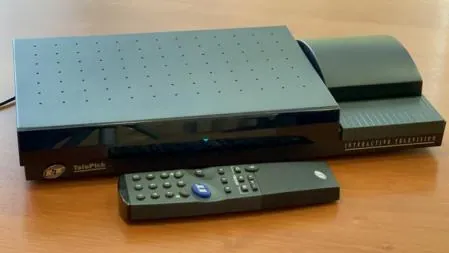
Spain's Interactive TV Box with a Printer
Forgotten Technology · 1992–1994
Archived on
Region
Spain
Associated With
TVE - broadcast service operator; Interactive Television - licence holder and commercial operator
Defining Feature
Dedicated television terminal with a modem and built-in thermal printer
Status
Discontinued - TVE’s supported service ended in February 1994 after Interactive Television entered suspension of payments
Overview
Telepick was TVE’s interactive television service and a dedicated terminal sold to Spanish households.
TVE integrated questions and data into broadcasts, while Barcelona-based Interactive Television licensed and sold the box. Connected to the television, telephone line and mains, it used a remote, display, modem and thermal printer to send responses and print items such as coupons and recipes.
After a Barcelona demonstration in July 1992 and household trials, retail sales began in January 1993. TVE’s supported service ended in February 1994, around the time Interactive Television entered suspension of payments.
Why It Mattered
Telepick matters as an early attempt to make analogue television participatory and connect broadcast viewing with household data services. Its reach across nearly 30 programmes and more than 40 interactive hours a week shows that it progressed beyond a one-off demonstration into regular TVE programming.
Its disappearance also exposes the fragility of this model: participation relied on one broadcaster’s programme support and one commercial operator’s continued service. When that support ended, the interactive layer vanished. Surviving terminals, advertisements and broadcaster retrospectives therefore preserve evidence of a brief experiment in two-way domestic television.
How Telepick Connected
- TVE described the unit as connecting to the television by SCART, as well as to a telephone line and the mains supply.
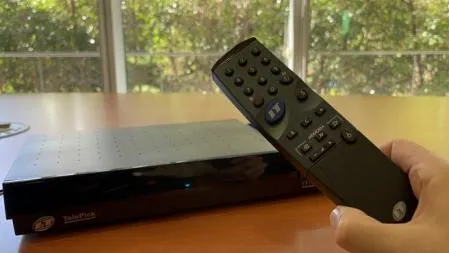
- Programme instructions appeared on the terminal’s alphanumeric display, with answers entered using the remote control.
- Its modem used the telephone return path to send responses to TVE’s processing centre.
Programmes and Participation
- Programmes using Telepick included ¡Hola Raffaella!, Un, dos, tres…, El precio justo, ¿Qué apostamos?, Pasa la vida, ¿Quién sabe dónde? and Código Uno.
- Viewers could enter competitions and surveys, request information, access ticket-purchase services and respond to interactive advertising.
- The public demonstration on 31 July 1992 used a question linked to Olympic athletics in Barcelona.
Trials, Prices and Suspension
- Regular interactive programming was reported from October 1992, with 600 households participating experimentally by December.
- Period reports quoted about 25,000 pesetas or 27,000 pesetas for the terminal, with the latter account also listing a monthly charge of approximately 550 pesetas.
- On 21 February 1994, El País reported debts of 800 million pesetas and said the Telepick symbol had disappeared from TVE broadcasts about ten days earlier.
Sources & Records
- Telepick reaches nearly 30 programmes — Servimedia, August 1993 — Confirms January retail sales, more than 40 weekly interactive hours and the terminal’s connections and uses.
- Interactive television — Information World en Español, October 1992 — Describes Telepick’s modem, thermal printer and telephone return path to TVE.
- Telepick’s operator suspends payments — El País, February 1994 — Reports the operator’s financial collapse and the disappearance of Telepick’s on-screen symbol.
- TVE plans January sales of Telepick — El País, December 1992 — Records the announced retail launch and programmes already broadcasting interactive material.
- Remember Telepick? — La Vanguardia, November 2020 — Recounts the July 1992 Barcelona demonstration and the terminal’s household uses.
Gallery
Credit
Photograph: Martí Paola / La Vanguardia.
Licence
Historical Ephemera
Displayed for commentary, criticism, research and historical documentation where permitted by applicable law. No permission for reuse is granted.
Caption
Telepick put a printer beside the television. TVE’s interactive experiment let viewers join in from the sofa and receive information on paper.
Credit
Photograph: Martí Paola / La Vanguardia.
Licence
Historical Ephemera
Displayed for commentary, criticism, research and historical documentation where permitted by applicable law. No permission for reuse is granted.
Caption
The remote was meant to do more than change channels: its buttons turned viewers into quiz contestants and participants in TVE’s interactive programmes.