Welfare orange juice
Vitamins by coupon
Forgotten Food & Drinks · 1941–1945
Archived on
Region
United Kingdom
Associated With
Ministry of Food - scheme administrator
Defining Feature
Concentrated orange juice collected with welfare coupons
Status
Superseded
Overview
Wartime welfare orange juice put concentrated vitamin C into a six-ounce bottle collected with ration-book coupons.
Britain’s Vitamin Welfare Scheme began in December 1941 with blackcurrant products and cod-liver oil. The Ministry of Food’s official history records Lend-Lease orange juice gradually replacing the blackcurrant products from April 1942.
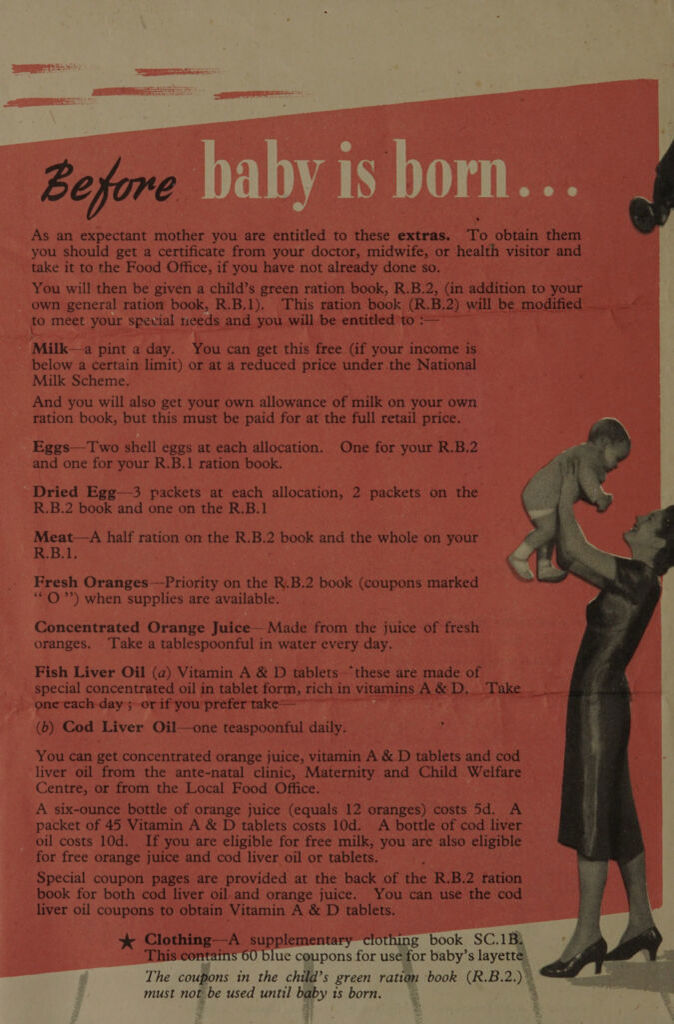
A wartime leaflet told expectant mothers that concentrated orange juice could be collected from an ante-natal clinic, a maternity and child-welfare centre or a Local Food Office. A six-ounce bottle cost 5d; people eligible for free milk also qualified for free orange juice, and R.B.2 ration books included special coupon pages.
Why It Mattered
The bottle turned wartime nutrition policy into a repeated household routine. Overseas supply was joined to Britain’s clinics, Food Offices and ration-book system, making a national welfare measure collectable in local places.
A 1942 survey shows that machinery in use. Among mothers obtaining fruit juices, 55.9% used clinics, 41.3% Food Offices and 2.8% district nurses. Those figures cover fruit juices as a group, but they reveal the practical network behind the little bottles.
From blackcurrants to orange juice
- The Vitamin Welfare Scheme began in December 1941, supplying free blackcurrant syrup or purée and cod liver oil for children up to two.
- The Ministry of Food’s 1946 account says Lend-Lease orange juice gradually replaced the blackcurrant products from April 1942.
Coupons and collection points
- The wartime leaflet describes concentrated orange juice in six-ounce bottles, collected through an ante-natal clinic, a Maternity and Child Welfare Centre or a Local Food Office.
- It links free orange juice to free-milk eligibility and identifies special R.B.2 ration-book coupon pages for orange juice and cod liver oil.
- In the 1942 survey, 55.9% of mothers taking combined fruit juices obtained them from clinics, 41.3% from Food Offices and 2.8% from district nurses.
Local scale and postwar provision
- St Marylebone recorded issuing 39,198 six-ounce orange-juice bottles between 31 December 1944 and 29 December 1945.
- In 1961, Parliamentary Secretary Edith Pitt retrospectively described the wartime 5d charge as covering bottling and distribution, while the juice itself came under Lend-Lease.
- A 1957 Commons debate over age eligibility shows that concentrated orange juice remained part of Welfare Foods beyond this record’s wartime focus.
Selected Sources
How Britain Was Fed in War Time: Food Control, 1939–1945
1946 — Primary source. The Ministry of Food’s wartime history dates the scheme’s December 1941 start and says Lend-Lease orange juice gradually replaced blackcurrant products from April 1942.
Extras Needed by Mother and Child in Wartime: ...and How You Can Get Them
Date not established; catalogue range 1940–1945 — Primary source. This wartime leaflet explains the six-ounce bottle, collection points, free-milk-linked eligibility and the R.B.2 coupon pages for orange juice and cod liver oil.
Report of the Medical Officer of Health for St. Marylebone, 1945, page 6
Report year: 1945 — Primary source. Records St Marylebone’s issue of 39,198 six-ounce orange-juice bottles between 31 December 1944 and 29 December 1945.
Gallery
Credit
Ministry of Food and Ministry of Health / Wellcome Collection, P10374, b32185637; Public Domain Mark
Caption
A wartime Ministry leaflet explains how expectant mothers could collect concentrated orange juice with welfare coupons.