Ford Nucleon
Forgotten Engineering · 1958
Published
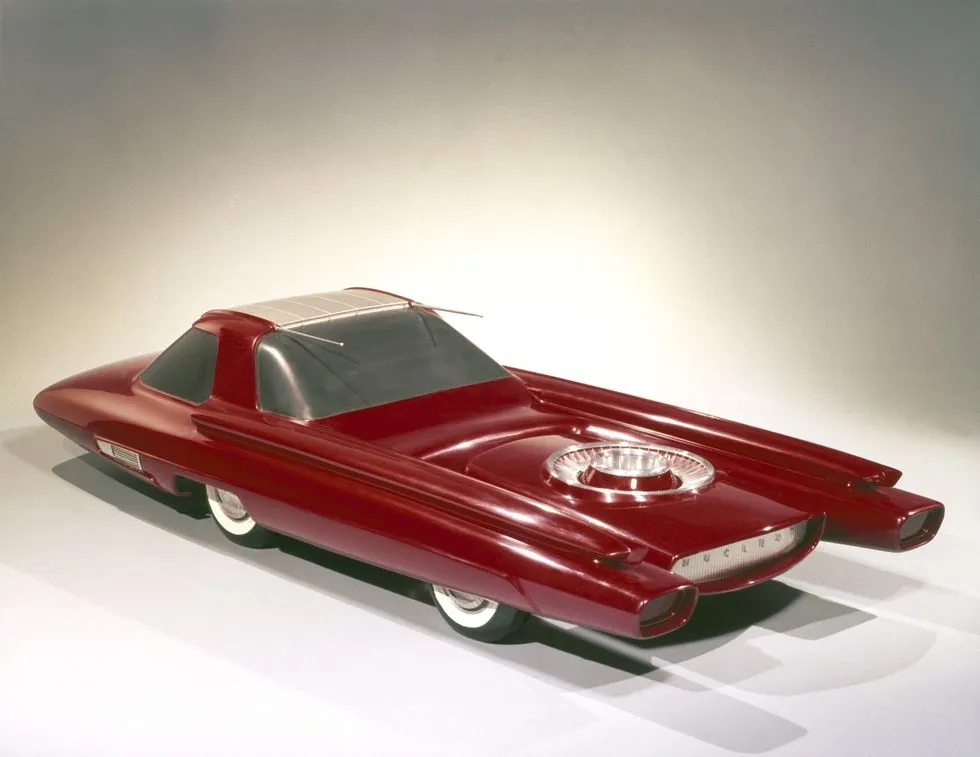
Ford unveiled the Nucleon in 1958 as a vision of a car powered by its own nuclear reactor. The passenger compartment sat far forward while a replaceable power capsule occupied the rear, imagining a future in which miniature reactors had become safe enough for everyday roads. It remained a non-functional 3/8-scale model.
Why It Mattered
The Nucleon captured the extraordinary optimism of the early atomic age, when nuclear power seemed capable of reshaping almost every part of daily life. Its impracticality is precisely what makes it memorable: it shows how boldly carmakers once imagined the road ahead.
Proposed power source
- Ford's concept placed a self-contained nuclear reactor at the rear of the car.
- The design assumed future reductions in reactor size and advances in nuclear safety.
What Ford built
- The surviving 1958 object is a 3/8-scale plastic model.
- The model is non-functional and the Nucleon was never produced.
Promotion
- Ford issued a 1958 brochure titled “Nucleon, a Glimpse into an Atomic-Powered Future.”
- The Henry Ford catalogues the concept as principally a public-relations exercise rather than a developed vehicle programme.
Associated With
Ford Motor Company - creator or operator
Defining Feature
A non-functional 3/8-scale model conceived around a rear-mounted nuclear reactor
Status
Preserved - Never produced; the model and an original brochure survive in The Henry Ford collections
Primary Records
Image Sources
- All one image sources are not yet verified — editorial review required.
Rights Notice
Images are included for historical and archival reference.
Rights holders may contact Forgotten Archive through the publishing account to request a credit correction or removal.
Gallery
Credit
Ford Heritage Vault; reproduced by Hemmings
Licence
Historical Ephemera
Displayed for commentary and research. Fair dealing under the UK CDPA 1988 applies only where its conditions are met. No permission for reuse is granted.
Caption
Ford's Nucleon model imagined a nuclear-powered car rather than demonstrating a working vehicle, capturing the optimism surrounding atomic energy in mid-century design.