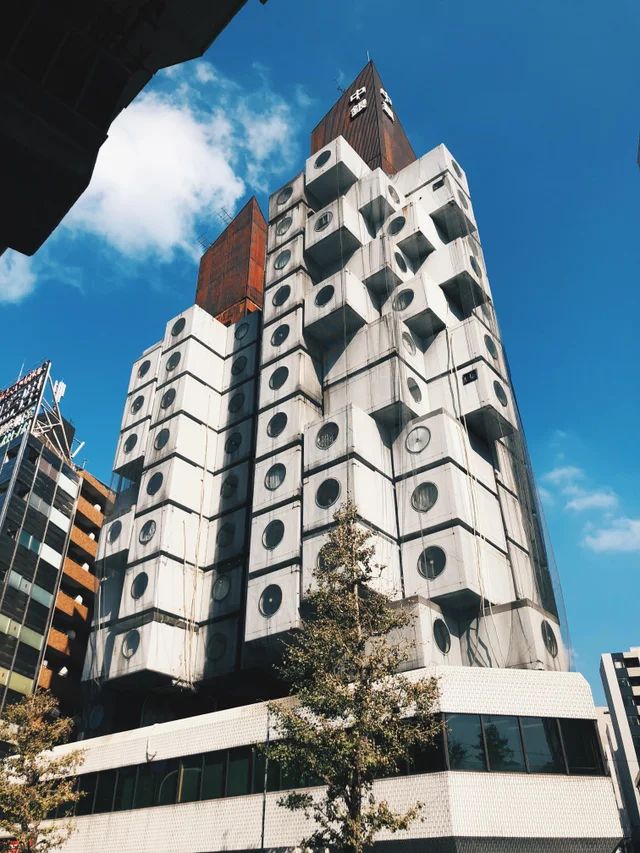
Kisho Kurokawa’s Nakagin Capsule Tower opened in Tokyo in 1972 with 140 prefabricated rooms attached to two central cores. Each compact capsule contained the essentials for one occupant, including a circular window that gave the building its unmistakable appearance. The units were first marketed to businesspeople needing a small base in the city.
Why It Mattered
The tower made the Japanese Metabolist idea of replaceable, adaptable architecture visible at full scale. Although its capsules were never renewed as intended, their later use as homes, offices and studios gave the building a life far richer—and messier—than the original system promised.
Modular structure
- The building contained 140 capsules prefabricated away from the site.
- The capsules were attached to two structural cores made from concrete and steel.
Changing uses
- The units were first promoted as compact dwellings for commuting businesspeople.
- Residents later adapted capsules as homes, offices, studios, libraries, galleries and other spaces.
Demolition and survival
- The tower was dismantled between April and October 2022.
- Twenty-three capsules were rescued; MoMA's A1305 was restored in 2022–2023.
Associated With
Kisho Kurokawa Architect & Associates - creator or operator
Defining Feature
140 single-occupancy capsules fixed to two concrete-and-steel cores
Status
Demolished - in 2022; 23 capsules were rescued and several were restored
- All one image sources are not yet verified — editorial review required.
Rights Notice
Images are included for historical and archival reference.
Rights holders may contact Forgotten Archive through the publishing account to request a credit correction or removal.
Photographer not identified; supplied Pinterest repost
Licence
Historical Ephemera
Displayed for commentary and research. Fair dealing under the UK CDPA 1988 applies only where its conditions are met. No permission for reuse is granted.
Caption
Nakagin Capsule Tower expressed the idea of replaceable living units at the scale of an apartment building, making its clustered capsules a recognisable architectural experiment.