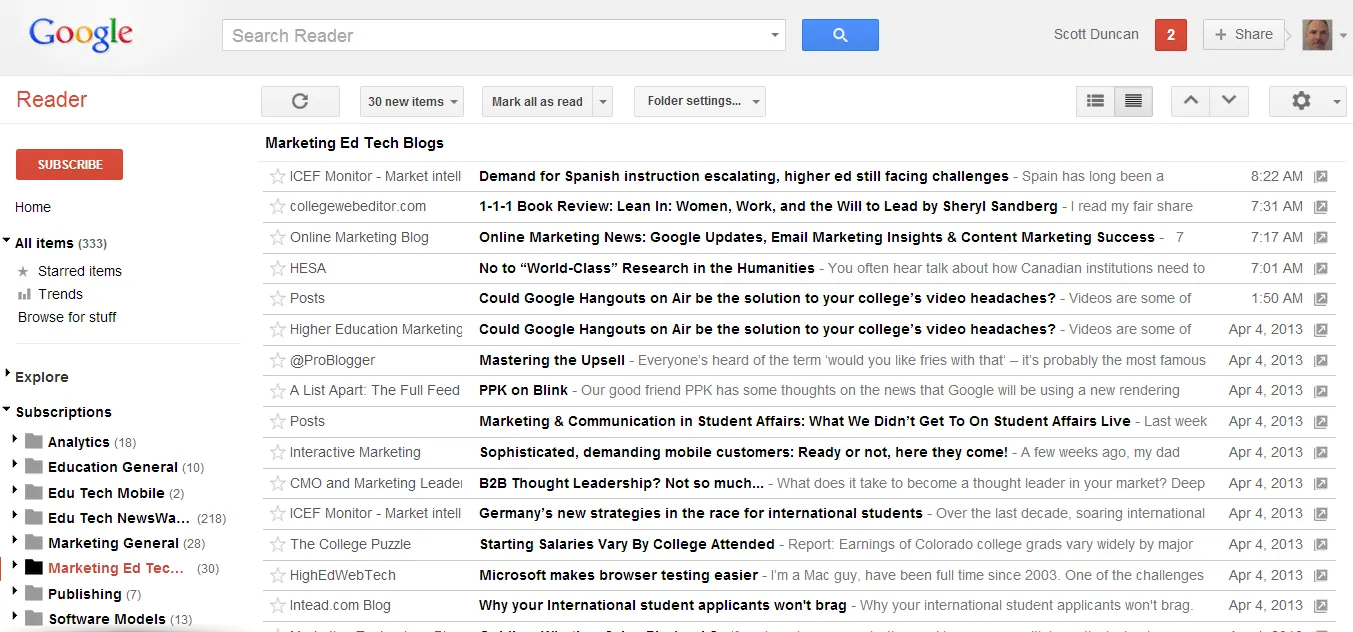
Google Reader launched in October 2005 as one place to follow updates from websites through RSS feeds. Instead of visiting dozens of pages, users could subscribe, scan new entries and organise their reading inside a clean web interface. It quickly attracted hundreds of thousands of accounts and became a daily tool for heavy web readers.
Why It Mattered
Reader made the open web feel manageable at a time when blogs and independent sites were flourishing. Its 2013 closure removed one of RSS’s most accessible homes and became a lasting example of the risk in building personal routines around a free platform that its owner can simply discontinue.
Labs Launch
- The Reader team described the service as a beta-level Google Labs project.
- It reported account numbers in the hundreds of thousands after its first two weeks.
Feed Infrastructure
- Reader used Google's BigTable system to store and manage feed items.
- The team planned additional interfaces, recommendations and performance improvements.
Shutdown and Export
- Google announced the retirement on 13 March 2013 with a closure date of 1 July.
- Users were directed to Google Takeout to retain subscriptions and other Reader data.
Associated With
Google Reader team - creator or operator, brand
Defining Feature
A Google-hosted platform for reading and organising RSS feeds
- All one image sources are not yet verified — editorial review required.
Rights Notice
Images are included for historical and archival reference.
Rights holders may contact Forgotten Archive through the publishing account to request a credit correction or removal.
Google Reader interface; reproduced by Keith Peters on BIT-101
Licence
Historical Ephemera
Displayed for commentary and research. Fair dealing under the UK CDPA 1988 applies only where its conditions are met. No permission for reuse is granted.
Caption
Google Reader gathered updates from many websites into one inbox-like view, giving readers a way to follow the web without visiting every site individually.