Fax Machine

Forgotten Technology · 1843

Published

Fax machines scanned documents, transmitted their visual information through communications networks and reproduced them at another location. Alexander Bain patented an early facsimile system in 1843, long before telephone-connected office machines became commonplace.

Why It Mattered

Fax changed the speed of document exchange by allowing contracts, forms and handwritten pages to cross long distances in minutes. It became part of the everyday infrastructure of offices, hospitals and public institutions before email and online document services displaced much of its role.

From Bain’s Patent to Office Fax

- Scottish clockmaker Alexander Bain patented an early system for transmitting images in 1843. - Later facsimile technologies combined synchronised scanning, photoelectric sensing, telephone connections and printing mechanisms. - Commercial systems became increasingly common from the 1960s, with broad office adoption during the 1980s and 1990s.

Scanning and Reconstruction

- A transmitter scanned a document line by line and encoded light and dark areas as electrical signals. - A receiving machine decoded those signals and reconstructed the page remotely. - Thermal-paper and plain-paper machines brought the process into ordinary workplaces.

Decline in the Digital Era

- Email, cloud storage, electronic signatures and online document systems reduced everyday fax use. - Fax remained in limited use where established procedures or compatibility requirements persisted. - Museum collections preserve its place between telegraphy and internet-based document exchange.

Associated With

Xerox Corporation - inventor, developer or manufacturer

Defining Feature

Line-by-line transmission and remote reproduction of documents over communications networks

Status

Preserved - Widespread office use declined with digital communication; preserved in communication and technology collections

Primary Records

- **International Telecommunication Union — Overview of ITU History** - **Science Museum Group Collection — Alexander Bain**

Image Sources

- Image 1 source not verified — editorial review required.

Rights Notice

Images are included for historical and archival reference. Rights holders may contact Forgotten Archive through the publishing account to request a credit correction or removal.

Gallery

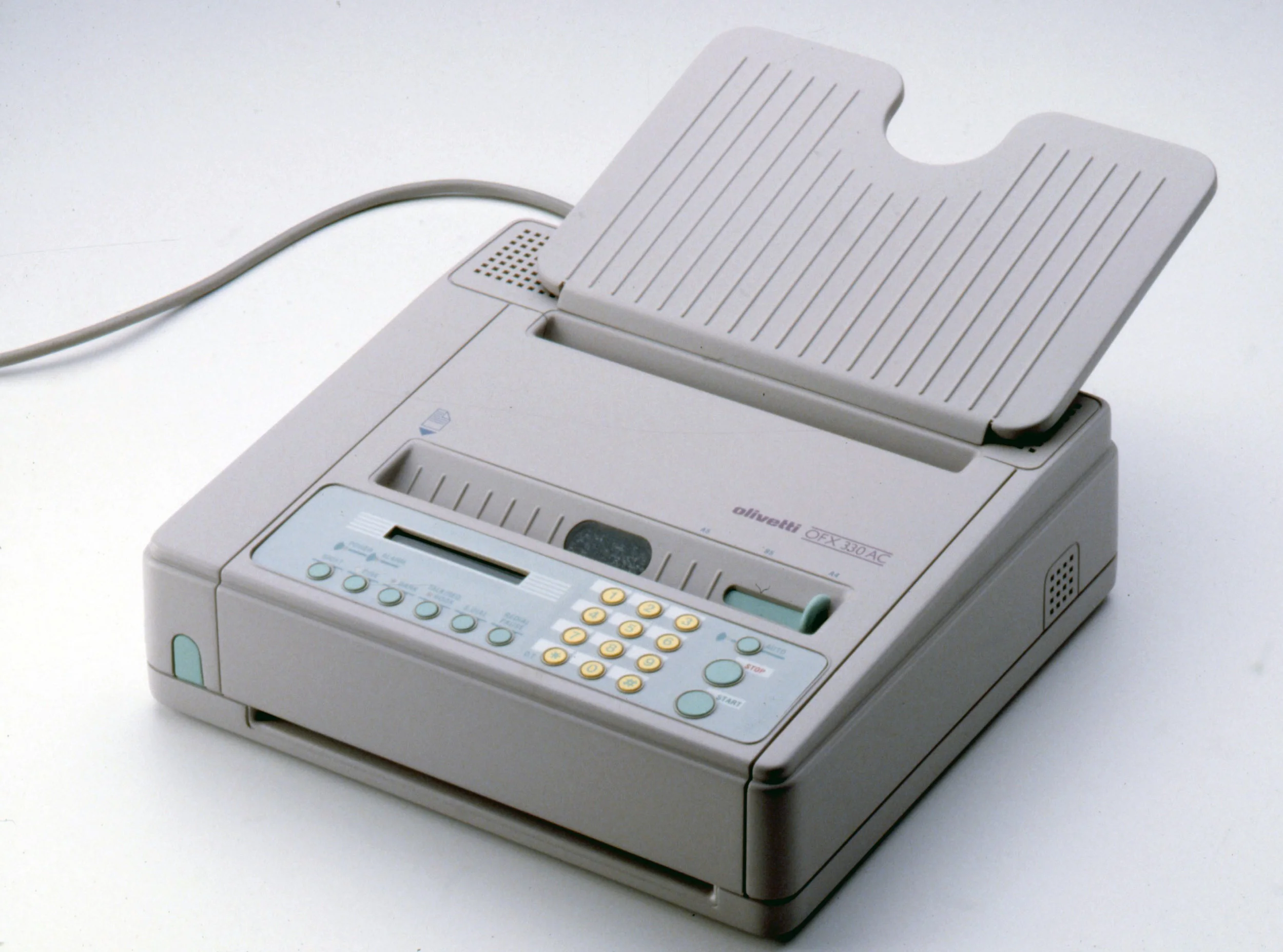
Grey Olivetti OFX 330AC fax machine with paper support raised and telephone keypad controls.
Source
Credit

Olivetti OFX 330AC design: George Sowden; image reproduced by PORT, photographer not separately identified

Licence

Historical Ephemera

Displayed for commentary and research. Fair dealing under the UK CDPA 1988 applies only where its conditions are met. No permission for reuse is granted.

Caption

George Sowden's Olivetti OFX 330AC treats the fax machine as a designed office object, bringing deliberate form to equipment usually remembered for its practical function.
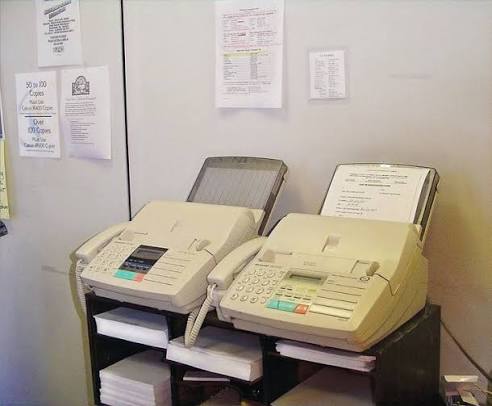
Two beige office fax machines standing side by side on paper-filled cabinets.
Source
Credit

Fax-machine photograph; reproduced via The Shovel; photographer unknown.

Licence

Historical Ephemera

Displayed for commentary and research. Fair dealing under the UK CDPA 1988 applies only where its conditions are met. No permission for reuse is granted.

Caption

Fax machines made paper documents transmissible between offices, with receiving trays and nearby filing storage forming part of the everyday workflow before email attachments became routine.
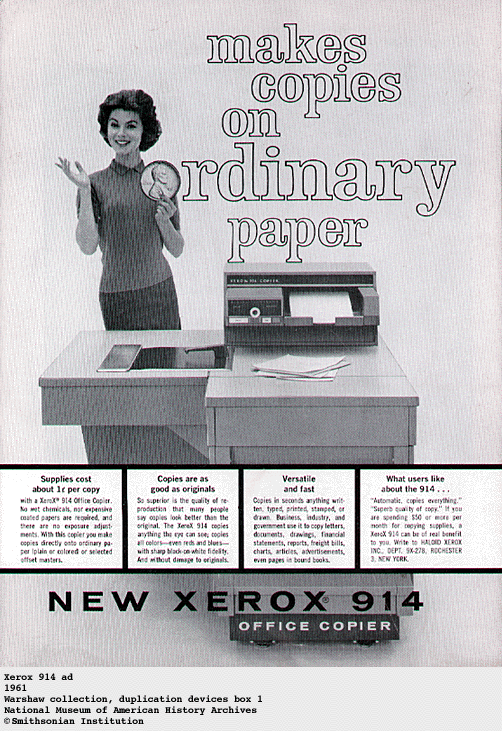
1961 advertisement for the Xerox 914 office copier with the headline 'makes copies on ordinary paper'.
Source
Credit

Xerox advertising artwork; National Museum of American History Archives, Smithsonian Institution collection; reproduced via Sprint Media.

Licence

Historical Ephemera

Displayed for commentary and research. Fair dealing under the UK CDPA 1988 applies only where its conditions are met. No permission for reuse is granted.

Caption

Xerox's 1961 advertisement makes ordinary-paper copying the selling point of the 914, illustrating a related office revolution rather than a fax transmission system.