Switch

Forgotten Technology · 1988

Published

Switch was a bank-led domestic UK debit-card scheme launched in October 1988 by Midland Bank, National Westminster Bank and The Royal Bank of Scotland. In its early form, it was operated by Switch Card Services plc and enabled electronic point-of-sale purchases debited from the cardholder’s bank account. Cash access and cheque-guarantee features varied by issuing card. The move to Maestro was phased: migration was announced in August 2002, MasterCard Europe began processing for S2 members during 2003, and the former Switch scheme was formally rebranded UK Maestro on 1 July 2004.

Why It Mattered

It became a major domestic electronic payment scheme in the UK. By the end of 1990, there were 11.4 million Switch cards in issue, and by October 1991 around 40,000 outlets accepted them. Petrol stations, supermarkets and high-street chains were among the main places where customers used EFTPOS terminals — Electronic Funds Transfer at Point of Sale — to pay directly by card. The transition was gradual rather than instant. UK Maestro did not simply replace every Switch transaction overnight; domestic Switch-style processing continued for a period while MasterCard Europe took on more of the underlying payment-processing role.

Scheme and Early Use

- Launched in October 1988 by Midland Bank, National Westminster Bank and The Royal Bank of Scotland. - Switch was a proprietary domestic UK scheme rather than an international card scheme in its own right. - Early retail transactions used signature authorisation; PIN use was associated with cash withdrawals.

Retail Acceptance

- 11.4 million Switch cards were in issue at the end of 1990. - Around 40,000 outlets accepted Switch in October 1991. - Petrol stations, supermarkets and high-street chains were major EFTPOS locations.

Migration to UK Maestro

- A licensing agreement to phase out the Switch brand in favour of Maestro was reported in August 2002. - MasterCard Europe began authorising and clearing transactions for S2 Limited during 2003. - The former Switch scheme was rebranded UK Maestro on 1 July 2004.

Associated With

Midland Bank, National Westminster Bank and The Royal Bank of Scotland; early operator Switch Card Services plc - inventor, developer or manufacturer

Defining Feature

Domestic electronic point-of-sale debit payments from the cardholder’s bank account

Status

Discontinued

Primary Records

- **Payment Systems in EC Member States, September 1992** - **Information Leaflet Introducing the Switch Debit Card to Retailers** - **Payment Systems Oversight Report 2005, Issue no. 2** · Archived copy - **Mastercard Incorporated Annual-Report Filing**

Image Sources

- **Image 1** - **Image 2** - **Image 3** - **Image 4** - **Image 5**

Rights Notice

Images are included for historical and archival reference. Rights holders may contact Forgotten Archive through the publishing account to request a credit correction or removal.

Gallery

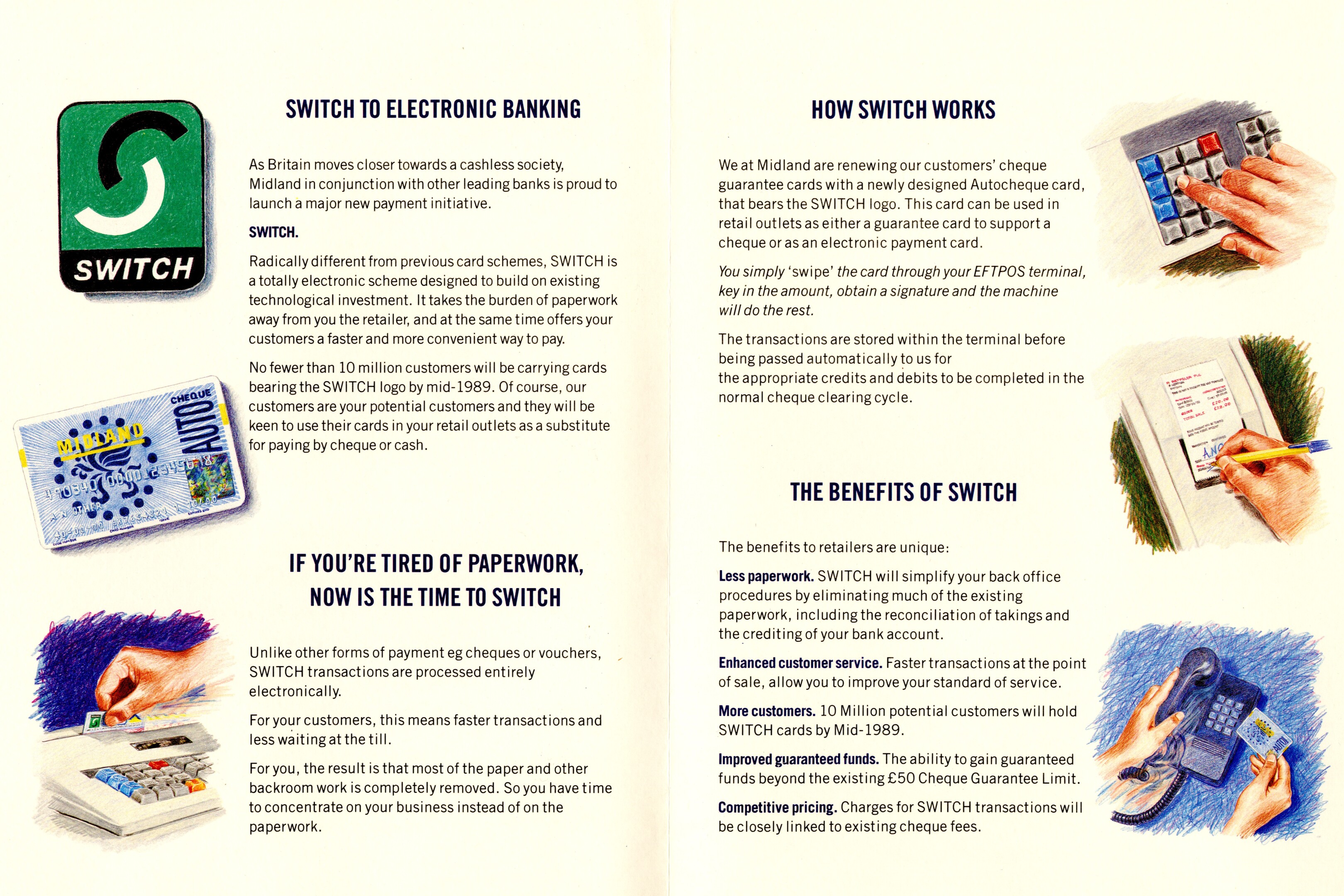
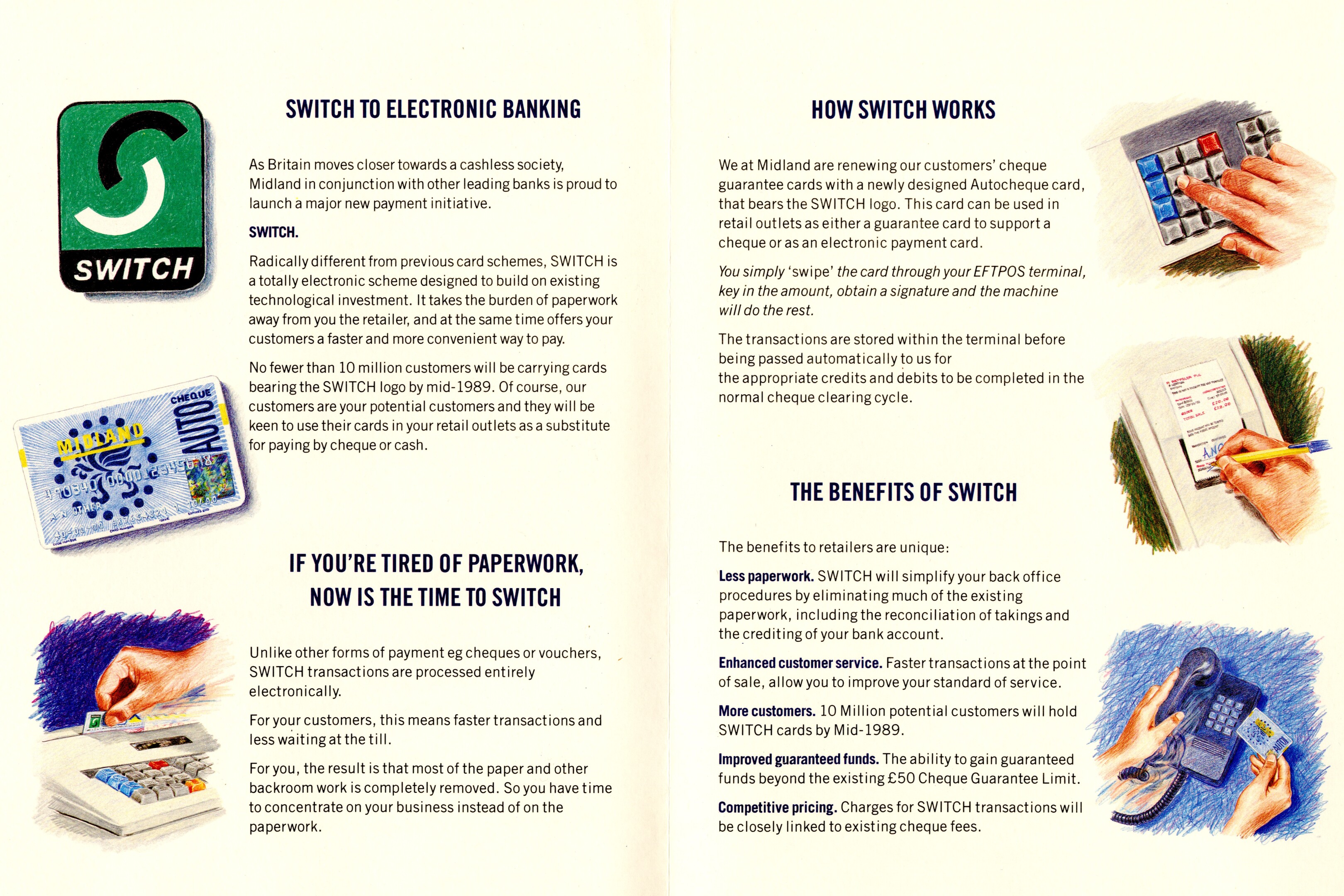
Two-page Midland promotional brochure for SWITCH electronic banking, with the green-and-black SWITCH logo, a pictured Midland Autocheque card, and illustrations of a card being swiped through a keypad terminal, a signed receipt, and a telephone payment device.
Source
Credit

Midland Bank SWITCH promotional artwork; scan supplied through PastView, scan contributor not identified

Licence

Historical Ephemera

Displayed for commentary and research. Fair dealing under the UK CDPA 1988 applies only where its conditions are met. No permission for reuse is granted.

Caption

Midland's brochure explained how SWITCH could move a bank card from cash withdrawal to direct payment, introducing the steps of a newer shopping routine.
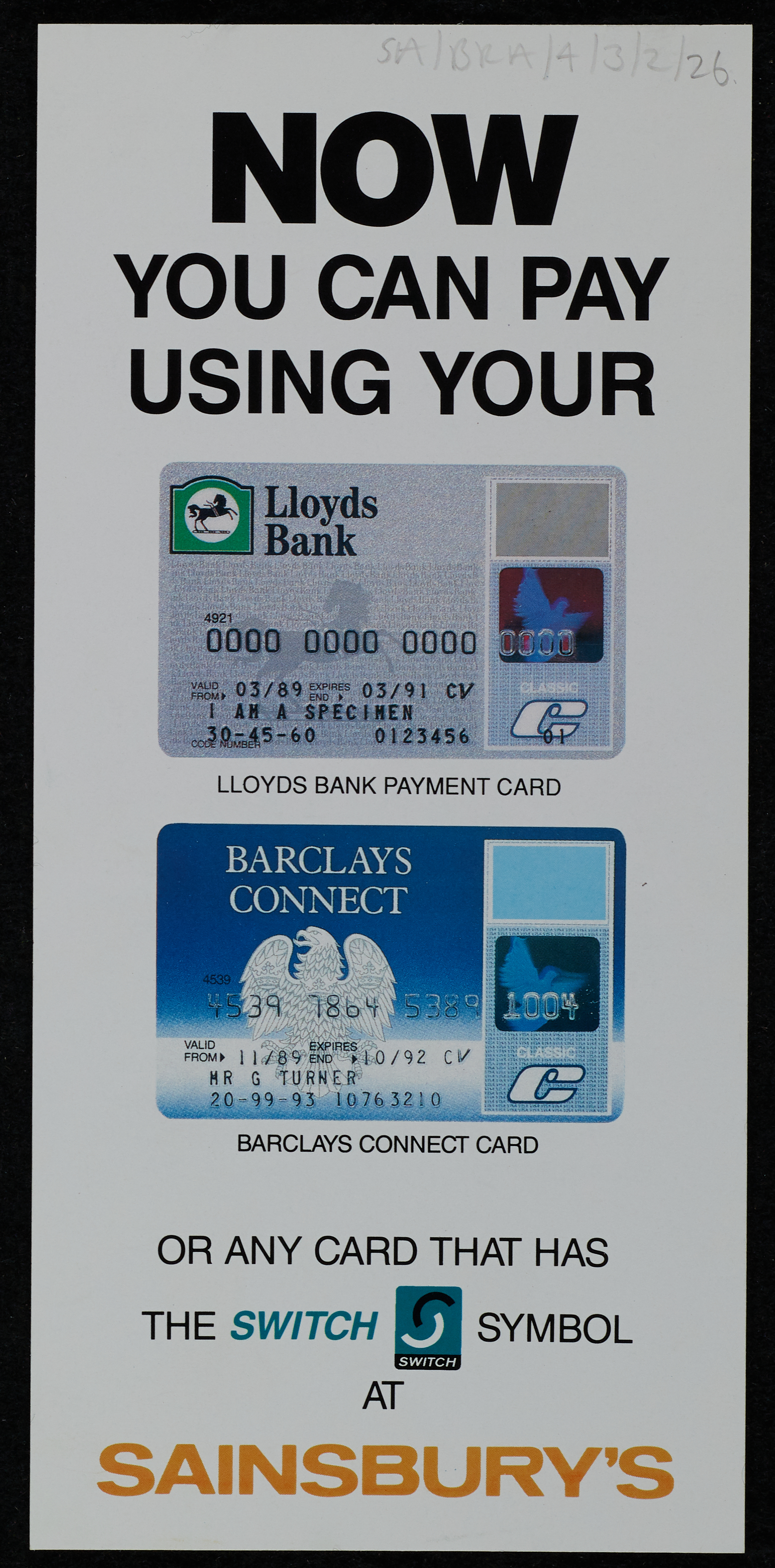
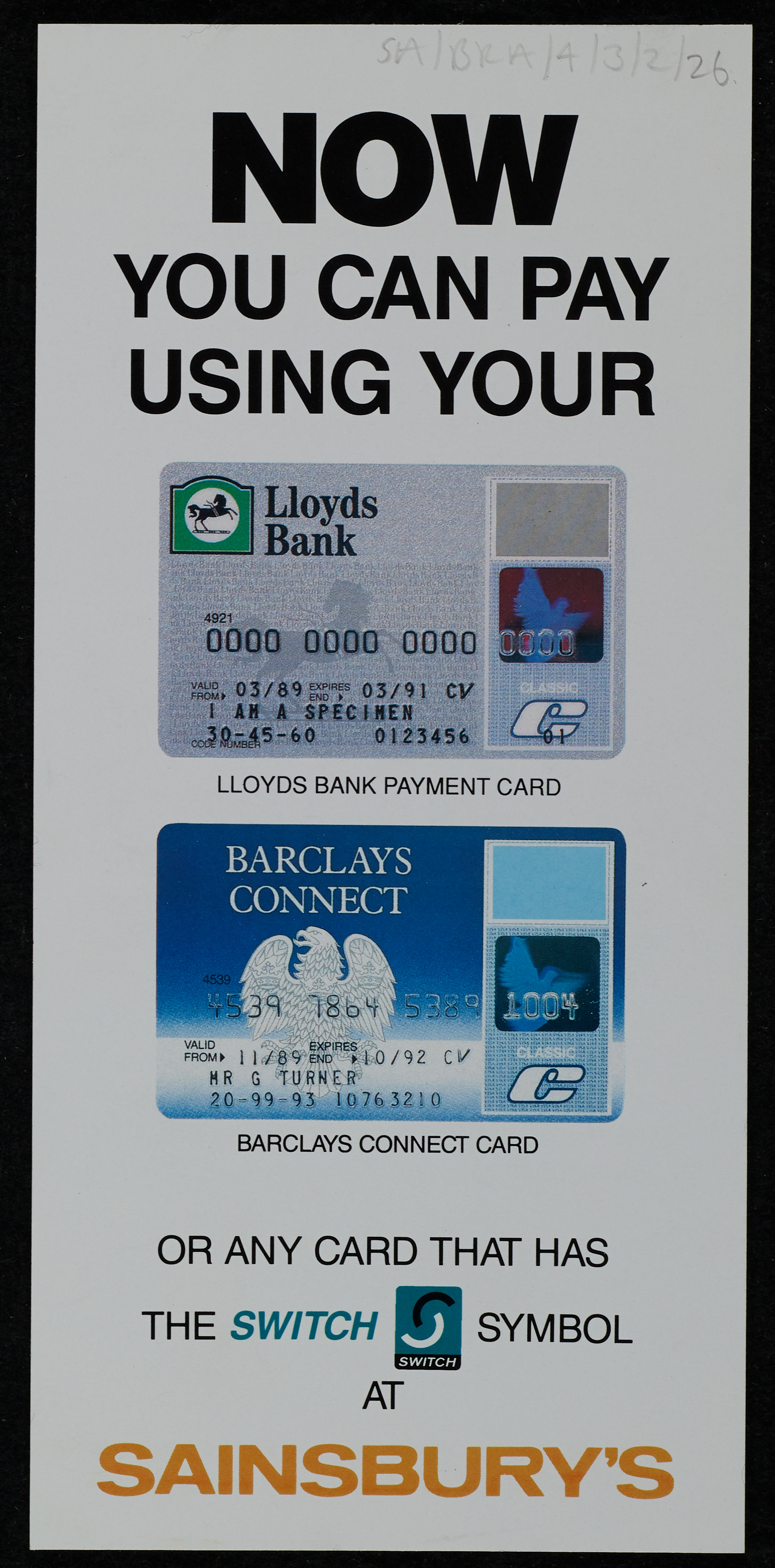
Vertical printed sign reading “Now you can pay using your” above specimen Lloyds Bank and Barclays Connect payment cards, followed by text saying cards with the Switch symbol can be used at Sainsbury’s.
Source
Credit

Sainsbury Archive; in-store payment sign artwork

Licence

Historical Ephemera

Displayed for commentary and research. Fair dealing under the UK CDPA 1988 applies only where its conditions are met. No permission for reuse is granted.

Caption

An in-store sign announced debit-card payment at Sainsbury's, helping shoppers recognise which cards could be used at the till.
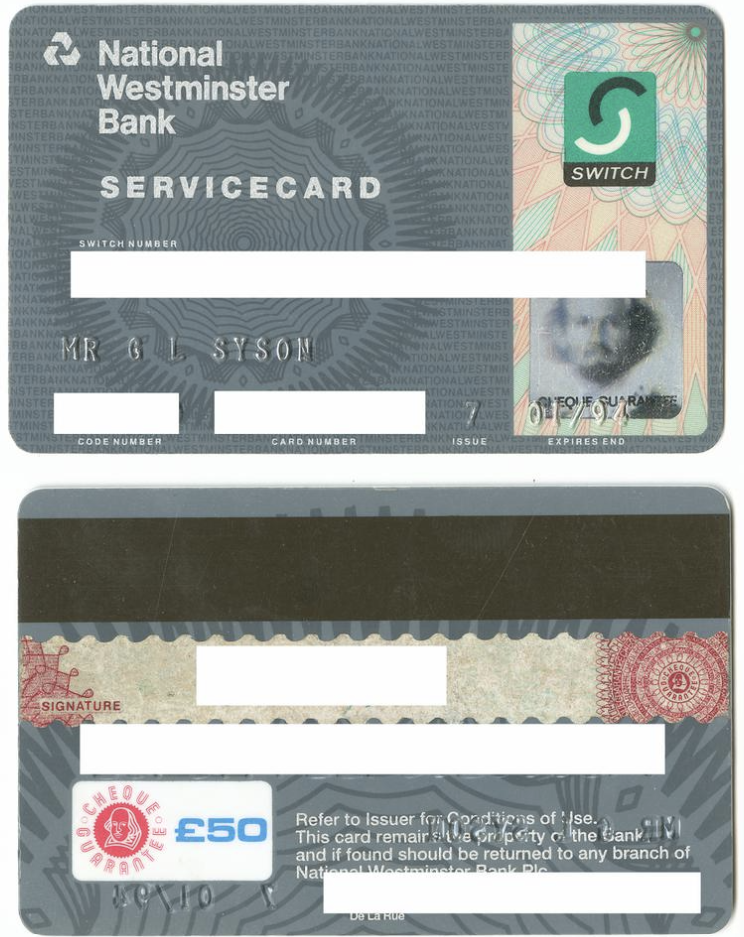
Front and back views of a National Westminster Bank Servicecard. The front includes a green Switch logo, a large blanked-out number field, the name “Mr G L Dyson,” and a portrait panel; the back has a magnetic stripe, blanked-out fields, a signature panel, and a £50 cheque-guarantee marking.
Source
Credit

National Westminster Bank card design; collection photograph via the British Museum, object 2009,4208.1; photographer unknown.

Licence

Historical Ephemera

Displayed for commentary and research. Fair dealing under the UK CDPA 1988 applies only where its conditions are met. No permission for reuse is granted.

Caption

A NatWest Servicecard combined SWITCH branding with a cheque guarantee, preserving the overlap between older payment habits and debit-card shopping.

Two large penguin mascots stand in a gondola on a canal, one wearing a Maestro logo and the other a Switch logo, with a gondolier behind them and a large red “CASH” sign between buildings in the background.
Source
Credit

Rathergood / Joel Veitch; produced by Passion Pictures for CDP-Travissully

Licence

Historical Ephemera

Displayed for commentary and research. Fair dealing under the UK CDPA 1988 applies only where its conditions are met. No permission for reuse is granted.

Caption

The Penguins in Venice advert made SWITCH's move to Maestro into a travel story, using the mascots to explain a change of payment brand.

Large Switch logo with a green upper field containing black and white curved shapes and a black lower band with the word “SWITCH” in white.
Source
Credit

SWITCH logo; individual designer unknown, file preserved by Wikimedia Commons

Licence

Public domain

This image is recorded as public domain. Its source provides the provenance.

Caption

The green-and-black SWITCH mark became a familiar sign at British tills, indicating that a bank card could be used to pay directly for a purchase.