The Atmospheric Railway
Vacuum-Propelled Trains in South Devon
Forgotten Engineering · 1847
Archived on
Associated With
Samuel Clegg, Jacob and Joseph Samuda; South Devon system pioneered by Isambard Kingdom Brunel - inventor, South Devon system pioneer
Defining Feature
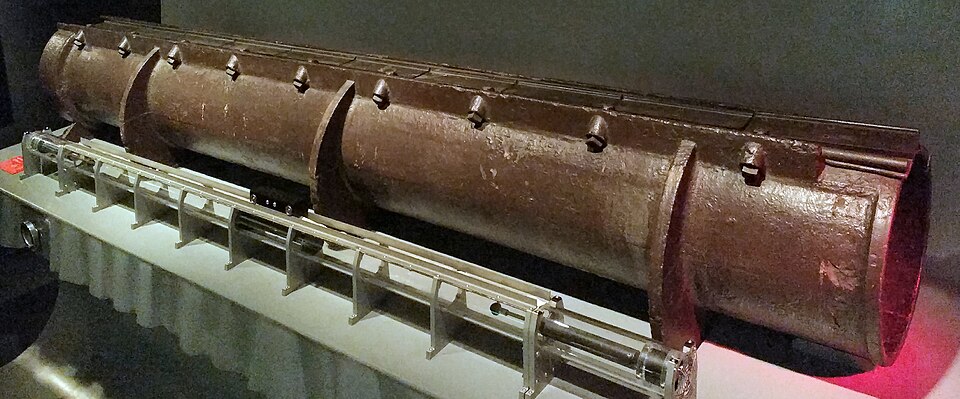
A track-centre vacuum pipe, piston and leather sealing flap supplied by stationary pumping engines
Status
Discontinued - South Devon atmospheric operation ended on 10 September 1848
Overview
The South Devon atmospheric railway moved trains without carrying a locomotive at the front.
Stationary steam engines drew air from a pipe between the rails, allowing atmospheric pressure to push a piston attached beneath the leading vehicle.
The system began operating between Exeter and Teignmouth in September 1847 and reached Newton Abbot in February 1848.
Why It Mattered
It offered a striking alternative to conventional steam traction: the power came from pumping stations along the route rather than an engine hauling each train. Its brief life also exposed the weakness of that ambition, because miles of leather-sealed pipe had to remain flexible and airtight in everyday service.
Propulsion system
- Stationary steam engines removed air from a pipe laid beneath the train.
- Atmospheric pressure acted on a piston connected to the first vehicle through a sealed slit.
- Clegg and the Samuda brothers patented a workable atmospheric system in 1838.
South Devon operation
- The first Devon atmospheric train ran between Exeter and Teignmouth in September 1847.
- Brunel pioneered the South Devon atmospheric railway between Exeter and Newton Abbot.
- The system reached Newton Abbot in February 1848 and ceased operation that September.
Maintenance limits
- The leather flap had to remain flexible and airtight over an exposed linear pipe.
- Newton Abbot Museum records difficult operation, seal damage and high running costs.
Sources & Records
- Atmospheric Railway — Explains the vacuum propulsion system, South Devon operation and maintenance problems.
- Isambard Kingdom Brunel (1806–1859) — Corroborates Brunel’s involvement, the route and the abandonment of atmospheric operation.
Gallery
Credit
AndyScott, via Wikimedia Commons, CC BY-SA 4.0
Caption
A preserved atmospheric railway pipe displays the physical machinery behind a system that moved trains using air pressure.