The Dancing Plague
Strasbourg's Dance Epidemic
Forgotten History · 1518
Archived on
Associated With
Not applicable - historical event recorded by Strasbourg institutions
Defining Feature
Municipal records documenting official responses to weeks of public dancing
Status
Historical event - in Strasbourg's municipal record and chronicle tradition
Overview
In July 1518, dozens of people began dancing in Strasbourg and continued for several weeks.
Relatives were questioned, confraternities were asked to provide care, and municipal administrators, clergy and medical practitioners attempted to respond. Some affected people were sent to Saverne.
On 2 August, Sebastian Brant signed a prohibition on public dancing.
Why It Mattered
The outbreak remains unsettling because the dancing prompted an extensive official response, yet its cause is still unresolved. Medical explanations, religious interpretations and later theories have not established why the collective episode took hold.
The Strasbourg Outbreak
- Dozens of people danced in Strasbourg during July 1518 over a period of several weeks.
- Relatives were questioned, and some affected people were sent to Saverne.
- Confraternities were asked to help care for those affected.
Municipal Response
- Municipal administrators, clergy and medical practitioners attempted responses.
- A public-dance prohibition signed by Sebastian Brant was proclaimed on 2 August 1518.
- Preachers and municipal chroniclers also recorded the event.
Records and Unresolved Cause
- Strasbourg archive files are identified under references 1 MR 3 and III 200/15.
- Later interpretations do not establish the cause of the outbreak.
- The cause remains unexplained.
Sources & Records
- Archives de Strasbourg post on the 1518 dance epidemic — Identifies surviving municipal records and the authorities’ response to the 1518 outbreak.
- 1518: The Dancing Fever — Summarises the outbreak and competing interpretations without establishing a definite cause.
Gallery
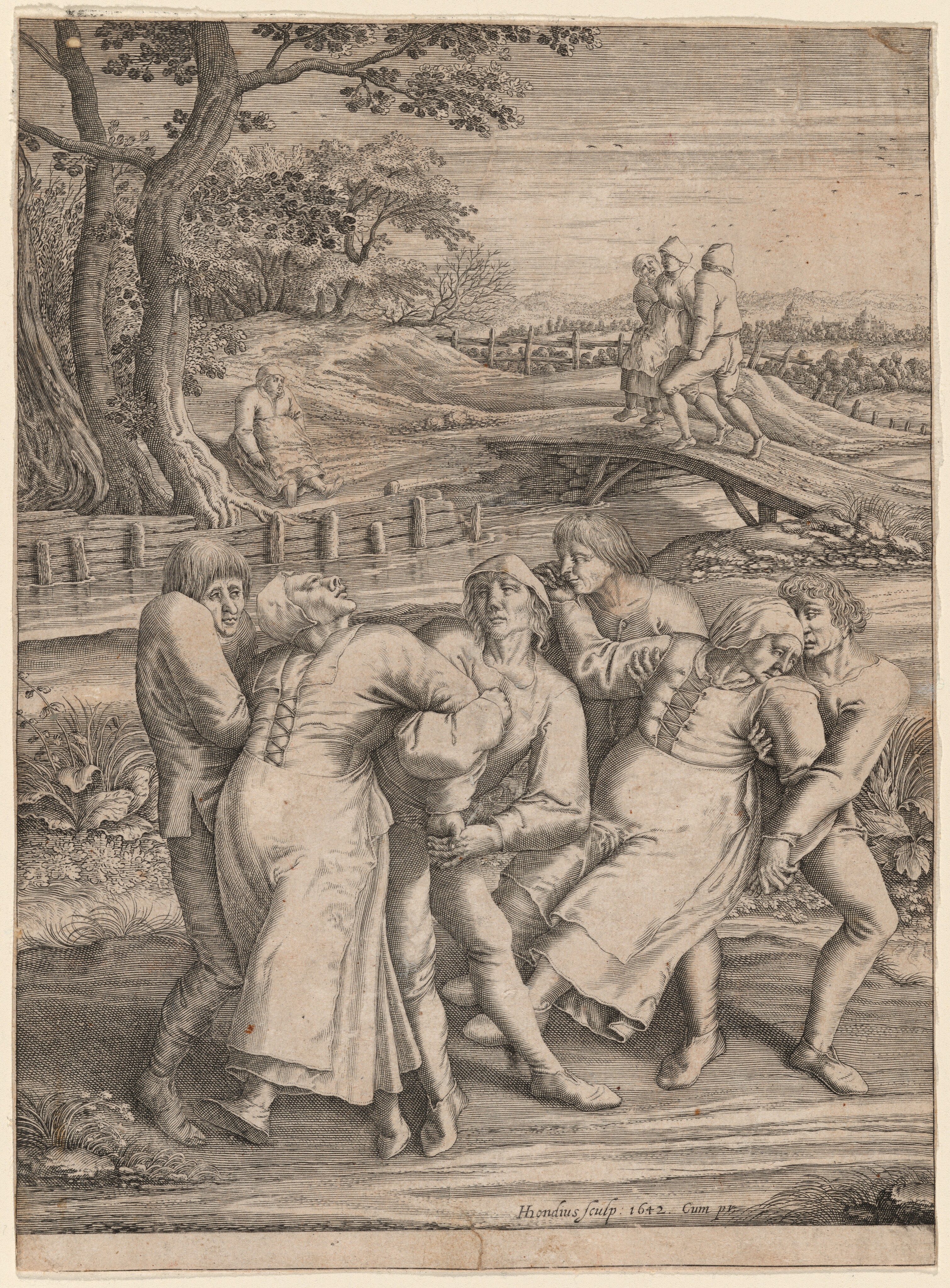
Credit
Hendrik Hondius I, after Pieter Bruegel the Elder, 1642. Courtesy National Gallery of Art, Washington; Gift of Hope and Julian Edison, 2019.114.6.
Caption
Hondius’s 1642 engraving shows pilgrims and their companions at Molenbeek near Brussels. It provides related historical context for dancing rituals and illness, not a depiction of Strasbourg’s 1518 outbreak.