The Great Molasses Flood
A Tank Rupture in Boston's North End
Forgotten History · 1919
Archived on
Associated With
Purity Distilling Company - creator or operator
Defining Feature
Rupture of a 50-foot tank holding 2.3 million gallons of industrial molasses
Status
Historical event - Historical industrial disaster; 21 people were killed and 150 injured
Overview
At about 1 p.m. on 15 January 1919, a tank burst in Boston’s North End and released molasses.
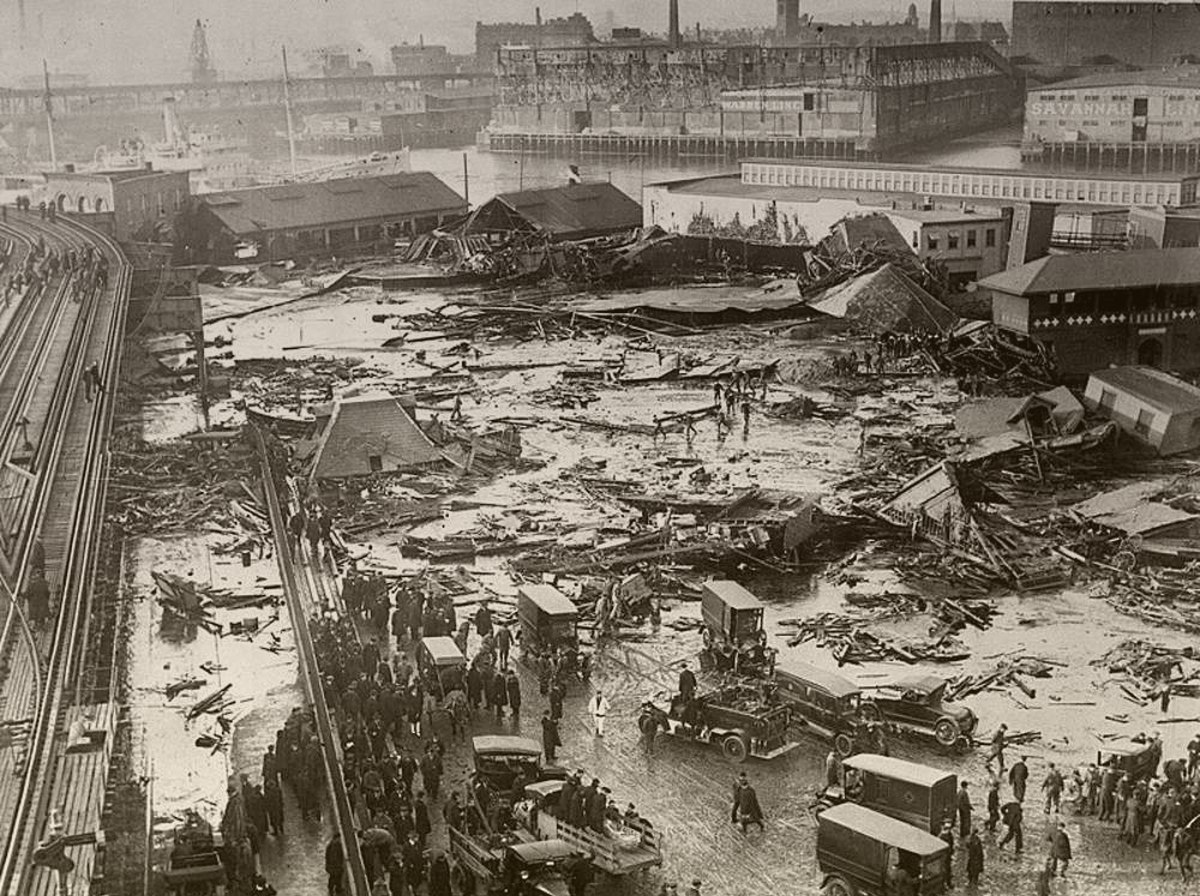
The rupture released 2.3 million gallons of molasses, sending a dense wave through nearby streets and buildings. It killed 21 people and injured around 150.
Years of legal action followed, culminating in a 1925 finding that held the tank’s owner negligent.
Why It Mattered
The flood showed how the failure of industrial infrastructure could devastate a surrounding neighbourhood. The 1925 finding that held the tank’s owner negligent made corporate responsibility central to the disaster’s legal outcome.
Tank and Distribution
- The tank was built in 1915 beside elevated railway tracks in the North End.
- Molasses delivered at Copp’s Hill Wharf was stored before transfer to rail cars and distilleries.
Legal Finding
- A 1925 finding held the tank owner negligent.
Surviving Photograph
- The Library of Congress preserves a glass-negative image captioned “Boston molasses explosion” in the American National Red Cross photograph collection.
- The catalogue dates the negative to the period between 1919 and 1929.
Sources & Records
- City of Boston — the Great Molasses Flood — Documents the tank’s purpose, rupture, volume released and casualties.
- Library of Congress — Boston molasses explosion photograph — Catalogues the surviving Red Cross glass negative and its archival provenance.
Gallery
Credit
Globe Newspaper Co. / Boston Public Library, via Wikimedia Commons
Licence
Public domain
This image is recorded as public domain. Its source provides the provenance.
Caption
Wreckage and onlookers in Boston’s waterfront district after the tank rupture, documenting the disaster’s effect on the surrounding neighbourhood.