ILOVEYOU
The Email Worm Disguised as a Love Letter
Forgotten Internet · 2000
Archived on
Associated With
Widely attributed to Onel de Guzman - creator or operator
Defining Feature
VBScript worm spread through a deceptive email attachment and Microsoft Outlook contacts
Status
Preserved - Contained historical cybersecurity incident; preserved in government and security records
Overview
ILOVEYOU spread through email on 4 May 2000 by posing as a personal message with a love-letter file.
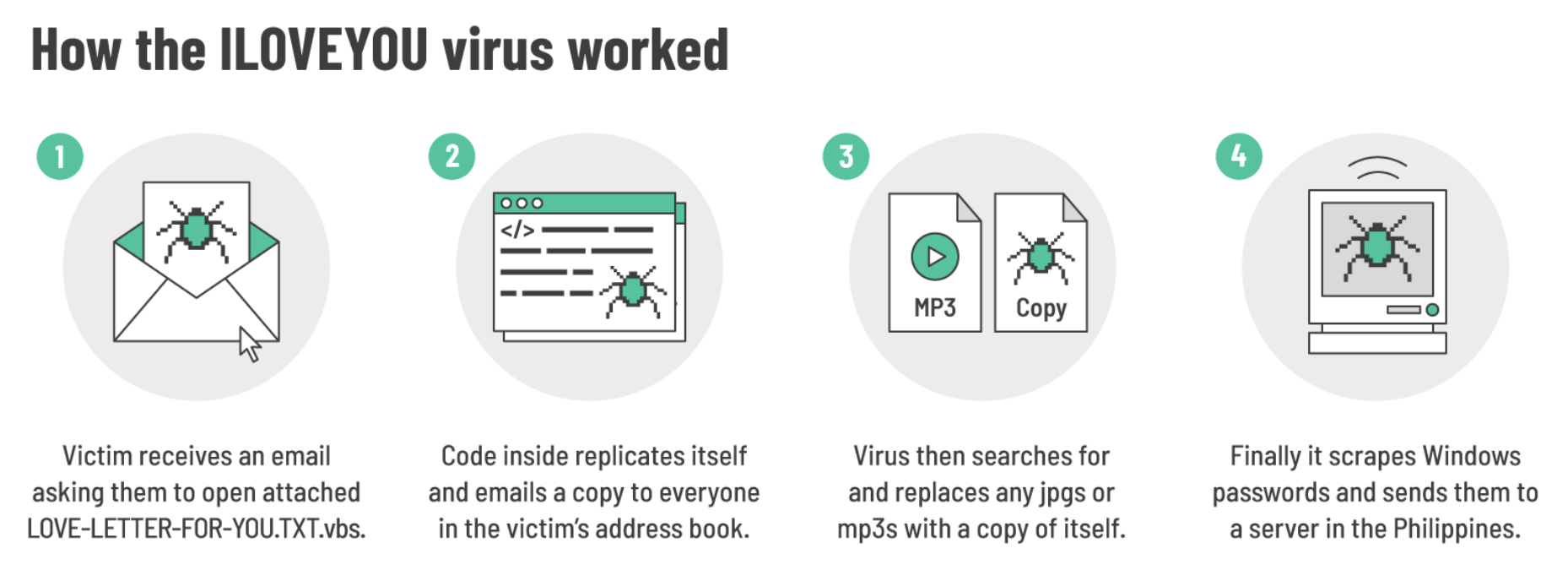
Once opened, its VBScript code altered files and used Microsoft Outlook address books to send copies onward. The worm spread rapidly because messages appeared to come from trusted personal and workplace contacts.
The outbreak disrupted businesses, public institutions and government networks worldwide. Investigators traced it to the Philippines, where the absence of legislation covering the relevant computer-related conduct hindered prosecution.
Why It Mattered
The outbreak demonstrated how social engineering could turn trusted personal contacts into a worldwide delivery system. Its disruption of companies and public agencies made attachment controls, email filtering and user awareness urgent parts of internet security.
The Deceptive Attachment
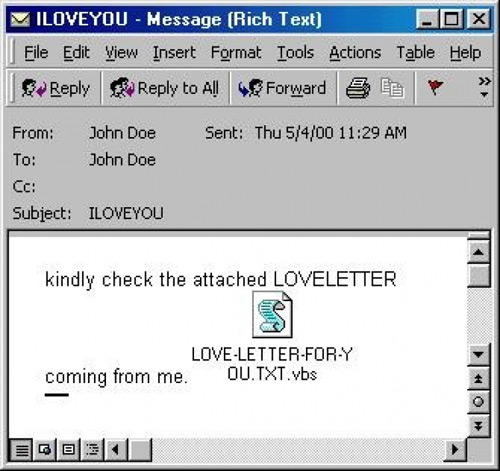
- Emails carried the subject ILOVEYOU and the attachment LOVE-LETTER-FOR-YOU.TXT.vbs.
- The VBScript worm altered files and sent copies through Microsoft Outlook address books.
- Its propagation depended on recipients choosing to open the attachment.
- The outbreak is widely attributed to Onel de Guzman, a student in the Philippines.
Disruption and Containment
- At least fourteen United States federal agencies were affected.
- Administrators disconnected systems, blocked the attachment and distributed removal guidance.
- Antivirus companies released updated detection signatures and removal tools.
- Organisations introduced stronger filtering and restrictions on executable attachments.
Investigation and the Legal Gap
- Investigators traced the outbreak to the Philippines.
- Philippine authorities investigated Onel de Guzman.
- Prosecution was hindered by the absence of legislation covering the relevant conduct.
- Republic Act No. 8792 was enacted in June 2000 with provisions covering electronic transactions and certain computer offences.
Sources & Records
- FBI — congressional testimony on cyber security — Describes the Love Bug’s address-book propagation, federal disruption and the Philippine legal obstacle to prosecution.
Gallery
Credit
Microsoft email interface; screenshot reproduced by Stoel Rives Privacy & Security Law Blog, original contributor not established
Licence
Historical Ephemera
Displayed for commentary, criticism, research and historical documentation where permitted by applicable law. No permission for reuse is granted.
Caption
The ILOVEYOU email disguised its dangerous script as a love letter. Its ordinary-looking attachment helped the outbreak spread through address books in May 2000.
Credit
GeeksforGeeks infographic; individual designer not identified
Licence
Historical Ephemera
Displayed for commentary, criticism, research and historical documentation where permitted by applicable law. No permission for reuse is granted.
Caption
An explanatory graphic traces the ILOVEYOU outbreak from a tempting email attachment to damaged files and stolen passwords.
Credit
Historical newspaper clipping; original publication and scan contributor not established; reposted by Enigma Elysium
Licence
Historical Ephemera
Displayed for commentary, criticism, research and historical documentation where permitted by applicable law. No permission for reuse is granted.
Caption
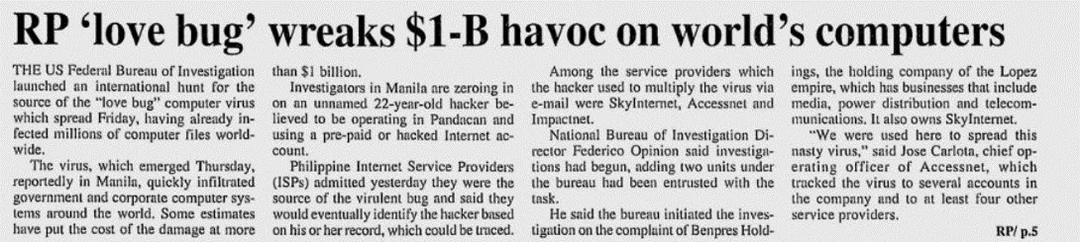
A contemporary newspaper headline captures the scale of the ILOVEYOU outbreak and the sudden international attention directed towards its Philippine origins.