Poo-Chi
The Sensor-Driven Robot Dog That Sang and Danced
Forgotten Toys · 2000
Archived on
Associated With
Sega Toys and Tiger Electronics - co-producers
Defining Feature
A sensor-driven robot dog with LED moods, songs and infrared communication
Status
Superseded - followed by Super Poo-Chi and the wider Robo-Chi line
Overview
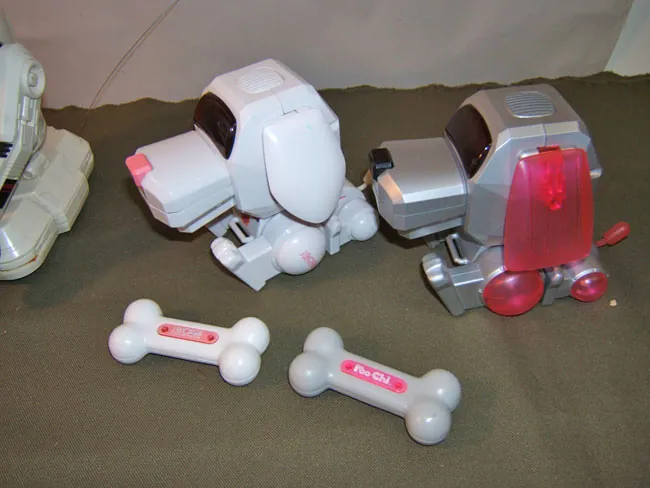
Poo-Chi was a sensor-driven robot dog that sang, danced on its toes and responded to a magnetic bone.
Co-produced by Sega Toys and Tiger Electronics, it launched in 2000 as a comparatively inexpensive physical counterpart to virtual-pet play. Its light, sound and touch sensors shaped its responses, while red LED eyes displayed changing moods.
Poo-Chi could sit, stand and perform songs, but it could not walk. Place two units face to face and their infrared links let them sing together or growl at one another.
Why It Mattered
You didn’t need an expensive robot like Sony’s AIBO to experience a toy that seemed to react to you. Poo-Chi used simple sensors, glowing eyes and small movements to give a much cheaper pet its own personality.
Its success helped carry the idea into Super Poo-Chi and the wider Robo-Chi line. Hasbro called it its bestseller of 2000, placing it among the defining electronic toys of that year.
Development and Launch
- Poo-Chi was officially described as a co-production of Sega Toys and Tiger Electronics.
- Sega Toys employee Tomohiko Onishi wrote a development report, while design patent D448,433 names Mie Ueda, Tomohiko Onishi and Nobata Fujio as inventors.
- Poo-Chi went on sale in Japan on 1 April 2000. US commercial use is recorded in April, although an exact nationwide retail date has not been established.
- US launch publicity placed the price at about US$30; an NPD-based chart later recorded an average retail price of US$23.95.
Sensors, Movement and Play
- The original toy was recommended for ages four and over and ran on three AAA batteries.
- Light, sound and head-touch sensors shaped its responses, while a magnetic bone triggered feeding interactions.
- Its red LED eyes displayed changing moods, and it could sit, stand, dance on its toes, play songs and enter sleep states.
- Two units placed face to face could communicate by infrared, allowing them to sing together or growl at one another.
Successors and Product Line
- Hasbro identified Poo-Chi as its bestseller of 2000 and recorded a Girls Product of the Year award.
- Sources from 2000 document silver-bodied versions with blue, purple, pink and red coloured parts, although availability may have varied by territory or production run.
- Super Poo-Chi was a separate later model, while the broader Robo-Chi interactive-animal line became a major Tiger Electronics initiative for 2001.
- No formal end date has been established for the original model, which was superseded as the product line expanded.
Sources & Records
- Poo-Chi instruction manual — Documents the three sensors, eye expressions, movement and communication between two dogs.
- Sega Toys — company product timeline — Places the original Poo-Chi launch in April 2000, separately from later robot pets.
- Tomohiko Onishi — Poo-Chi development report — Explains the balance between low cost, responsive behaviour and safety in the toy's design.
- Television Digest — Poo-Chi launch report, April 2000 — Reports the 1 April Japanese launch and planned US shipments that month.
- Hasbro annual report, 2000 — Identifies Poo-Chi as the year's bestseller and describes plans for the Robo-Chi range.
- Poo-Chi robotic dog design — US patent D448433 — Names the three credited inventors and Sega Toys as assignee.
Gallery
Credit
VofDoom at English Wikipedia
Caption
Two Poo-Chi robot dogs with their accessory bones.