Vaikiškas kinas
The Hand-Cranked 8 mm Cinema for One
Forgotten Technology · 1970s
Archived on
Region
Lithuania; Soviet Union
Associated With
Neringa - manufacturer
Defining Feature
Hand-cranked direct viewing of looped 8 mm films through an eyepiece
Status
Discontinued - final manufacturing year unknown
Overview
Vaikiškas kinas (“Children’s Cinema”) was a hand-cranked film viewer made by Neringa in Vilnius from the mid-1970s.
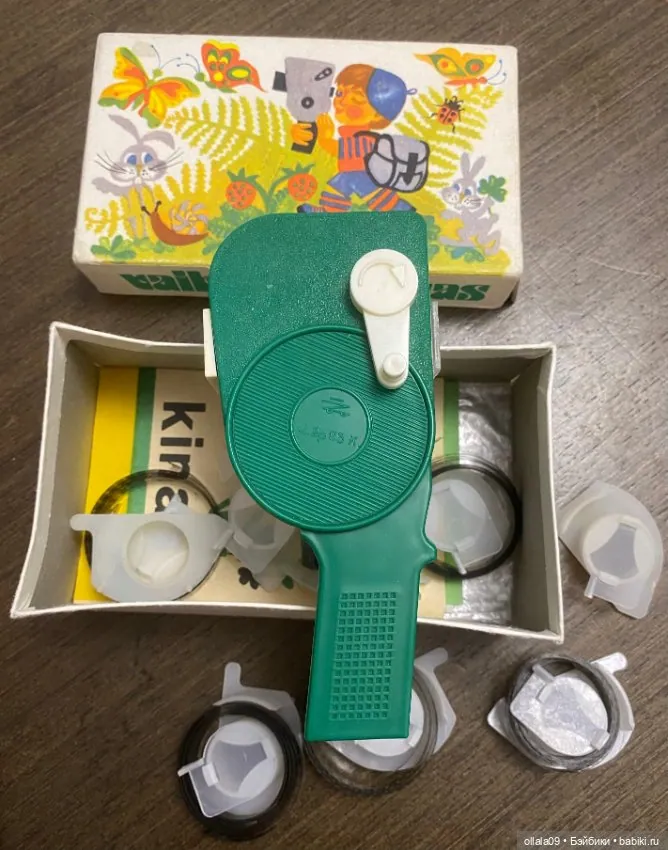
Rather than casting pictures onto a wall, it used an eyepiece, interchangeable holders and looped 8 mm films. Turning the side crank advanced each short, giving one viewer a private miniature screening.
Neringa’s instructions list four films in the standard set and credit the Lithuanian Society of Amateur Filmmakers with the stories. A bilingual leaflet was printed in 1985. The product was later discontinued, although its final manufacturing year is unknown.
Why It Mattered
The ability to watch moving pictures through a small, hand-powered device made animation a personal, interactive experience rather than a conventional projected screening.
The viewer also brought together Lithuanian manufacturing, filmmaking and illustration. With more than a hundred short stories reportedly created for Neringa, it provided a distinctive outlet for Lithuanian animation across the Soviet Union.
How the Viewer Worked
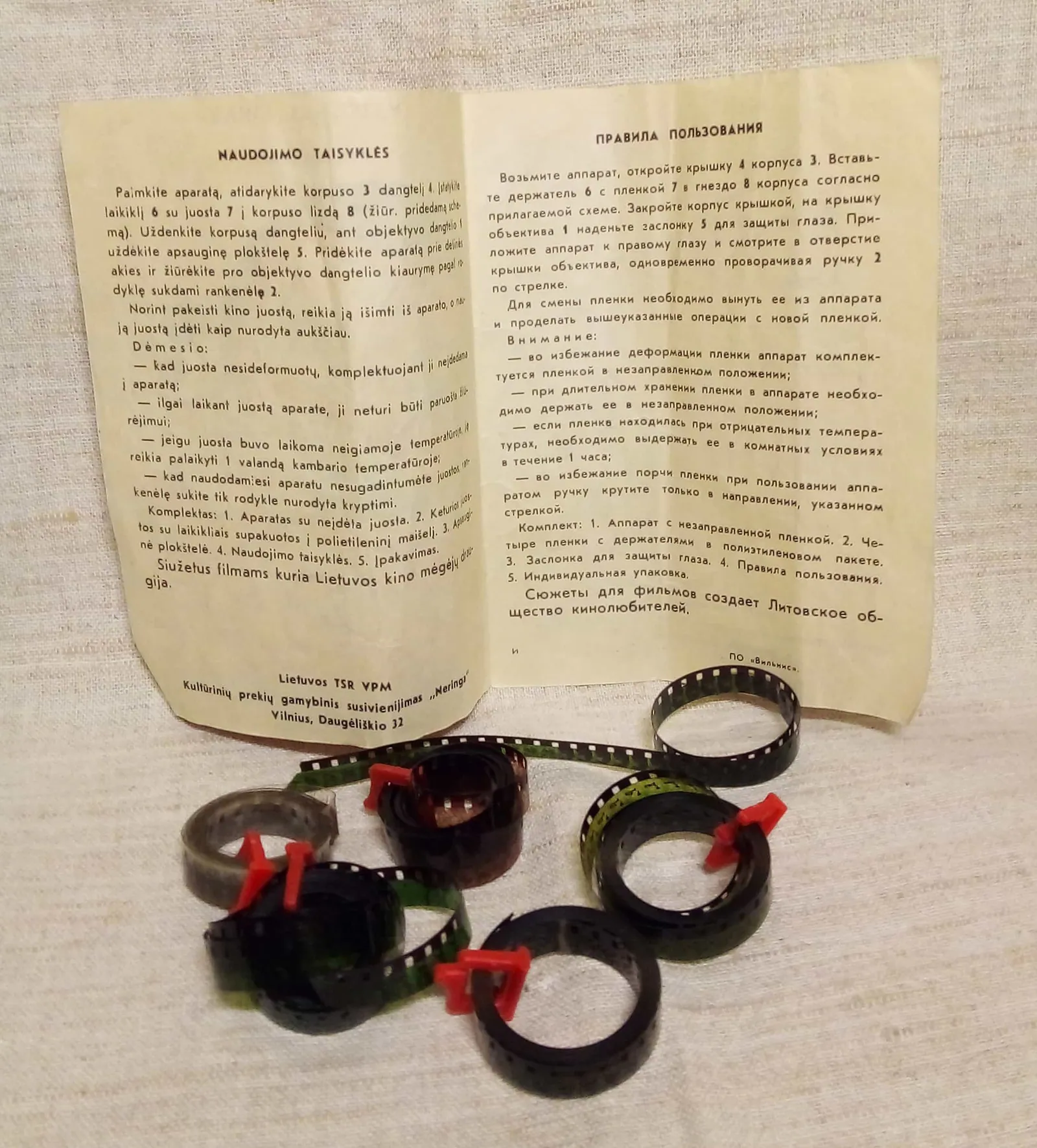
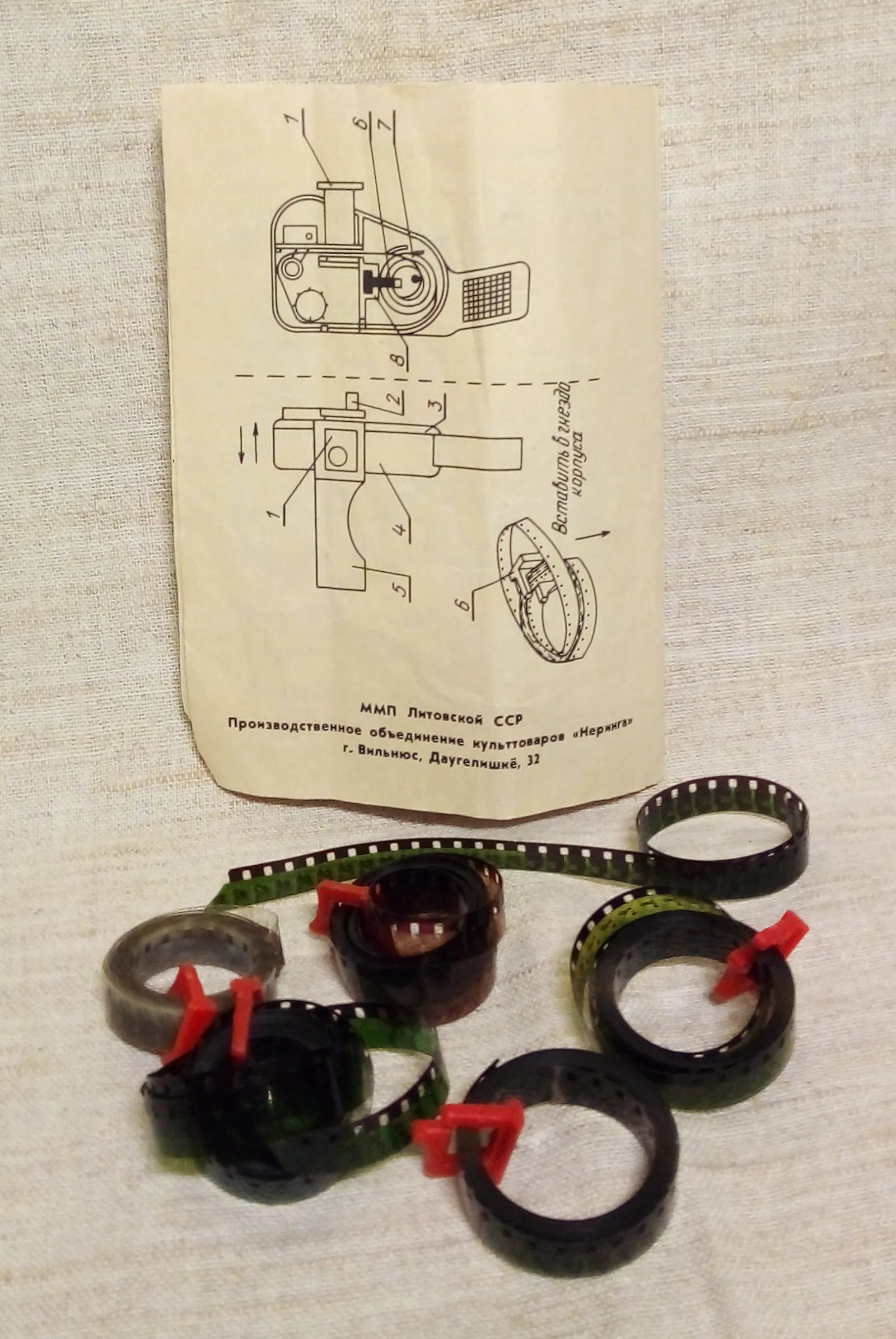
- The user inserted a film holder, closed the body, placed the viewing aperture to the right eye and turned the side handle in the marked direction.
- The daylight viewer displayed the film directly through its eyepiece instead of projecting an image onto a wall.
- Each film was an endless 8 mm loop; Valentas Aškinis describes the shorts as lasting about one minute.
What Came in the Set
- Neringa’s instructions list the viewer, four films with holders, an eye-protection plate, instructions and packaging.
- The leaflet carries the Lithuanian title Vaikiškas kinas and the Russian equivalent Детское кино, alongside Neringa’s Vilnius address.
- Its 1985 colophon states a print run of 500,000 copies for the leaflet edition, not the number of viewers manufactured or sold.
Films, Artists and Distribution
- The instructions credit the Lithuanian Society of Amateur Filmmakers with creating the film stories, while Neringa is named as the viewer’s manufacturer.
- Aškinis identifies Juozas Sakalauskas and colleagues as principal creators and names several participating Lithuanian artists and illustrators.
- Two attributed stories are Čiukas ir muilas, drawn by Vitalijus Suchockis, and Hopkins Oil, drawn by Romas Palčiauskas; they are not established as part of every retail set.
- Aškinis reports that more than one hundred stories were created for Neringa and that the viewer was distributed throughout the Soviet Union.
Sources & Records
- Neringa — Children’s Cinema instructions, 1985 — Explains loading and hand-cranking, lists the four-film set and identifies the maker and leaflet edition.
Gallery
Credit
Бэйбики
Licence
Historical Ephemera
Displayed for commentary, criticism, research and historical documentation where permitted by applicable law. No permission for reuse is granted.
Caption
The Neringa viewer bundled its hand-cranked mechanism, illustrated box and interchangeable film loops into a self-contained children’s cinema set.
Credit
Antique Shop POGORELOV
Licence
Historical Ephemera
Displayed for commentary, criticism, research and historical documentation where permitted by applicable law. No permission for reuse is granted.
Caption
The bilingual Lithuanian and Russian instructions explain the ritual: load a loop, hold the eyepiece to the light and turn the crank to bring the tiny film to life.
Credit
Photographer unresolved; source publisher Antique Shop POGORELOV.
Licence
Historical Ephemera
Displayed for commentary, criticism, research and historical documentation where permitted by applicable law. No permission for reuse is granted.
Caption
A cutaway diagram reveals the simple optical path that turned perforated loops and a hand crank into a private miniature screening.