Inflatable Antenna Experiment
The Space Dish Packed into a Small Box
Forgotten Engineering · 1996
Archived on
Region
United States
Associated With
L’Garde, NASA Jet Propulsion Laboratory and NASA Langley Research Center - project participants
Defining Feature
A canister-packed reflector deployed in orbit using nitrogen-inflated supports
Status
Historical event - orbital deployment test flown in May 1996
Overview
The Inflatable Antenna Experiment was a vast, packable reflector flown aboard Space Shuttle Endeavour.
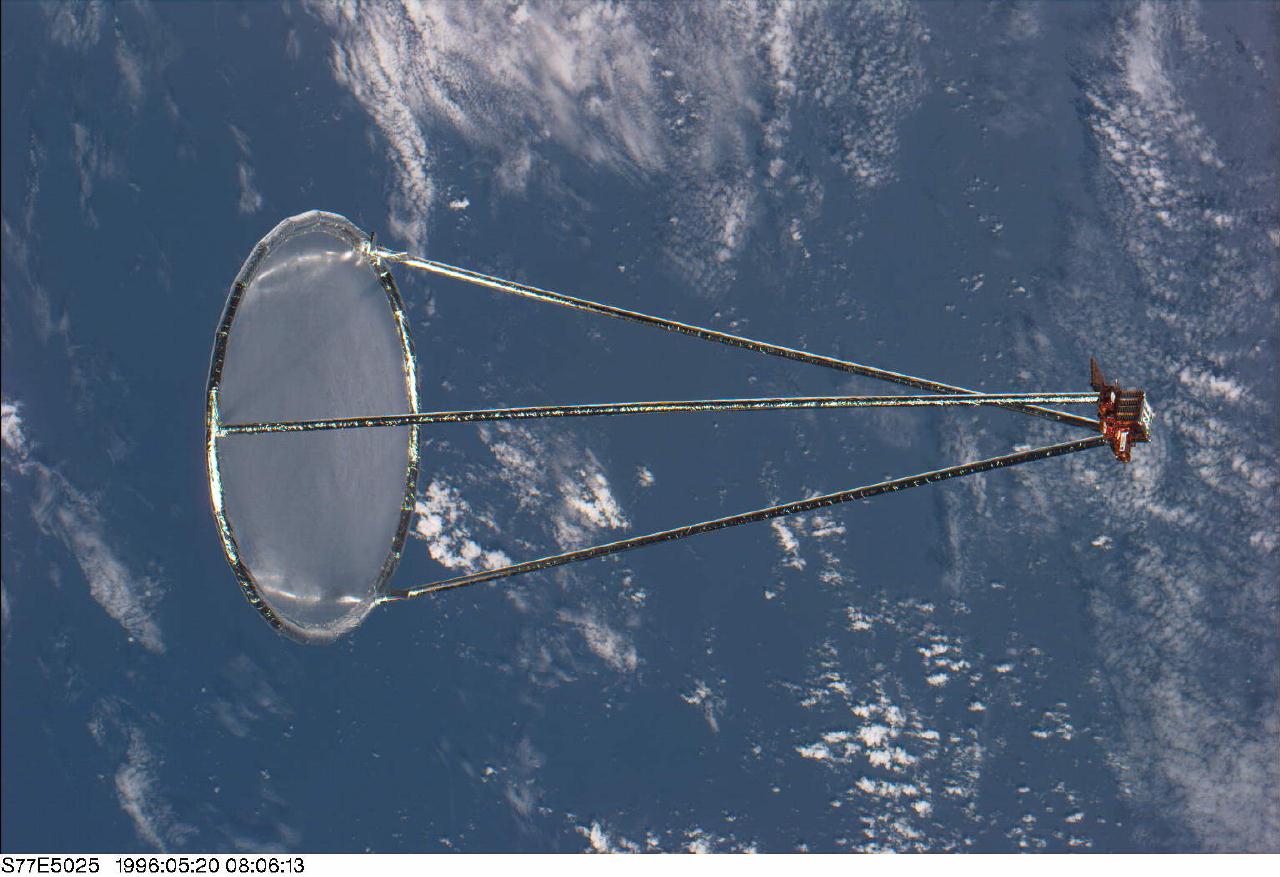
Released in orbit in May 1996, nitrogen inflated three long struts and a supporting ring around its thin reflector, turning a canister-sized payload into a structure spanning tens of metres.
The support structure formed and held its shape, but the reflector did not appear fully deployed and could not be characterised by the planned orbital measurements. The inflatable unit was later ejected; the shuttle retrieved its carrier.
Why It Mattered
The appeal of an inflatable reflector lay in a difficult spacecraft-design bargain: proposed large antennas faced constraints in mass, packed volume and development cost, while an inflatable structure offered another approach. Deployment also introduced complications. Preliminary analysis linked unexpected behaviour to residual air in the packed structure and strain energy released by its supporting ring, suggesting that conditions created during packing could affect how the structure unfolded in orbit.
Flight and Deployment Sequence
- Space Shuttle Endeavour launched with the experiment on 19 May 1996 and released it in Earth orbit on 20 May.
- A spring-loaded plate ejected the packed assembly from a canister mounted on the Spartan 207 carrier.
- Nitrogen inflated three 28-metre struts, a supporting torus and the 14-metre offset reflector-and-canopy assembly.
- Onboard imaging was intended to measure the reflector’s surface shape in orbit.
Measurement and Flight Result
- One-millimetre RMS surface precision was a project objective, not a result demonstrated in orbit.
- The measurement system could position the reflector rim, but the preliminary paper says the surface itself could not be characterised.
- The paper’s photogrammetric surface measurements were made on the ground, while its radiation patterns were calculated rather than measured in orbit.
- NASA’s June 1996 mission report left the final assessment of canopy inflation pending analysis of the recorded data.
Project Context and Later Assessment
- The project paper identifies participants at JPL in Pasadena, L’Garde in Tustin and NASA Langley Research Center in Hampton.
- The project authors presented inflatable reflectors as possible structures for mobile communications, Earth observation and space radar; IAE did not demonstrate those services.
- In 2000, JPL described the flight as a useful demonstration and a foundation for continuing inflatable-structure research, while presenting later concepts as future work.
Sources & Records
Inflatable Antenna Technology with Preliminary Shuttle Experiment Results and Potential Applications
Original engineers’ paper directly read, relevant PDF pages 2–4 visually inspected. Eight-page surviving file includes later corporate cover. Section 5 ground precision and calculated radiation pattern distinguished from section 6 orbital deployment and incomplete reflector characterization. Authors’ overall success judgement retained alongside limitations.
STS-77 Space Shuttle Mission Report — NASA-TM-112641 / NSTS-37408
Original full 58-page report preserved, relevant payload and operations sections read; cover and PDF 17–18 visually inspected. Printed page 9/PDF 17 says support structure formed but canopy inflation assessment remained pending. Separate failed EMU camera transmission is not evidence all onboard photographic recording failed.
The Shuttle Launches an Inflatable Antenna — APOD
Full relevant original period APOD text preserved via current NASA Science migration. Photograph individually inspected, visible identifier S77E5025 and date stamp. General description of antenna function is not evidence this engineering experiment transmitted useful communications.
Original institutional announcement directly read. Describes IAE as a useful demonstration and outlines future Gossamer and ARISE concepts. Future mission promises not converted into flown missions or evidence every IAE objective was achieved.
Gallery
Credit
NASA / STS-77 crew, S77E5025, 20 May 1996; published by APOD 25 May 1996. US-government photograph; NASA acknowledgement, no implied endorsement.
Caption
The Inflatable Antenna Experiment after unfolding above Earth in May 1996. Its supports formed a vast, lightweight structure, but the engineers’ preliminary report records an important limit: the reflector did not fully deploy as intended, preventing the planned surface measurement.