Bug Labs BUG
The Modular Linux Gadget with Snap-On Hardware
Forgotten Technology · 2007–2009
Archived on
Region
United States
Associated With
Bug Labs, Inc. - developer
Defining Feature
Linux BUGbase with four snap-on module positions
Status
Superseded - the original BUGbase generation was followed by BUGbase WiFi and BUG 2.0; its exact withdrawal date is unknown.
Overview
Bug Labs’ BUG was a Linux gadget base that accepted four snap-on modules for custom devices.
Developers could combine a touchscreen, GPS, camera and motion sensor, then write or download software to make the parts work together. The first $549 Hiro P bundle opened for US pre-orders in January 2008, but its base had no Wi-Fi.
A wireless BUGbase followed in 2009, before the faster BUG 2.0 superseded the original generation in 2010.
Why It Mattered
Instead of locking one purpose into a finished gadget, BUG let developers change both its hardware and software for the next project. This suited the specialised, small-audience devices Peter Semmelhack imagined, but making those combinations work still required Java or Linux skills and sometimes additional library work. The flexibility depended on the user’s technical ability.
Hardware and the Hiro P Bundle
- The first-generation BUGbase used an ARM11-class Freescale i.MX31 processor, 128 MB of RAM and four module positions.
- The $549 Hiro P bundle included touchscreen display, GPS, motion-sensing and two-megapixel camera modules; its BUGbase had no built-in Wi-Fi.
- A reviewed base also had removable storage, controls, USB connectivity, a speaker and a tripod mount. Bug Labs estimated battery life at three to four hours.
Linux Software and Development
- BUG ran an embedded Linux distribution and exposed attached modules through device and Java interfaces.
- Development support included Eclipse tools, a virtual BUG, examples and BUGnet; C, Python and Ruby were also described.
- Users could still need to build packages or write libraries, while Bug Labs characterised many community applications as proofs of concept.
Rollout, Modules and Revisions
- The May 2006 announcement proposed the platform; working prototypes appeared publicly in 2007, before US pre-orders opened on 21 January 2008.
- Initial inventory was reported depleted by 27 March 2008, but neither the number sold nor the exact first customer-dispatch date was disclosed.
- Five modules were described as available at CES 2009 and five more were announced; several announced modules were still called forthcoming that July.
- The $449 BUGbase WiFi reached the United States and Europe in September 2009. The OMAP3-based BUG 2.0 was announced in February 2010.
Sources & Records
Introduces Peter Semmelhack as Bug Labs’ founder and records the original 2006 proposal for an open, modular consumer-electronics hardware and web-services platform.
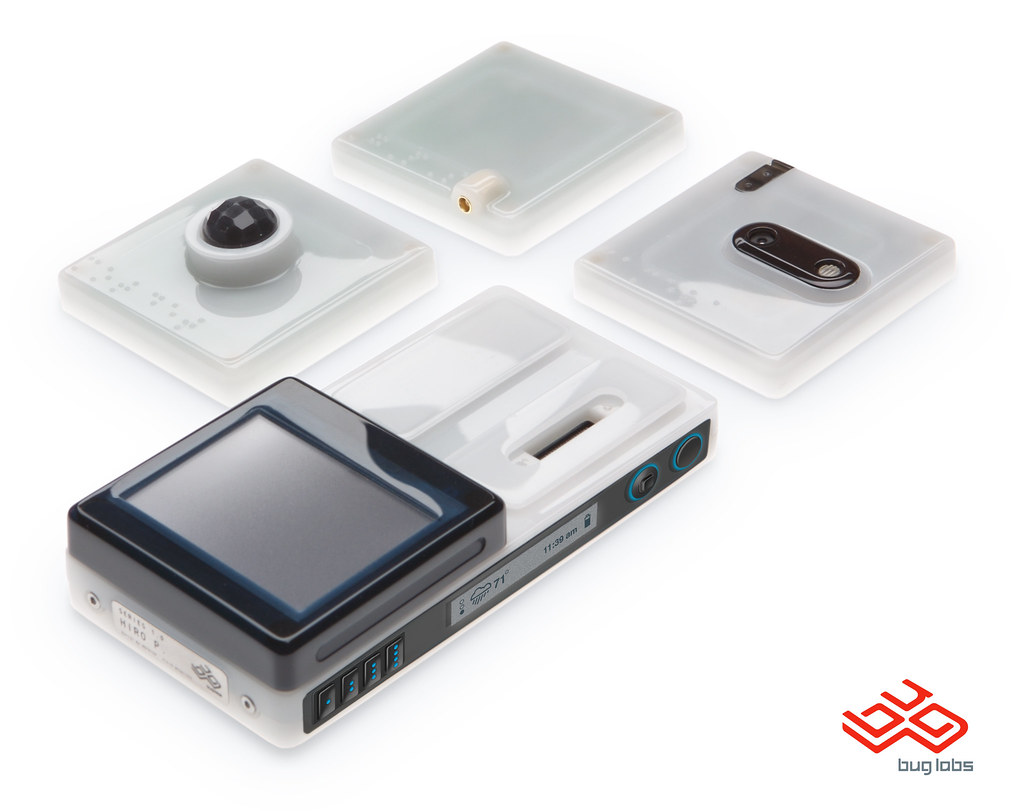
Shows the named Hiro P edition BUGbase, screen and loose modules in an official Bug Labs photograph licensed under CC BY-SA 2.0.
The Bug Store Is Open for Business
Clarifies that the store opened for pre-orders on 21 January 2008 and that Bug Labs initially recommended the system only to Java and Linux developers.
Documents the 2009 hardware and software stack, programming demands, proof-of-concept applications, battery estimate, forthcoming modules and Bug Labs’ New York Test Kitchen.
Gallery
Credit
Bug Labs Inc, BUG Group - Hiro P edition.
Licence
Reuse and sharing, including commercial use, are allowed with attribution. Credit the creator, link the licence and identify any changes. ShareAlike applies to adaptations. Other rights may apply.
Caption
Bug Labs’ BUG let developers combine snap-on modules into their own electronic devices.