Grand Theft Auto
When an 18 Certificate Became the Advert
Forgotten Adverts · 1997–1998
Archived on
Region
United Kingdom; France; Germany; United States
Associated With
BMG Interactive - British publisher and advertiser; ASC Games - North American PC launch promotion; Take-Two Interactive Software - subsequent GTA rights holder, Max Clifford — publicity consultant reported as involved in BMG’s launch campaign.
Defining Feature
A British magazine advert presented the BBFC 18 certificate as an honour and a selling point.
Status
Historical event - Original launch marketing and publicity, 1997–1998
Overview
Grand Theft Auto’s original launch publicity treated controversy as part of the product.
Before its European release in November 1997, the game was raised in the House of Lords. Campaign reported that publicist Max Clifford was involved in BMG Interactive’s launch plans, which included proposed press and radio advertising, online promotion and posters in public toilets.
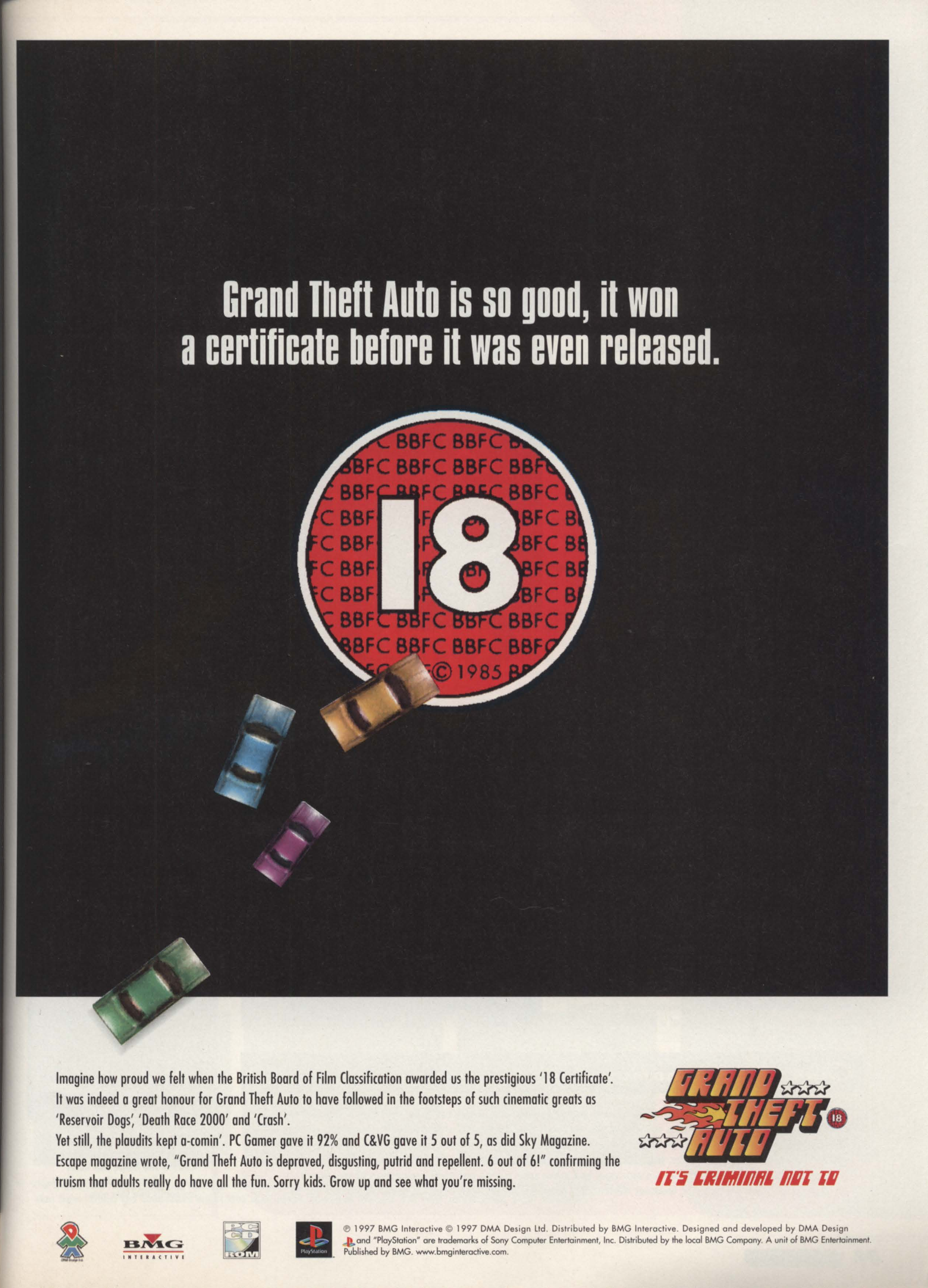
After the BBFC awarded GTA an 18 certificate, BMG’s British advertising turned the classification into a creative asset. A full-page PC Zone advert placed the certificate at its centre and celebrated it as an honour. In North America, ASC Games announced a separate campaign aimed at players aged 17 and over, including planned advertising through Howard Stern.
Across the surviving material, that attitude took different forms. A French advert suggested that if the player was going to be a bastard, they might as well be the worst. German adverts presented the reader with typed instructions from the Mafia, while ASC’s American campaign staged six supposed offenders in a police line-up beneath the words “It’s a crime.”
Why It Mattered
An age restriction became an invitation to an adult audience. By comparing GTA with Reservoir Dogs, Death Race 2000 and Crash, the PC Zone advert placed the game alongside provocative cinema. Its closing line turned exclusion into part of the appeal: “Sorry kids. Grow up and see what you’re missing.”
The practical selling points were still present: more than 30 vehicles, three cities and prominent review scores. But they appeared beneath headlines built around crime, threat, innuendo and restricted access. Across different markets, the campaign framed GTA’s features through its criminal identity.
Launch Promotion and Advertising
- Campaign’s 20 November 1997 report described plans for press and radio advertising, a four-week online promotion and posters in public toilets. These were announced arrangements, not confirmed placement logs.
- Campaign reported Max Clifford’s publicity involvement. In 2012, Mike Dailly and David Jones recalled his anticipation of press reactions; their recollections do not establish who prompted particular parliamentary interventions.
- The PC Zone advert credits DMA Design with design and development and BMG Interactive with publication and distribution. It appears on PDF p. 73; printed p. 71 is inferred from neighbouring pages because the advert is unnumbered.
British Classification and Parliamentary Scrutiny
- During the 20 May 1997 Lords exchange, the minister said GTA had not yet been submitted to the BBFC. This was not a classification refusal or a ban.
- The BBFC dates classification to 21 November 1997, and the 26 January 1998 parliamentary answer confirms the 18 certificate. The BBFC’s separate release-date field does not establish platform-specific retail availability.
- On 31 March 1998, Lord Campbell of Croy quoted “CRIME DOES PAY”, acknowledged the 18 certificate and raised concerns about children’s access. The subsequent defeat of Amendment No. 6 was not a vote to ban GTA.
Regional Releases and Commercial Record
- The original European launch is recorded as 28 November 1997. That date does not establish simultaneous availability on every platform or in every market.
- ASC’s North American PC release announcement is dated 24 March 1998. It targeted players aged 17 and over and described planned Howard Stern advertising, not confirmed broadcasts.
- Take-Two’s release table groups PC and PlayStation together under June 1998 for North America. That grouped entry does not establish a separate PC launch date or supersede ASC’s March announcement.
- Take-Two’s fiscal-1999 filing records the March 1998 acquisition of BMG’s GTA rights and puts GTA at approximately 7.6% of fiscal-1998 company revenues. Its reported sales figures do not isolate territories or demonstrate that controversy caused those sales.
Sources & Records
PC Zone, Issue 61, March 1998 — Grand Theft Auto Certificate Advertisement
Documents the certificate-led British advert, its film comparisons, review quotations and BMG/DMA credits.
Advertising & Promotion: BMG Plans Spree with Crime Game
Reports BMG’s planned launch activity and Max Clifford’s involvement before GTA’s European release.
House of Lords: Grand Theft Auto Computer Game — 20 May 1997
Records the pre-release Lords exchange and the minister’s statement that GTA had not yet been submitted to the BBFC.
Grand Theft Auto — BBFC Classification Record
Provides the official 18 classification and its 21 November 1997 classification date.
ASC Games’ Grand Theft Auto Races Into Stores
Announces the North American PC launch and describes ASC’s planned promotion to players aged 17 and over.
Grand Theft Auto Computer Game — Written Answer, 26 January 1998
Confirms the 18 certificate while recording a parliamentary question about PlayStation coverage and the slogan ‘Crime Does Pay’.
Crime and Disorder Bill — House of Lords Debate, 31 March 1998
Records later parliamentary criticism of GTA, including its slogan and access by younger players.
‘Crime Pays’ Video Attacked — The Independent
Provides contemporary reporting on criticism of the game and BMG’s use of BBFC classification before release.
Grand Theft Auto — Six Regional Print Advertisements
Catalogues the six British, French, German and US adverts discussed in this record so readers can inspect the surviving variants.
The Man Who Engineered the Grand Theft Auto Controversy
Records later participant recollections about Max Clifford’s publicity role and anticipation of press reaction.
From Movie-Style Marketing to Business as Usual: Cinema in Games Promotion, 1990–1999
Places GTA’s certificate-led advertising within a peer-reviewed study of cinema-style games promotion.
Grand Theft Auto — ESRB Rating Record
Provides the official Mature 17+ rating and content descriptors for the North American releases.
Take-Two Interactive Software — Form 10-K for the Fiscal Year Ended 31 October 1999
Records Take-Two’s acquisition of BMG’s GTA rights and contemporary sales and release information.
CD 113: Grand Theft Auto, October 1997 — VGHF Catalogue
Catalogues surviving October 1997 BMG press material from the original launch period.
Grand Theft Auto — Scottish Games Industry Record
Identifies DMA Design, BMG Interactive and the 28 November 1997 European release date.
Grand Theft Auto — Centre for Computing History Collection Record
Documents a surviving 1997 BMG PC edition and its DMA Design attribution.
Gallery
Credit
BMG Interactive (publisher and advertiser); DMA Design (developer); originally published in PC Zone; scan digitised by Pix’s Origin Adventures.
Licence
Historical Ephemera
Displayed for commentary, criticism, research and historical documentation where permitted by applicable law. No permission for reuse is granted.
Caption
Grand Theft Auto’s BBFC 18 certificate forms the centrepiece of this full-page BMG Interactive advert in PC Zone, issue 61 (March 1998), p. 71. Digital scan made available by Pix’s Origin Adventures.