Minute Maid Enhanced Pomegranate Blueberry
The Juice Blend Behind a Supreme Court Label Case
Forgotten Food & Drinks · 2007–2014
Archived on
Region
United States
Associated With
The Coca-Cola Company - marketer under the Minute Maid brand
Defining Feature
A five-juice blend labelled prominently as “Pomegranate Blueberry”
Status
Discontinued - reported withdrawn from United States sale in 2014
Overview
Minute Maid Enhanced Pomegranate Blueberry was a five-juice blend sold by Coca-Cola and challenged by a rival.
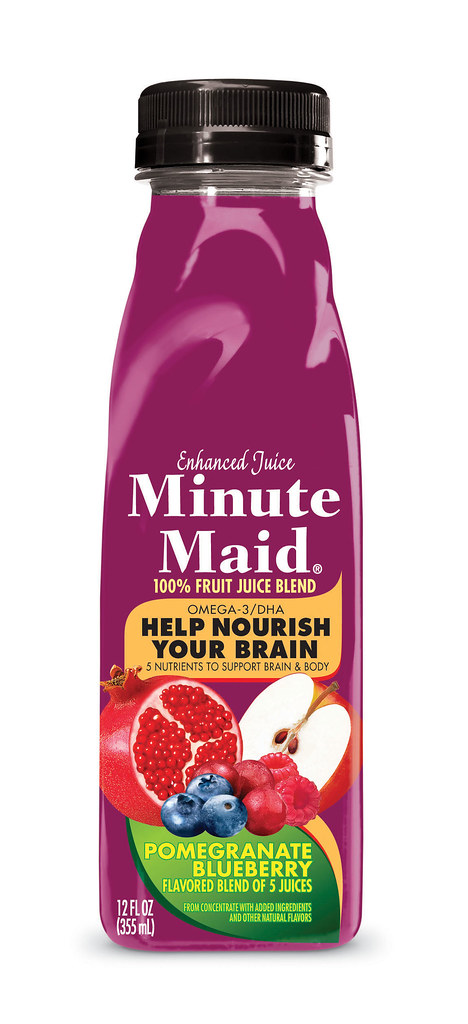
Announced in September 2007, its label displayed “Pomegranate Blueberry” prominently above “Flavored Blend of 5 Juices”. The drink contained 99.4% apple and grape juices, 0.3% pomegranate, 0.2% blueberry and 0.1% raspberry.
POM Wonderful alleged that the presentation misled consumers. In 2014, the Supreme Court ruled that federal food-labelling law did not block its Lanham Act challenge. The case returned to trial, where a 2016 jury found that POM had not proved the label or packaging misled a substantial portion of consumers.
Why It Mattered
The dispute showed that food-labelling regulation and competitors’ false-advertising claims could operate alongside each other. A manufacturer’s obligations extended beyond the rules governing individual label statements to questions about the overall impression presented to shoppers. The Supreme Court’s decision kept that route to challenge open, while leaving the alleged deception to be tested separately.
Bottle Wording and Contents
- The blend was 99.4% apple and grape juices, with 0.3% pomegranate juice, 0.2% blueberry juice and 0.1% raspberry juice.
- “Pomegranate Blueberry” appeared more prominently on the front label than “Flavored Blend of 5 Juices”.
- The label also used a vignette showing five fruits.
The Competitor-Label Case
- POM Wonderful filed its action against Coca-Cola in September 2008, challenging the blend’s name, label, marketing and advertising.
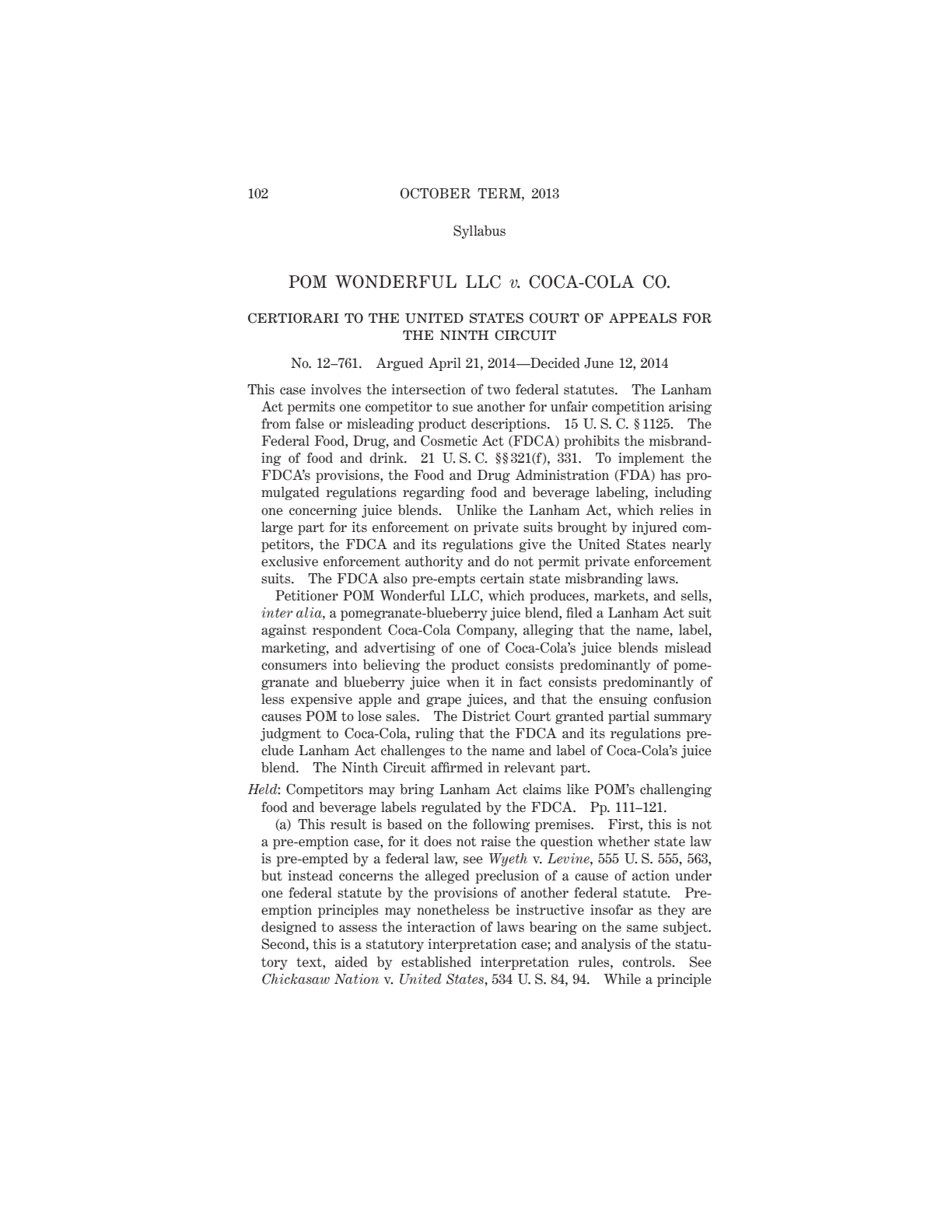
- On 12 June 2014, the Supreme Court held that FDCA regulation did not preclude a Lanham Act challenge to a food or beverage label.
- The Court did not decide whether consumers had been misled; on remand, a 2016 jury found POM had not proved substantial consumer deception.
Naming Rules and Discontinuation
- Federal rules for specified multiple-juice beverages set conditional alternatives when a named juice is not predominant, including identifying it as a flavour or stating an amount range.
- Coca-Cola argued that “flavored” and “blend” described the product’s taste and its character as a juice blend.
- A February 2016 consumer-litigation tracker reported that Coca-Cola had stopped selling the blend in 2014 and did not plan to reintroduce it in the United States.
Sources & Records
POM Wonderful LLC v. Coca-Cola Co., 573 U.S. 102 (2014)
The controlling Supreme Court decision states the formula and label presentation, then holds that the FDCA does not preclude Lanham Act claims challenging food and beverage labels.
POM Wonderful LLC v. The Coca-Cola Company, No. 10-55861 (9th Cir. 2012)
Records the September 2007 announcement, product naming and composition, and the Ninth Circuit’s pre-Supreme-Court treatment of the FDA-regulation issue.
Identifies the September 2007 Minute Maid Enhanced launch, the formal product name, ingredient ranking, and the product’s advertising and web-page descriptions.
Brief for the United States as Amicus Curiae, POM Wonderful LLC v. The Coca-Cola Company, No. 12-761
Sets out the 2007 announcement, formula percentages and front-label wording in the federal government’s account of the case; it is advocacy material, not a judicial finding.
Juice Labeling and Pom Wonderful v. Coca-Cola: A Legal Overview
Provides a readable legal overview and reproduces a black-and-white image of the bottle, identifying it as Minute Maid’s product pictured in the Ninth Circuit case.
Minute Maid Enhanced Pomegranate Blueberry
A creator-attributed photograph of the single-serve bottle, taken on 20 October 2009 and uploaded on 24 March 2010; Flickr displays an all-rights-reserved notice.
Minute Maid Enhanced Pomegranate Blueberry Juice
Reports that Coca-Cola stopped selling the product in 2014 and did not plan to reintroduce it in the United States; this is useful status context, not a Coca-Cola archival notice.
21 CFR § 102.33, “Beverages that contain fruit or vegetable juice” (2013 edition)
Copied source text ID f1053cd098444d79a154241057f6d544 identifies the 1 April 2013 edition and supplies printed pp. 177–178 / PDF pp. 1–2. It establishes the quoted conditional naming requirements only; it is not evidence of product-specific compliance.
Brief in Opposition to Petition, POM Wonderful LLC v. The Coca-Cola Company, No. 12-761
Supplied text ID dd97b34fd6274f0aa7d0e7f24f96140b identifies a 27-page 2013 Coca-Cola brief, with Steven A. Zalesin and Travis J. Tu named as counsel. The inspected excerpt covers printed p. 2 / PDF p. 10, with operator context for printed pp. 2–3 / PDF pp. 10–11. It is primary evidence of Coca-Cola’s litigation argument, not of regulatory compliance or a judicial holding. Supplied text dd97b34fd6274f0aa7d0e7f24f96140b inspected (not a fresh website visit): Checked from supplied text (not a website visit): Supplied excerpt identifies this as Coca-Cola’s 2013 certiorari-opposition brief. On printed p. 2 / PDF p. 10, the brief characterises the product as “a blend of identified fruit juices” and says the name conveys “what it tastes like (pomegranate and blueberry)”. The supplied operator paraphrase of printed pp. 2–3 / PDF pp. 10–11 records Coca-Cola’s argument that the flavour-and-blend naming approach was authorised by FDA rules. This is evidence of Coca-Cola’s advocacy position only. Limits: Supplied copied excerpt only (ID dd97b34fd6274f0aa7d0e7f24f96140b), not a fresh website visit or a full-brief reading. The supplied material does not establish actual compliance with every FDA requirement, judicial acceptance of Coca-Cola’s position, the precise product’s coverage by every condition in 21 CFR § 102.33, or consumer deception.
Gallery
Credit
Sade Council Taylor Strategy (photographer/uploader, per Flickr page). Hosted by Flickr.
Licence
Historical Ephemera
Displayed for commentary, criticism, research and historical documentation where permitted by applicable law. No permission for reuse is granted.
Caption
Opening syllabus page of POM Wonderful LLC v. Coca-Cola Co., decided12 June2014, No.12-761. Printed page102, PDF page1; public-domain federal judicial text. It concerns whether a competitor’s claim may proceed, not a finding that this label misled consumers. Full page rendered without editorial alteration.
Credit
Supreme Court of the United States / US Government Publishing Office — 573 U.S.102; public-domain federal judicial text
Licence
The source records this image as public domain. No copyright licence is required for the photograph; other rights may apply.
Caption
Opening syllabus page of POM Wonderful LLC v. Coca-Cola Co., decided12 June2014, No.12-761. Printed page102, PDF page1; public-domain federal judicial text. It concerns whether a competitor’s claim may proceed, not a finding that this label misled consumers. Full page rendered without editorial alteration.