WPA Talking-Book Machines
A Record Player on Loan
Forgotten Technology · 1935–1942
Archived on
Region
United States
Associated With
Library of Congress - federal talking-book lending programme
Defining Feature
Government-owned disc players lent through library centres
Status
Discontinued - WPA manufacture and repair ended in 1942
Overview
WPA talking-book machines were government-owned record players lent through US libraries to blind readers.
Production began in Manhattan in December 1935 on a project sponsored by the Library of Congress and supervised by the American Foundation for the Blind. The machines played talking-book discs and were distributed through local and regional library centres.
Wartime material demands stopped WPA manufacture and repair after June 1942. Machines already in stock continued to reach libraries, while the lending service carried on beyond the WPA project.
Why It Mattered
Making recorded books available was only part of providing access: readers also needed a suitable player. Machine cost had left some dependent on their own funds or charitable help. Government-owned lending equipment addressed that obstacle by making the means of playback part of the library service, alongside the recorded books.
A Federal Lending Service
- Roosevelt’s September 1935 funding transfer allocated $211,500 for construction of 5,000 talking-book machines.
- The attached schedule directed the Librarian of Congress to loan the machines through appropriate local or regional library centres.
- The machines were government property, forming part of a lending network rather than ordinary household purchases.
Building the Players
- WPA manufacture began in December 1935 at 475 Tenth Avenue in Manhattan.
- The Library of Congress sponsored the project, while the American Foundation for the Blind supervised it under contract.
- Early talking-book reproducers included electric and hand-cranked forms for 12-inch, 33⅓-rpm records.
Wartime End and Continuation
- WPA manufacture and repair stopped after 30 June 1942, when wartime material requisitioning prevented new construction.
- Machines already in stock continued to be distributed to libraries after the WPA project ended.
- The American Foundation for the Blind later repaired Library-owned machines under a wartime contract beginning in 1943.
Sources & Records
Report of the Librarian of Congress for the Fiscal Year Ended June 30, 1936
The 1936 annual report reproduces the September 1935 funding letter and loan schedule, and records Library ownership, distribution and eligibility conditions. Printed pp. 291–293; PDF pp. 316–318.
1935 WPA Talking Book Machine Address
Provides a transcribed March 1936 address by WPA administrator Harry L. Hopkins on New York production, free distribution, 27 regional libraries and reader operation.
Talking Book Committee Meeting Notes, April 4, 1934
Catalogue description records a 1934 committee discussion of distributing Foundation machines and an Ohio model. The item image itself was not retrievable in this research session.
History - National Library Service for the Blind and Print Disabled
Summarises machine types, Library ownership, lending through local and regional centres, 1942 stoppage and postwar repair and procurement.
A Works Progress Administration Project
Dates WPA manufacture to December 1935 at 475 Tenth Avenue, Manhattan, and identifies AFB’s contract role for the Library of Congress through June 1942.
More than 23,000 WPA Machines Built
Reports 23,505 machines distributed by the project’s end and explains that wartime material requisitioning halted new construction; it also identifies a 1943 repair contract.
Phonograph, accession 2003.145.1-2
Documents a circa-1935 spring-driven S-10 variant, its controls, headphones, government-property label, makers and stated New York origin. Rights restriction is stated on the page.
The 1994 NLS history describes the early 1933–34 players and the pre-WPA cost barrier, then the federally sponsored New York machine project. Printed pp. 2–3; PDF p. 3.
Transcript of WPA Aids the Blind Video
Transcribes archive footage of machine assembly, recorded-book production and a reader handling a braille-labelled disc on a talking-book machine.
Contains a circa-December 1935 photograph of Helen Keller and Robert B. Irwin with an early talking-book machine, credited to AFB’s Talking Book Archives.
Gallery
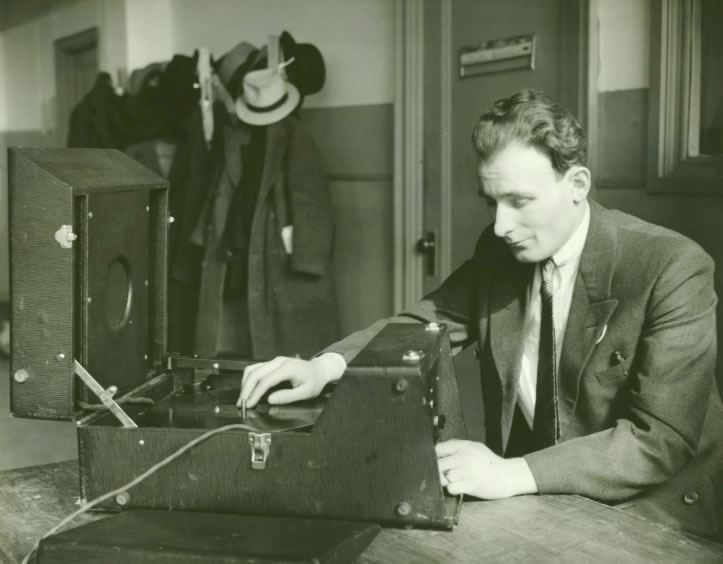
Credit
Talking Book Archives, American Foundation for the Blind
Licence
Historical Ephemera
Displayed for commentary, criticism, research and historical documentation where permitted by applicable law. No permission for reuse is granted.
Caption
A worker tests a talking-book machine before dispatch at the American Foundation for the Blind, circa 1937.