Library Hand
Script for Catalogue Cards
Forgotten Miscellaneous · 1887–1916
Archived on
Region
United States
Associated With
Library Bureau - publisher of the 1912 reprint
Defining Feature
Standardised, print-like handwriting for catalogue cards
Status
Historical event - documented library practice
Overview
Library hand was a prescribed writing style intended to make handwritten catalogue cards clear and uniform.
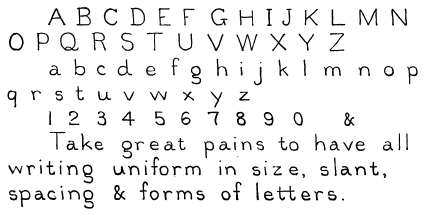
American manuals specified permanent ink, upright letters and consistent spacing, with letter sizes measured against the card’s rulings. Specimen alphabets demonstrated both joined and disjoined forms for cataloguing and other library records.
John Cotton Dana’s 1903 A Library Primer included these instructions. A 1912 Library Bureau handbook also set out library-handwriting rules, favouring the disjoined form for cataloguing because it resembled print.
Why It Mattered
A misplaced dot could affect where a catalogue entry belonged. Dana’s manual described a poorly dotted name being filed under the wrong spelling, connecting careful penmanship directly with finding information. The rules made handwriting a shared working tool: a card had to remain understandable to someone other than the person who wrote it.
Rules for the Written Card
- The 1912 Library Bureau rules named legibility as the main consideration and uniformity as vital among cataloguers in one library.
- Dana’s 1903 manual prescribed permanent non-copying ink, vertical letterforms, consistent spacing and an unshaded black line.
- Its instructions related the writing to measured rulings on standard catalogue cards.
Joined and Disjoined Forms
- The 1912 rules set out both joined and disjoined forms, with specimen alphabets and figures.
- Dana’s Chapter XVII likewise illustrated separate joined-hand and disjoined-hand alphabets.
- The 1912 rules described disjoined hand as the ideal form for cataloguing because it was more like print and more legible.
Manuals and Publication History
- The 1912 Library Handwriting section stated that it was revised from Library Notes, March 1887, pp. 273–282.
- John Cotton Dana included the related chapter “Ink and handwriting” in the 1903 third edition of A Library Primer.
- Library Notes, Volume 1, is catalogued as a Library Bureau publication from 1887, edited by Melvil Dewey.
Sources & Records
Melvil Dewey’s 1912 reprint directly sets out the requirements, materials, joined and disjoined forms, and identifies its library-handwriting section as revised from Library Notes, March 1887, 1:273–82.
A Library Primer, Third Edition
John Cotton Dana’s 1903 Chapter XVII gives the card-ruling measurements, spacing, ink and letterform rules, and includes joined- and disjoined-hand specimen alphabets.
Library Notes: Improved Methods and Labor-Savers for Librarians, Readers and Writers, Volume 1
Bibliographic record for Library Notes, Volume 1, edited by Melvil Dewey and published by the Library Bureau in 1887. It identifies the original volume cited by the later handwriting manuals; the catalogue page does not reproduce the handwriting article itself.
Edison’s Telegraphic Script Inspired “Library Hand”
Supplies archival references for Dewey’s October 1886 enquiry and Samuel Insull’s November 1886 reply, while presenting one interpretation of Edison’s relationship to library hand.
David Kaminski — Library Hand: Its History in the Context of American Handwriting and Typefaces
A historical research essay compares handwriting models, library records and published accounts. It examines Carrie F. Pierce’s reported role and questions a simple Edison–Dewey origin story, providing a contrasting interpretation of library hand’s development.
Gallery
Credit
John Cotton Dana / Library Bureau
Licence
The source records this image as public domain. No copyright licence is required for the photograph; other rights may apply.
Caption
Dana’s disjoined alphabet shows the clear, uniform lettering prescribed for handwritten library records.