Boeing X-40A
An Unpowered Testbed for Autonomous Spaceplane Landings
Forgotten Engineering · 1998–2001
Archived on
Region
United States
Associated With
Boeing - designer and builder
Defining Feature
Unpowered autonomous approach-and-landing demonstrator
Status
Preserved - displayed in the National Museum of the United States Air Force's Space Gallery
Overview
Boeing X-40A was an unpowered aircraft built to test autonomous spaceplane approaches and landings.
Built at Seal Beach for the Air Force Research Laboratory, it made its first free flight at Holloman in 1998.
NASA then flew seven approach-and-landing tests at Edwards in 2001, using Chinook tows before autonomous runway descents. The demonstrator is preserved in the National Museum of the United States Air Force’s Space Gallery.
Why It Mattered
X-40A isolated one part of spaceplane development: autonomous runway landing. Its unpowered flights gave the X-37 programme a testbed for approach-and-landing work, including a GPS/INS experiment that assessed differential-GPS navigation during those operations. Propulsion and re-entry remained outside its remit.
Flight-Test Role
- Boeing designed and built X-40A at Seal Beach, California, under contract with the Air Force Research Laboratory.
- Its first confirmed free flight took place at Holloman Air Force Base, New Mexico, on 11 August 1998.
- The vehicle had neither propulsion nor thermal-protection systems; its remit was autonomous approach-and-landing work rather than orbital or re-entry testing.
Edwards Descent Profile
- NASA conducted seven approach-and-landing tests at Dryden/Edwards in 2001, following the single 1998 flight.
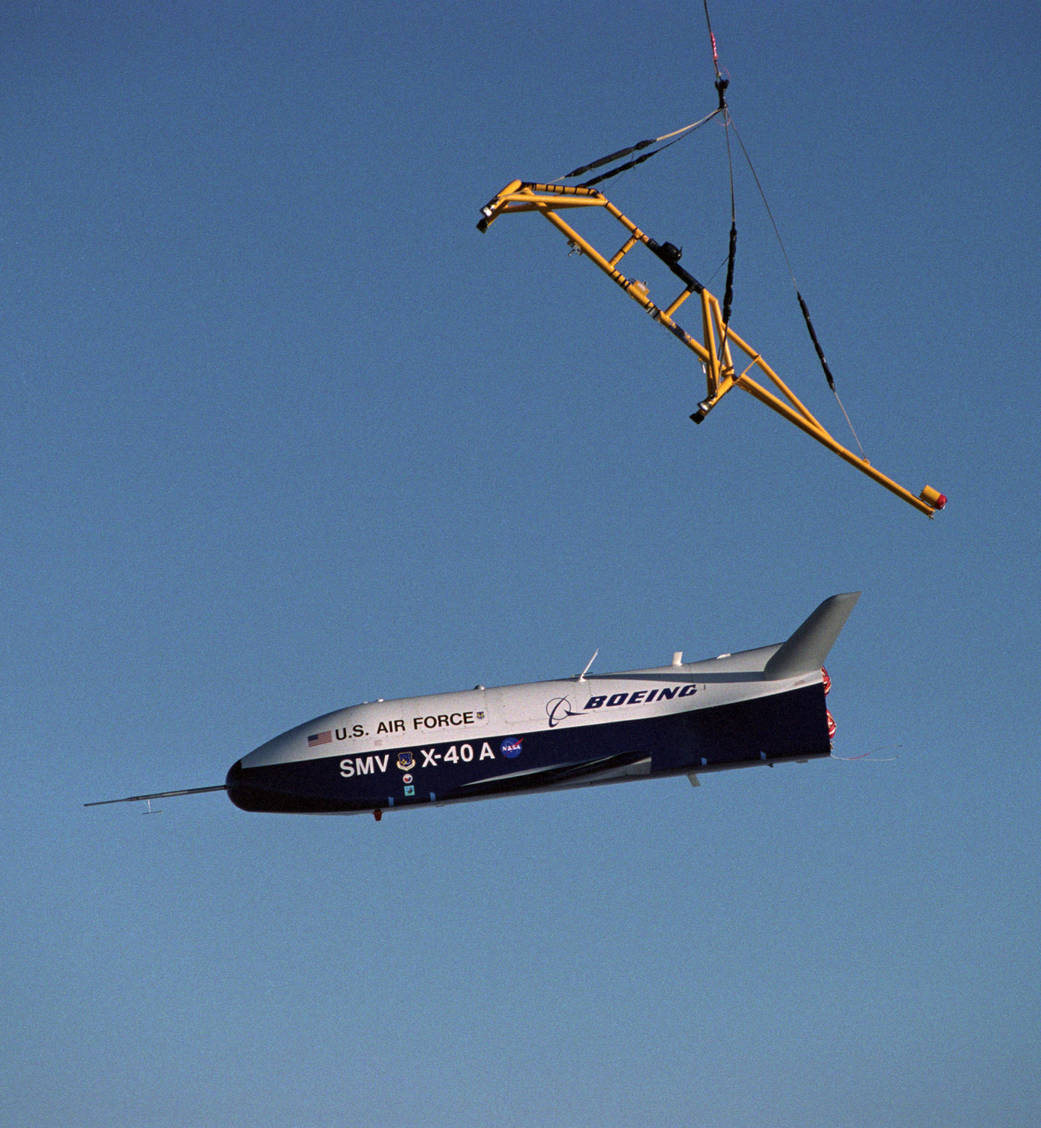
- A U.S. Army CH-47D Chinook towed X-40A to roughly 15,000 feet before release.
- After release, the vehicle made an autonomously controlled descent to Edwards' main runway in about 75 seconds.
Navigation Experiment and Final Record
- An X-37 Space Integrated GPS/INS experiment aboard X-40A characterised differential-GPS navigation during real approach-and-landing operations.
- JRF programme reports record a flight-computer freeze during a February 2001 captive-flight test and repeat-test requirements before the March captive flight.
- NASA's inventory lists 18 May 2001 as the last flight, while a later NASA Armstrong description dates the seventh free flight to 19 May; the precise endpoint remains unresolved.
- X-40A is preserved in the National Museum of the United States Air Force's Space Gallery.
Sources & Records
Boeing and U.S. Air Force Flight Test Space Maneuver Vehicle
Boeing's 1998 release identifies X-40A as the Phase 1 SMV test article, records its 11 August Holloman flight, and states its Seal Beach construction under AFRL contract.
X-40A Space Maneuvering Vehicle
NASA's aircraft history records one 1998 flight, seven 2001 Dryden approach-and-landing tests, Chinook release, 75-second descent, and the lack of propulsion or thermal protection.
Test Results for an Off-the-Shelf GPS/INS During Approach and Landing Testing of the X-40A
NASA technical preprint whose abstract describes the X-37 GPS/INS experiment aboard X-40A during approach-and-landing operations.
National Museum of the U.S. Air Force catalogue image identifying Boeing X-40A in the Space Gallery and crediting Ken LaRock.
NASA identifies EC01-0148-4 as X-40A Free Flight No. 5, dated 8 May 2001 and credited to NASA photographer Jim Ross.
Gallery
Credit
Jim Ross
Licence
The source records this image as public domain. No copyright licence is required for the photograph; other rights may apply.
Caption
NASA photographed X-40A Free Flight No. 5 at Edwards on 8 May 2001.