Austin Metro
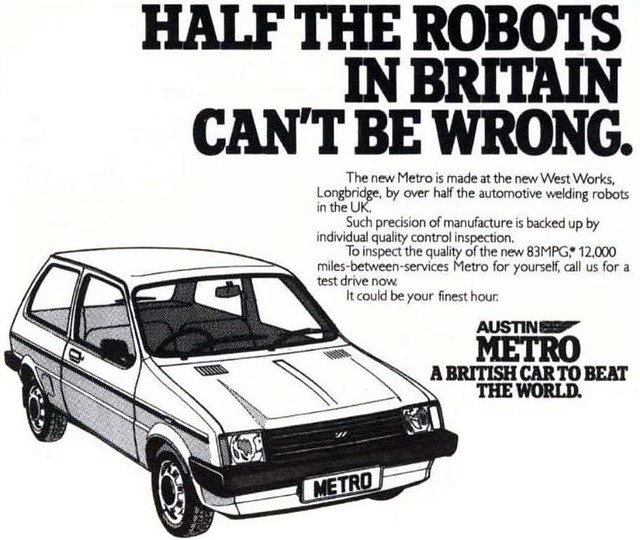
“A British Car to Beat the World”
Forgotten Vehicles & Transport · 1980
Archived on
Region
United Kingdom, Isle of Man and Europe
Associated With
British Leyland - developer and manufacturer
Defining Feature
British Leyland’s LC8 small-hatchback launch campaign, centred on “A British car to beat the World”
Status
Superseded
Overview
The Austin Metro arrived in 1980 as British Leyland’s answer to a new generation of European small cars.
Developed from the ADO88 Mini-replacement project into the LC8, the car was redesigned under David Bache. Its launch campaign set it against the Ford Fiesta, Renault 5, Fiat 127 and Volkswagen Polo, while a Kennings advert called it ‘the new Austin Metro’ and ‘A British car to beat the World’.
The launch included eight September 1980 trips from Liverpool to the Isle of Man, followed by European-export advertising in 1981. The car later wore Austin, MG and Rover badges before the Metro name was replaced by Rover 100 in December 1994.
Why It Mattered
The Metro made British Leyland’s industrial recovery part of the sales pitch. Months before launch, Adam Butler told Parliament that completing the Longbridge facilities and securing a sound market base were crucial to the company. The patriotic campaign translated those stakes for buyers, presenting the Metro as a British car capable of taking on established European rivals.
From ADO88 to LC8
- The Austin Mini Metro was British Leyland’s LC8 small hatchback, developed from the earlier ADO88 Mini-replacement project.
- The British Motor Museum identifies David Bache as leading the late redesign from ADO88 into LC8.
- Ford Fiesta, Renault 5, Fiat 127 and Volkswagen Polo were named in the campaign as rival small cars.
Selling a British Car
- The British Motor Museum attributes the launch advertising campaign to Leo Burnett.
- Its “A British car to beat the World” strapline formed part of marketing that the Museum says used patriotism and opposition to “foreign invaders”.
- A Kennings advertisement published on 16 October 1980 promoted “the new Austin Metro” with that same slogan.
Longbridge and the Corporate Plan
- In May 1980, Minister Adam Butler told the House of Commons that completing Metro facilities at Longbridge and securing a sound market base were crucial to British Leyland.
- Butler described British Leyland corporate-plan requirements of £430 million over later years and Sir Michael Edwardes’s £300 million request for 1980–81; neither figure was presented as a Metro-only cost.
Launch Activity and Later Renaming
- The British Motor Museum records eight Metro launch trips aboard MS Vistafjord from Liverpool to the Isle of Man in September 1980.
- The Museum also identifies an advertisement for the European export market in 1981, without establishing a country list or sales results.
- The Metro later carried Austin, MG and Rover badges before the Metro name was replaced by Rover 100 in December 1994.
Metadata context
- Status context: Superseded - Metro name replaced with Rover 100 in December 1994
Selected Sources
Metro Online — British Motor Museum anniversary exhibition
Later institutional account. The British Motor Museum traces the ADO88 and LC8 programmes, launch campaign, September 1980 activity and the December 1994 Rover 100 renaming.
Clitheroe Advertiser and Times — Kennings Austin Metro advertisement
16 October 1980 — Contemporary dealer advertisement. It calls the car “the new Austin Metro” and uses the line “A British car to beat the World”.
British Leyland 1980 Corporate Plan — House of Commons debate
16 May 1980 — Official parliamentary record. Adam Butler discusses British Leyland’s corporate plan, the Longbridge Metro facilities and the need for a sound market base.
Gallery
Credit
Scan: Jonathan / JON’s Cars and Adverts Corner (Flickr).
Licence
Historical Ephemera
Displayed for commentary, criticism, research and historical documentation where permitted by applicable law. No permission for reuse is granted.
Caption
Austin Metro advertising paired a British manufacturing message with the campaign’s “A British car to beat the world” line.