Sinclair C5
When pedal-cycle law met the visibility question
Forgotten Vehicles & Transport · 1985
Archived on
Region
United Kingdom
Associated With
Sinclair Vehicles - developer
Defining Feature
A low electric tricycle classed as an assisted pedal cycle
Status
Discontinued
Overview
The Sinclair C5 was a low, battery-assisted pedal tricycle launched in London in January 1985.
Its white recumbent body combined usable pedals with a 250-watt electric motor. The 1983 rules for qualifying electric tricycles limited weight, motor output and assisted speed; a ministerial answer said the C5 met those limits and the relevant requirements for brakes and lights.
Hoover assembled the C5 at Merthyr Tydfil. Its low riding position prompted visibility concerns from researchers and critics. Production stopped during 1985, and the renamed company entered voluntary liquidation in November.
Why It Mattered
A regulatory boundary became visible on the road. A compliant example could be ridden from age 14 without a driving licence, vehicle tax or compulsory motor insurance, yet those rules did not answer whether its low seat made it easy for other road users to see.
That distinction is the heart of the story. The C5 could satisfy the technical definition of an electrically assisted pedal tricycle while still provoking a separate argument about conspicuity and practical safety in traffic.
Pedal-Cycle Classification
- The Electrically Assisted Pedal Cycles Regulations 1983 came into operation on 12 August 1983, before the C5’s launch.
- A qualifying electrically assisted pedal tricycle needed pedals, a kerbside weight of no more than 60 kg, a motor of no more than 0.25 kW continuous rated output, and no motor propulsion above 15 mph.
- On 28 January 1985, a ministerial answer said the C5 met those limits and relevant brakes-and-lights requirements. That statement did not settle the separate question of road conspicuity.
Design, Launch and Manufacture
- Sir Clive Sinclair formed Sinclair Vehicles in March 1983. The C5 launched at Alexandra Palace in London on 10 January 1985.
- The launch catalogue credits Brian Spooner as designer. An institutional Coventry account places the design and development work in Coventry and at the University of Warwick Science Park.
- Hoover Limited made documented 1985 examples at Merthyr Tydfil. The C5 was Sinclair Vehicles’ only production model.
Visibility Concerns and Discontinuation
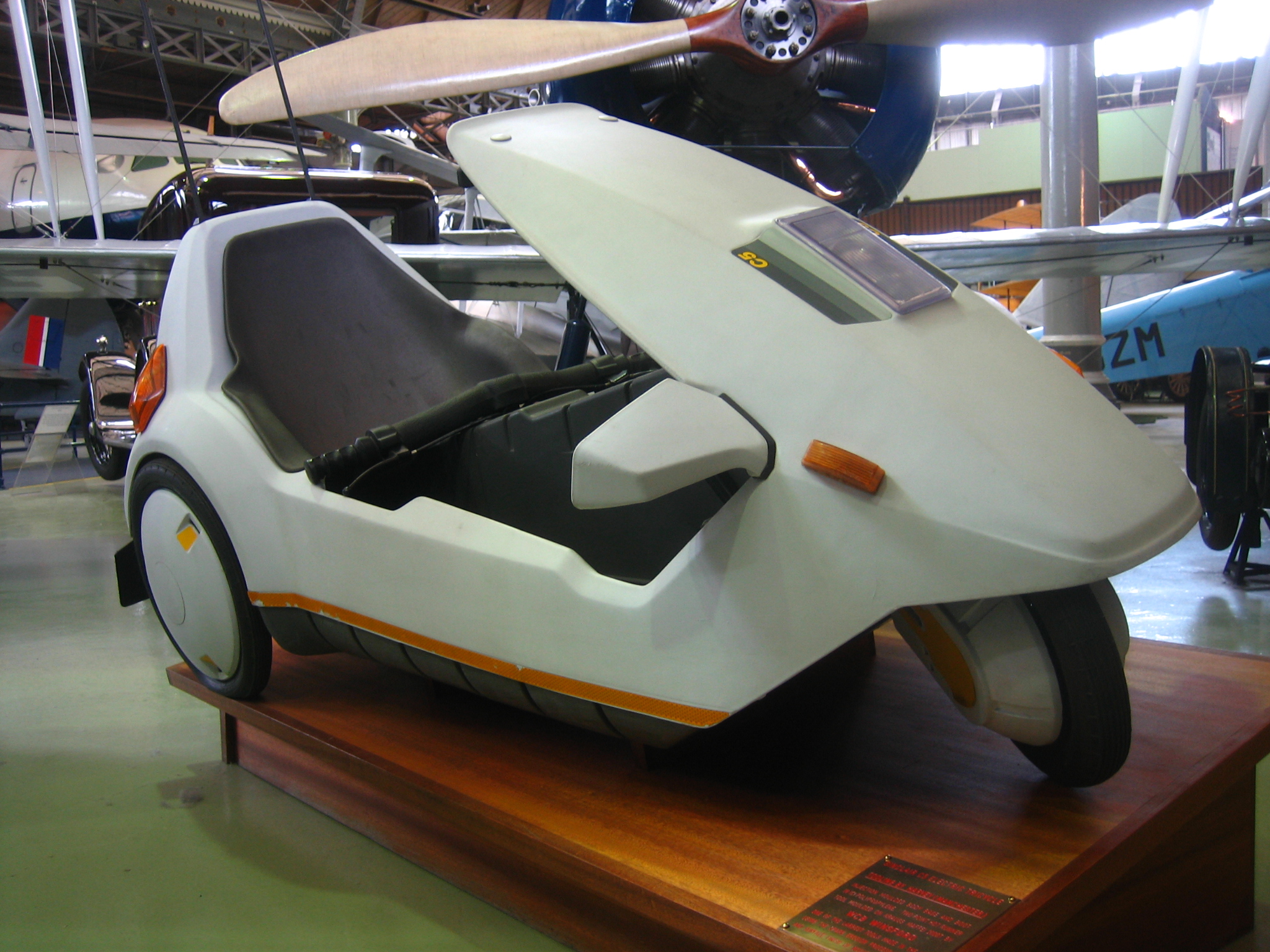
- The C5 used a low recumbent seating position, white bodywork, pedals and battery assistance. Its low height was central to the conspicuity concerns raised in 1985.
- TRL’s January 1985 report abstract identified problems arising from the vehicle’s low height, while a February ministerial answer noted its white bodywork and rear lamp.
- Production stopped in 1985. Sinclair Vehicles became TPD Ltd in September; TPD entered receivership on 15 October and voluntary liquidation on 4 November.
- Examples survive in the Science Museum Group and Amgueddfa Cymru – Museum Wales collections.
Selected Sources
The Electrically Assisted Pedal Cycles Regulations 1983
1983 — Primary legal record. Sets the qualifying pedal, weight, motor-output and motor-propulsion limits for electrically assisted tricycles; it came into force on 12 August 1983.
Sinclair C5 — Written Answer, House of Commons, 28 January 1985
28 January 1985 — Primary parliamentary record. Gives the ministerial statement that the C5 met the statutory limits and relevant brakes-and-lights requirements; this is not an empirical safety approval.
Safety aspects of the Sinclair C5 electrically assisted pedal tricycle
January 1985 — Primary report abstract. Identifies problems arising from the C5’s low height while comparing its daylight conspicuity with pedal cycles.
Gallery
Credit
Jeremy Keith (adactio)
Caption
A preserved Sinclair C5 shows the low seat, pedals and compact three-wheel body that put its road visibility under scrutiny in 1985.