BIGFON
When fibre carried sign language
Forgotten Engineering · 1983–1989
Archived on
Region
Germany — Hamburg, Hannover and Berlin
Associated With
Deutsche Bundespost - national telecommunications authority
Defining Feature
A fibre-network trial that included videophone research with deaf households
Status
Ended
Overview
BIGFON tested how one fibre network could carry calls, television, data and eventually video communication.
Contemporary plans described seven local networks combining telephone, television, radio, facsimile and data. In 1983, work began on fibre-trunk sections between Hamburg and Hannover; a trade report described 60 fibres at 140 Mbit/s each and planned video transmission for BIGFON services. Those records document plans and construction, not proof that every proposed service reached users.
The most human chapter came later. A Museum für Kommunikation Berlin account, citing a 1992 research report, says 17 Berlin households with deaf residents received videophones in 1989. The retained evidence does not establish BIGFON’s precise overall end date or programme-wide results.
Why It Mattered
The Berlin study turned fibre capacity into a question of access. Sign language depends on visible movement, so a video link could offer something a voice-only telephone could not: a conversation in the users’ own language.
BIGFON therefore belongs to both broadband history and disability history. The same network promoted for broadcasting, business and domestic communication was also tested against a specific human need. Its significance lies in that practical experiment—not in claiming that every ambitious service plan was completed, or that BIGFON was the world’s first such system.
Seven proposed local networks
- A 1985 publication described seven preliminary BIGFON networks and a planned 1984–1987 trial phase.
- The proposed mix included telephone, television, radio, facsimile and data; the timetable was a plan rather than confirmation of complete deployment.
Hamburg–Hannover construction
- A September 1983 report described initial trunk construction using 60 fibres rated at 140 Mbit/s each.
- The same report said video transmission was planned for BIGFON broadband services in Hamburg and Hannover.
Videophones in Berlin
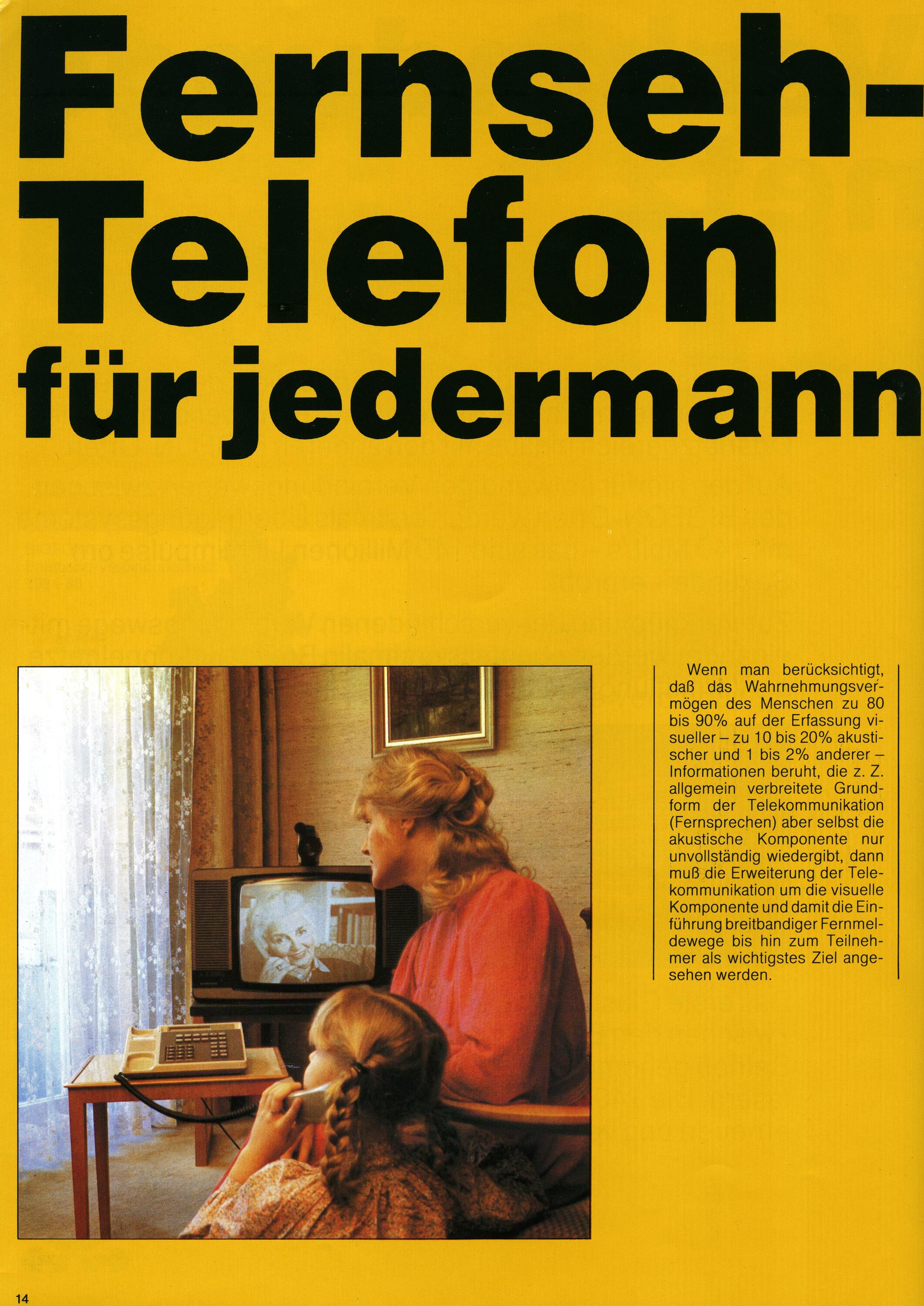
- A 1983 Bundespost brochure promoted private video telephony using a television, auxiliary camera and telephone.
- A later museum account says 17 Berlin households with deaf residents received videophones in 1989 for accompanying research.
- The exact overall end date and programme-wide outcome are not established by the retained sources.
Selected Sources
The fibre — a new technology revolutionises telecommunications — BIGFON
November 1983 — Museum catalogue record for Deutsche Bundespost's contemporary BIGFON brochure and its proposal for private video telephony using a television, camera and telephone.
Bundespost begins construction of the long-distance network
9 September 1983 — Contemporary report on initial Hamburg–Hannover fibre construction and planned video transmission for BIGFON services.
Accessible telephony? — BIGFON and sign-language video communication
2024 — Later museum account saying 17 Berlin households with deaf residents received videophones in 1989, while citing a 1992 final research report.
Gallery
Credit
Deutsche Bundespost brochure; Museumsstiftung Post und Telekommunikation / photo Matthias Lieb
Licence
Historical Ephemera
Displayed for commentary, criticism, research and historical documentation where permitted by applicable law. No permission for reuse is granted.
Caption
A 1983 Deutsche Bundespost BIGFON brochure presented private video telephony through a television, auxiliary camera and telephone.