Datel
A Post Office Connection for Computer Data
Forgotten Engineering · 1964–1966
Archived on
Region
United Kingdom
Associated With
Post Office - public telecommunications provider
Defining Feature
Data transmission over public telex and telephone systems
Status
Unknown - later service outcome not established
Overview
Datel was a family of British Post Office services for transmitting data over telex and telephone networks.
Datel 100 used public telex, while Datel 600 used the public telephone system. Customers could rent connection equipment and use private circuits for higher speeds, giving remote machines several ways to exchange data.
In December 1964, the Post Office announced Datel 600 for January 1965. By June 1966, it confirmed that Datel 100 and 600 were operating, with Datel 200 and 300 still planned. The statements document expansion, without establishing when the wider service family ended.
Why It Mattered
Connecting computers involved more than carrying signals between sites. In December 1964, the Post Office offered a rented error-detection unit for Datel 100, addressing the reliability of the data arriving at the other end. Datel combined transmission facilities, connection equipment and checks on accuracy within a public telecommunications service.
Public Systems and Private Circuits
- Datel 100 operated over the public telex system at up to 50 bits per second.
- Datel 600 operated over the public telephone system at up to 600 bits per second.
- Rented private circuits could provide up to twice those respective rates; facilities over improved rented telephone circuits reached up to 2,000 bits per second.
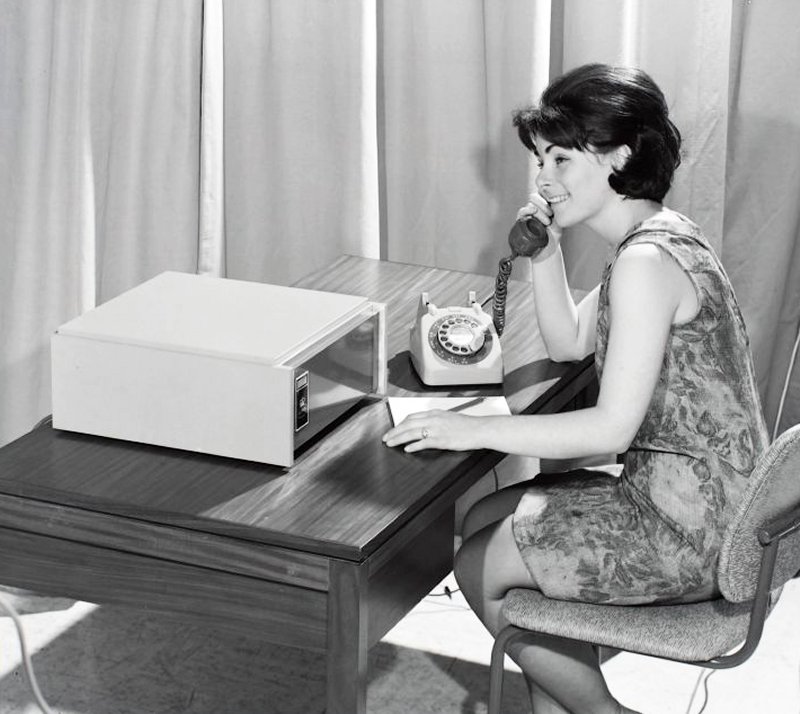
The Datel Modem No. 1A
- The Modem No. 1A converted Datel 600 binary direct-current signals for voice-frequency equipment on public telephone lines or private circuits.
- The July 1966 engineering article describes a free-standing metal cabinet with a two-tone-grey finish.
- Its Figure 3 shows the modem with an associated 700-type telephone.
Plans, Measurements and Later Services
- The December 1964 announcement measured proposed arrangements in characters per second, while the June 1966 statement reported operating-service speeds in bits per second.
- The 1964 statement proposed Datel 2000 provision over specially engineered, high-quality leased telephone circuits.
- In June 1966, Datel 200 and 300 were intended for later introduction; the published statements give no withdrawal date for the Datel family.
Sources & Records
Computers — HC Deb 17 December 1964 vol 704 c150W
Records the December 1964 announcement: the Datel 100 error-detection unit, planned January 1965 Datel 600 equipment rentals, and proposed Datel 2000 high-quality leased-circuit provision.
Datel Services — HC Deb 28 June 1966 vol 730 cc222–223W
States which services were operating in June 1966, their public-system and rented-private-circuit bit rates, and the separately planned Datel 200 and 300 services.
Explains the Datel Modem No. 1A’s conversion of binary signals for telephone-type circuits and includes a period photograph captioned “Datel Modem No. 1A with 700-type telephone”.
Modem 1A, by Plessey, 1964 — Object 2004-183
The catalogue records a 1964 Plessey Modem 1A, object 2004-183, credited to BT Group plc. Its title does not explicitly identify it as Datel. The museum photograph has a non-commercial CC BY-NC-SA licence; that image is not used here.
Gallery
Credit
General Post Office / British Telephones archive
Licence
Historical Ephemera
Displayed for commentary, criticism, research and historical documentation where permitted by applicable law. No permission for reuse is granted.
Caption
A Datel Modem No. 1C beside an office telephone in a marketing photograph.