DYMO Labelmakers
Raised Letters at a Squeeze
Forgotten Engineering · 1958–1964
Archived on
Region
United States; Belgium; Canada
Associated With
Dymo Industries - manufacturer
Defining Feature
Raised white lettering embossed into coloured self-sticking plastic tape
Status
Unknown - formal discontinuation date not established
Overview
Early DYMO hand-operated labelmakers pressed raised white letters into coloured, self-sticking plastic tape.
Users selected a character on a dial, squeezed the handle and advanced the tape to build a word. A cutter separated the finished strip, and peeling away its backing exposed the adhesive for fixing it in place.
Patent filings from 1958 onward document the tape and successive tool mechanisms. By June 1961, a Tapewriter advertisement offered golf shops a system for making personalised name labels for customers’ purchases.
Why It Mattered
The tool let a shop produce a customer’s name at the point of sale, with the lettering and adhesive backing already combined in one strip. DYMO’s 1961 advertisement promoted this as a personalisation service for golf-shop purchases. It gives the familiar embossed lettering a documented commercial setting, alongside the mechanical and material developments recorded in the patents.
Tape, Type and Adhesive
- U.S. Patent 3,036,945, filed in 1958, describes plastic tape engineered to reveal contrasting lettering when cold-embossed.
- The tape assembly used pressure-sensitive adhesive and a removable backing layer.
- The patent concerns tape construction rather than a named Model 1040 labelmaker.
The Hand-Operated Process
- A patent filed in 1959 by David W. Souza describes selectable letter and number dies, handle operation, tape movement and a cutting device.
- A June 1961 Tapewriter advertisement told users to load DYMO tape, dial a name and produce raised white letters on coloured self-sticking plastic.
Related Devices and the Model 1040
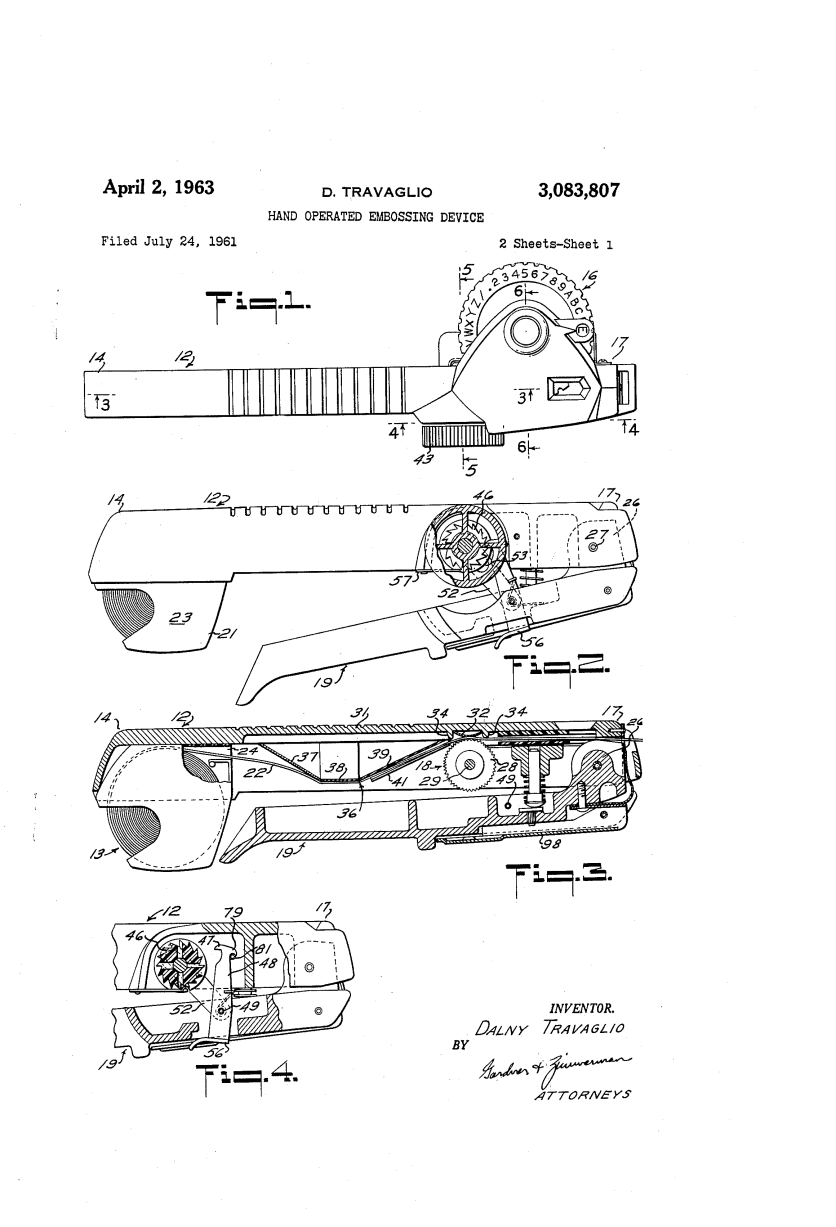
- Dalny Travaglio’s compact-device patent, filed in 1961 and granted in 1963, describes a tape magazine, embossing dies, feed arrangement and transverse cut-off mechanism.
- The approved illustration is the first drawing sheet from Travaglio’s patent, granted in April 1963 and assigned to Dymo Industries.
- The patent drawing documents a claimed mechanism, not a verified retail-model identity or launch date.
Sources & Records
Embossable Plastic Assembly — U.S. Patent 3,036,945
Names David W. Souza and Dymo Industries, records the 27 October 1958 filing, and describes contrast-colour embossing tape with adhesive and removable backing.
Hand Operated Embossing Tool — U.S. Patent 3,006,451
Documents Souza’s 27 April 1959 hand-operated tool, including a handle-actuated embossing action and a tape-feed arrangement allowing advance and retraction.
Hand Operated Embossing Device — U.S. Patent 3,083,807
Records Dalny Travaglio’s 24 July 1961 filing for a compact tool with tape magazine, embossing dies, feed mechanism and cut-off mechanism.
Sales Grow When You Personalize with Tapewriter, Golfdom, June 1961
June 1961 Golfdom, printed page47/PDFpage7, advertises raised white letters on coloured self-sticking tape and on-the-spot name labels for golf-shop purchases.
Corporations: Dial for Success
Reports that David Souza brought a hand-operated adhesive-tape label device to Rudolph Hurwich in 1958 and that Hurwich formed Dymo Industries to produce it.
Benjamin H. Stansbury Papers, NMAH.AC.1350
The institutional finding aid lists Dymo product literature, reports and label samples in Series3; PDFpage11/printedpage9. This verifies holdings, not the contents of uninspected archival items.
Gallery
Credit
Dalny Travaglio / Dymo Industries Inc.
Licence
Historical Ephemera
Displayed for commentary, criticism, research and historical documentation where permitted by applicable law. No permission for reuse is granted.
Caption
Travaglio’s 1963 patent drawing shows how a hand-operated tool selected, embossed and advanced the tape.