Mattel Power Glove
Motion control before it was ready
Forgotten Games · 1989
Archived on
Region
United States; Japan
Associated With
Mattel, Abrams-Gentile Entertainment and Nintendo - maker, licensor and platform owner
Defining Feature
A wearable NES controller using flex and ultrasonic sensors
Status
Discontinued
Overview
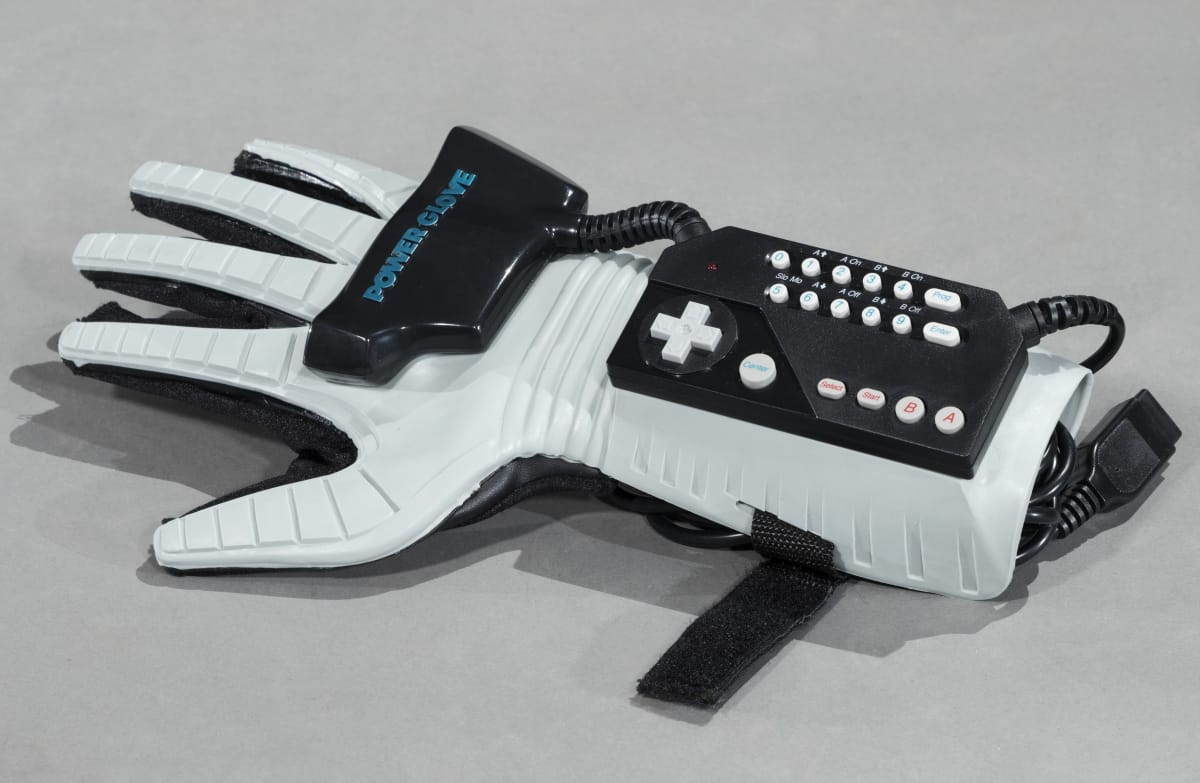
The Power Glove promised to put NES control on the player's hand, but its own manual began with calibration.
Mattel released the Nintendo-licensed controller in 1989. Flex sensors measured bends in four fingers, while two ultrasonic transmitters on the glove worked with three receivers mounted around the television to track hand position and orientation.
The glove still carried a D-pad, A and B buttons, and a programmable keypad. Players had to mount the receiver frame, centre the glove and select or enter control programmes before movement could be translated into NES commands. Packaging nevertheless promised 'hand-controlled on-screen action' and compatibility with most Nintendo games.
Why It Mattered
Hand tracking moved from specialist data gloves into an affordable games accessory. That was a substantial change of setting: hand tracking left the laboratory and arrived beside an ordinary television and console.
Its compromises are equally revealing. Calibration, coarse finger readings and programmed button mappings show how difficult it was to turn free hand movement into the precise inputs expected by existing NES games. The glove matters as a consumer experiment in embodied control—not because it made conventional controllers obsolete.
How the glove read movement
- Four flex sensors registered finger bending.
- Two glove-mounted ultrasonic transmitters worked with three television-mounted receivers to locate the hand.
Why setup mattered
- The receiver frame had to be mounted and the glove centred before play.
- Game actions could be selected or programmed through the forearm keypad; conventional NES buttons remained available.
Patent lineage and product reality
- US4988981A documents VPL glove-computing techniques and names Thomas Zimmerman and Jaron Lanier as inventors.
- The patent does not prove that Mattel implemented every described embodiment, so the consumer product is described from its own manual and museum objects.
Selected Sources
1989 — Mattel instructions for sensors, centring, programming, controls and troubleshooting.
Computer Data Entry and Manipulation Apparatus and Method (US4988981A)
1987–1991 — VPL patent record for flex sensing and ultrasonic glove tracking; technical lineage rather than a Mattel product specification.
1989 — Museum object and packaging record identifying Mattel, Nintendo licensing, ultrasonic sensors and programmable controls.
Gallery
Credit
From the Collections of The Henry Ford
Licence
Historical Ephemera
Displayed for commentary, criticism, research and historical documentation where permitted by applicable law. No permission for reuse is granted.
Caption
Mattel's 1989 Power Glove combined a wearable controller with a keypad and motion-sensing hardware for the NES.