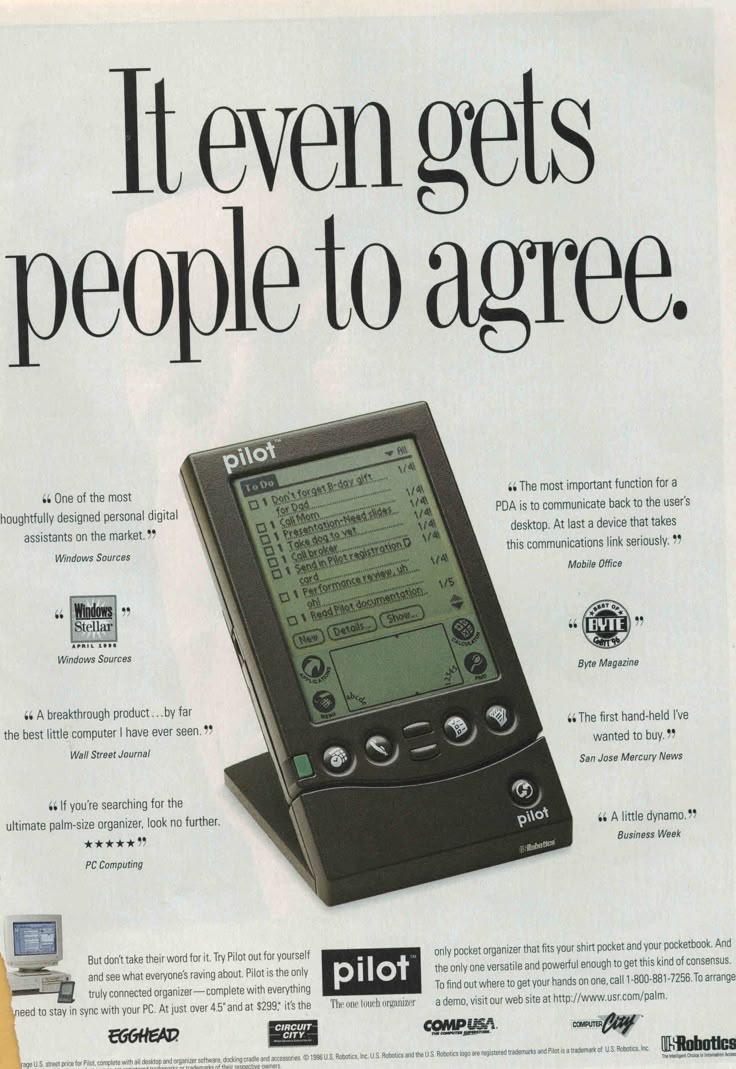
The PalmPilot arrived in 1996 as a pocket-sized organiser built around the information people needed every day. Contacts, appointments, tasks and notes travelled with the user, then synchronised with a desktop computer when the device was placed in its cradle. Its focused design helped Palm sell around one million units in the first 18 months.
Why It Mattered
The PalmPilot made digital organisation feel quicker than carrying a paper diary and more practical than opening a laptop. Its combination of a touch screen, handwriting input and dependable desktop syncing established the shape of the personal digital assistant.
Personal information
- The PalmPilot tracked contacts, notes, to-do items and events.
- It supported specialised applications on a general-purpose handheld computer.
Desktop connection
- An included cradle synchronised information with a desktop computer.
- The physical design was small enough for a shirt pocket.
Early adoption
- A 1996 U.S. Robotics advertisement survives in the Computer History Museum.
- The museum records about one million PalmPilots sold in the first 18 months.
Associated With
Palm Computing Division of U.S. Robotics - creator or operator
Defining Feature
A shirt-pocket handheld that synchronised personal data with a desktop computer
Status
Preserved - Original PalmPilot hardware is preserved in institutional collections
- All one image sources are not yet verified — editorial review required.
Rights Notice
Images are included for historical and archival reference.
Rights holders may contact Forgotten Archive through the publishing account to request a credit correction or removal.
Palm Pilot advertising artwork; reproduced via Marc Leff / LinkedIn; scan contributor unknown.
Licence
Historical Ephemera
Displayed for commentary and research. Fair dealing under the UK CDPA 1988 applies only where its conditions are met. No permission for reuse is granted.
Caption
Palm's claim that its organiser could 'get people to agree' highlights synchronisation: the handheld's usefulness depended on keeping personal information consistent with a computer.