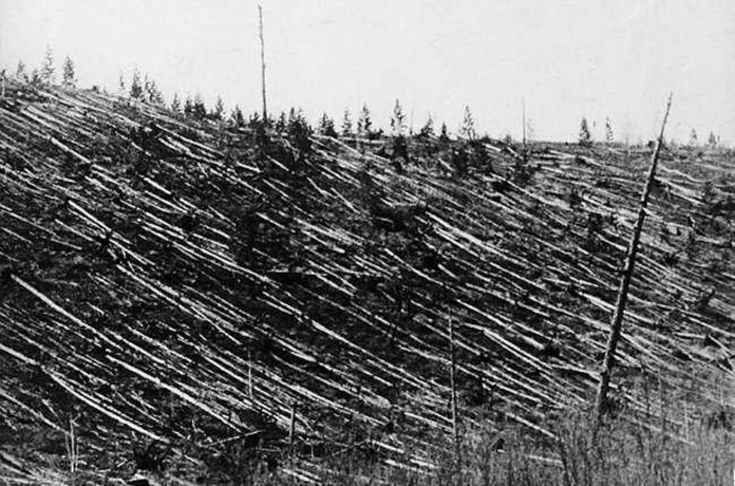
On 30 June 1908, a cosmic object exploded high above a remote part of Siberia. The blast flattened an immense area of forest, while witnesses described a fireball, heat and a shock powerful enough to be felt far beyond the site. The first scientific expedition did not reach the devastated landscape until 1927.
Why It Mattered
Tunguska showed that an object from space did not need to strike the ground to cause destruction on a vast scale. Its missing crater was once part of the mystery; today, the airburst is a central example of why asteroid detection and planetary defence matter.
Airburst
- NASA describes an asteroid entering the atmosphere and exploding above Siberia.
- ESA describes Tunguska as the largest asteroid impact in recorded history.
- The resulting shock wave and thermal radiation match the reported forest damage.
Evidence on the ground
- Trees near the centre remained standing but stripped, while a much wider area was flattened.
- Leonid Kulik reached the site in 1927, 19 years after the event.
Interpretation
- Later fieldwork mapped the destruction and supported a mid-air explosion.
- NASA notes that no recovered fragments have been conclusively tied to the blast.
Associated With
Natural event - associated person or organisation
Defining Feature
An atmospheric explosion that flattened and burned forest without a confirmed impact crater
Status
Unresolved - Explained principally as an asteroid airburst; exact physical parameters remain uncertain
- All one image sources are not yet verified — editorial review required.
Rights Notice
Images are included for historical and archival reference.
Rights holders may contact Forgotten Archive through the publishing account to request a credit correction or removal.
Leonid Kulik; reproduced in Duane Hamacher's research figure
Licence
Historical Ephemera
Displayed for commentary and research. Fair dealing under the UK CDPA 1988 applies only where its conditions are met. No permission for reuse is granted.
Caption
Leonid Kulik's photograph records flattened trees nineteen years after the Tunguska blast, showing the long-lived physical evidence that investigators encountered in the forest.