LimeWire

Forgotten Internet · 2000–2010

Published

LimeWire was a Java-based desktop file-sharing client released by Lime Wire LLC in August 2000. It searched the decentralised Gnutella network, allowing users to find files advertised by participating computers and transfer them directly from peers. It became a major part of 2000s internet culture, but its unauthenticated search results also exposed users to mislabelled files, commercial decoys, corrupt content and malware, particularly through disguised executables and archives. United States litigation culminated in a permanent injunction on 26 October 2010, ending official distribution and support. The business that revived the LimeWire name in 2022 is separate and has no founder continuity.

Why It Mattered

Its significance lay in bringing decentralised file sharing to a vast mainstream audience while making the risks of peer-supplied content unusually visible. Users had to judge filenames, formats, sizes and source counts without any guarantee that a result was authentic, complete or safe. That combination of convenience and uncertainty made LimeWire an enduring symbol of the peer-to-peer era: a place where downloading could feel part search engine, part guesswork and part risk assessment. It also became a major test case in the legal struggle over software associated with large-scale copyright infringement.

Origins and Development

- Lime Wire LLC was founded in June 2000 and released the relevant LimeWire client in August 2000. - Mark Gorton founded and directed the company, while Chris Rohrs was hired to write the first software version. - Early development also involved Greg Bildson, Adam Fisk, Sumeet Thadani, Rob Soule, Anurag Singla and Tarun Kapoor.

Gnutella Search and Transfer

- Search queries travelled through connected Gnutella peers rather than a LimeWire-owned media catalogue. - Later versions used leaf clients and higher-capacity ultrapeers to route queries and return matching results. - Selected data transferred directly from one or more sharing computers.

False Results, Malware and Closure

- Peer-supplied descriptors were unauthenticated, and results included mislabelled, corrupt, duplicated and deliberately spoofed files. - A 45-day 2006 study found malware in 68 percent of downloadable responses within selected executable, archive and Microsoft Office categories, not across all LimeWire files or MP3 recordings. - The permanent injunction entered on 26 October 2010 required Lime Wire to halt official distribution and support and disable functions under its control.

Associated With

Lime Wire LLC - historical operator; Mark Gorton - founder; Greg Bildson - founding CTO/COO; Chris Rohrs - original developer

Defining Feature

Java-based file sharing across the decentralised Gnutella network

Status

Discontinued - official distribution and support ended under injunction on 26 October 2010

Primary Records

- **Arista Records LLC et al. v. Lime Group LLC et al. — Opinion and Order** - **Defendants' Rule 56 Statement** - **LimeWire: Beginnings — Greg Bildson** - **Permanent Injunction, 26 October 2010**

Image Sources

- **Image 1** - **Image 2** - **Image 3** - **Image 4** - **Image 5**

Rights Notice

Images are included for historical and archival reference. Rights holders may contact Forgotten Archive through the publishing account to request a credit correction or removal.

Gallery

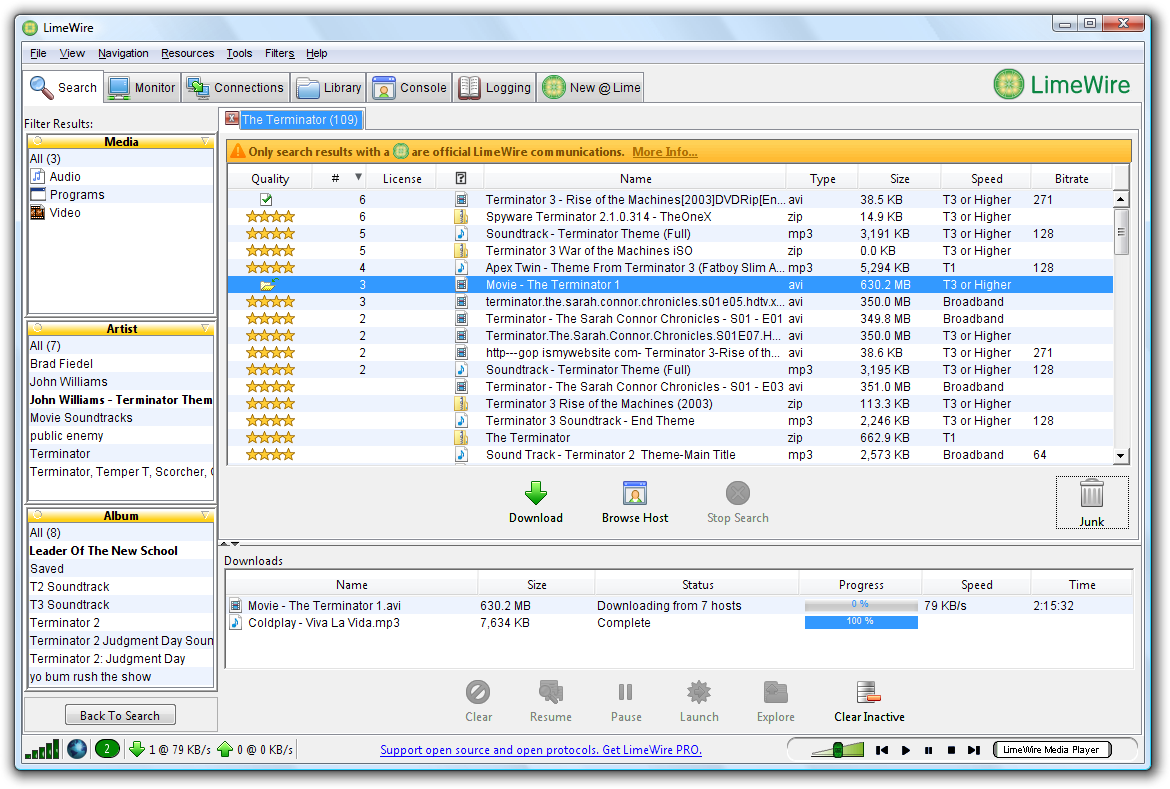
LimeWire desktop application window showing search results for “The Terminator,” media filters, file names and sizes, download controls, two download entries, and the green LimeWire logo.
Source
Credit

Navy Blue (formerly iDosh; en.wikipedia user Sanchmarc), via Wikimedia Commons; GPL-2.0-or-later

Licence

GPL-2.0-or-later

This screenshot is recorded under this licence. Consult the original source for its terms and attribution.

Caption

LimeWire’s search-and-download window brought file discovery and transfer into a single desktop interface.
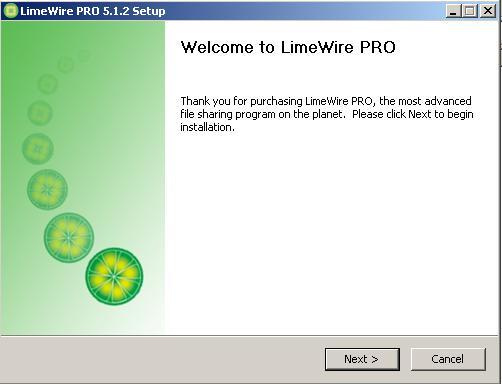
LimeWire PRO 5.1.2 Setup window with a green panel of lime-slice graphics, the heading “Welcome to LimeWire PRO,” installation text, and Next and Cancel buttons.
Source
Credit

Lime Wire LLC software interface; screenshot supplied via Software Informer

Licence

Historical Ephemera

Displayed for commentary and research. Fair dealing under the UK CDPA 1988 applies only where its conditions are met. No permission for reuse is granted.

Caption

LimeWire PRO's installer presented file-sharing software as an ordinary desktop application, with a branded welcome screen and a familiar setup sequence.
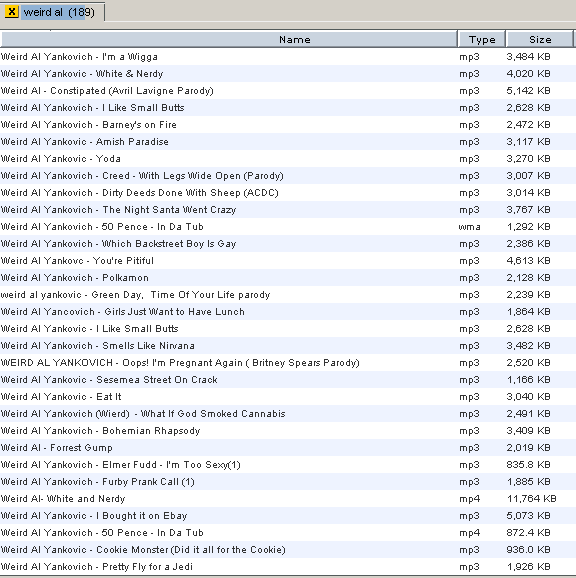
Search-results table for “weird al” listing 189 audio files, with columns for file name, type, and size and alternating pale blue rows.
Source
Credit

Gromreaper; revised by Sceptre; transferred by IngerAlHaosului, via Wikimedia Commons; GPL-2.0-or-later

Licence

GPL-2.0-or-later

This screenshot is recorded under this licence. Consult the original source for its terms and attribution.

Caption

A long list of Weird Al search results shows the abundance—and ambiguity—users encountered on a peer-to-peer network.
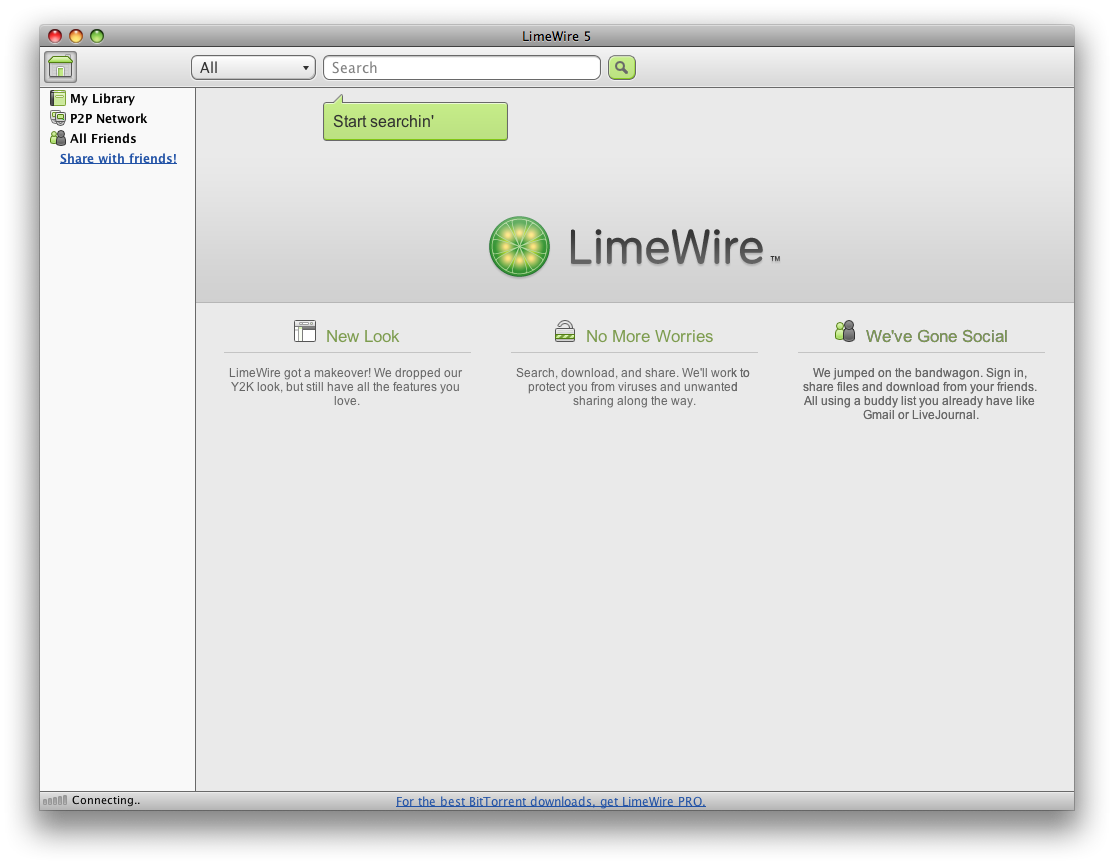
LimeWire 5 window on a black background with a search bar, navigation links for My Library, P2P Network, and All Friends, a large LimeWire logo, and panels titled “New Look,” “No More Worries,” and “We’ve Gone Social.”
Source
Credit

Cormier6083; transferred by IngerAlHaosului, via Wikimedia Commons; GPL-2.0

Licence

GPL-2.0

This screenshot is recorded under this licence. Consult the original source for its terms and attribution.

Caption

LimeWire 5’s redesigned library shows the later attempt to organise shared media in a cleaner desktop application.
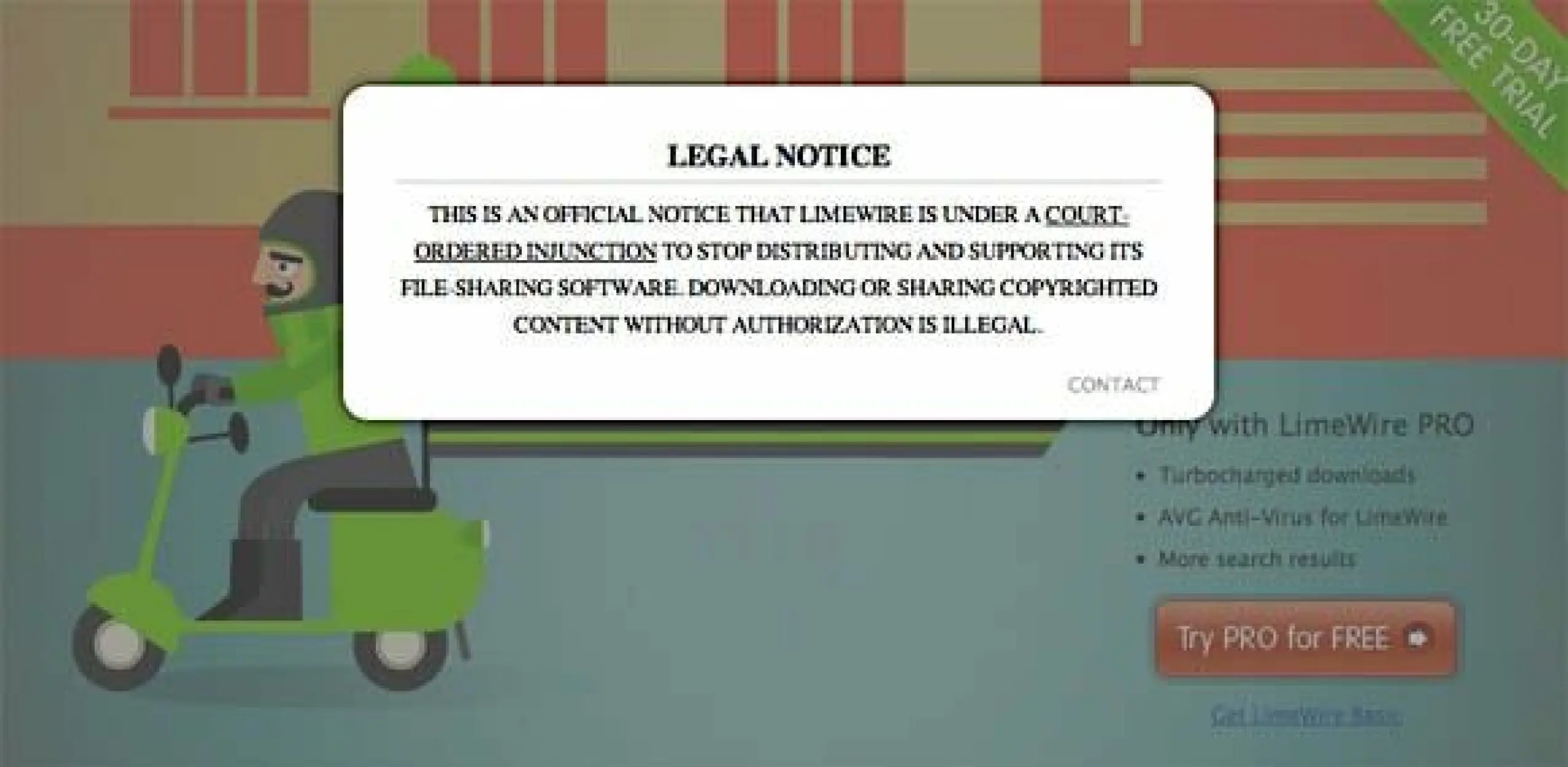
Dimmed LimeWire webpage with a centered legal-notice box stating that LimeWire is under a court-ordered injunction to stop distributing and supporting its file-sharing software; a cartoon scooter rider and a “Try PRO for FREE” button remain visible behind it.
Source
Credit

Lime Wire LLC website notice; screenshot reproduced by The Register

Licence

Historical Ephemera

Displayed for commentary and research. Fair dealing under the UK CDPA 1988 applies only where its conditions are met. No permission for reuse is granted.

Caption

The court-ordered notice on LimeWire's website marked the interruption of its official distribution, turning a familiar download page into a legal warning.