Genetically Modified Tomato Purée
Forgotten Food & Drinks · 1996–1999
Published
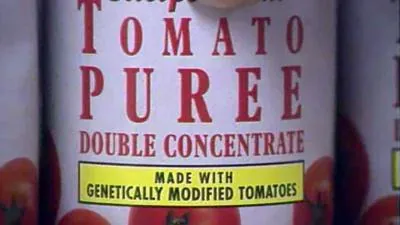
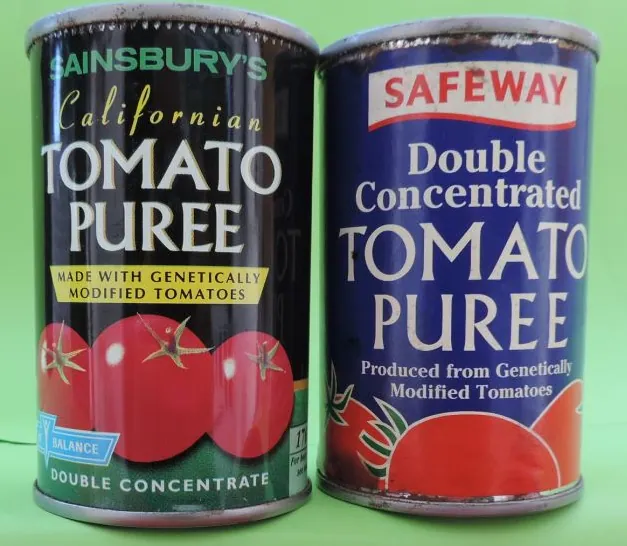
Sainsbury’s and Safeway sold clearly labelled GM tomato purées in Britain.
From 5 February 1996, shoppers in selected stores saw separate Sainsbury’s and Safeway tins openly marked as made with genetically modified tomatoes. These were processed purées, not fresh GM tomatoes, and conventional alternatives sat beside them. The modified processing tomatoes remained firmer and retained more pectin, helping manufacturers produce a thicker purée with a better yield. Early sales were strong, but demand later declined amid growing opposition to GM ingredients. Sainsbury’s stopped replenishing its product in 1999.
Why It Mattered
The prominent wording turned an emerging food technology into a choice shoppers could see and compare. A House of Commons committee later reported that the GM purée initially outsold its conventional equivalent by about two to one, showing that clearly declared genetic modification did not immediately deter buyers.
Its short lifespan also revealed how quickly public trust could reshape the reception of a new food technology. Value and clear labelling helped the products find an early market, but they did not settle the wider argument over GM ingredients, cultivation and food production.
How the Tomatoes Were Modified
- The modification reduced production of polygalacturonase, an enzyme involved in breaking down pectin during ripening.
- The processing tomatoes consequently remained firmer and retained more pectin.
- The retained pectin improved processing yield and produced a thicker purée.
- The products were unrelated to Calgene’s American Flavr Savr fresh tomato.
Packaging, Pricing and Retail Presentation
- Sainsbury’s and Safeway used separate own-brand packaging rather than a shared product line.
- Safeway described a 170g tin sold for the price of a 142g conventional tin; reporting at the time gave the price as 29p.
- The retailers supported the tins with shelf notices, leaflets or customer-information services.
- Photographs show more than one Sainsbury’s label design.
Sales, Withdrawal and Preservation
- Safeway reported selling more than 600,000 cans by June 1998.
- Sainsbury’s said demand weakened during late 1998 and ended supply at the close of June 1999.
- Don Grierson also cited the failure to obtain European cultivation clearance.
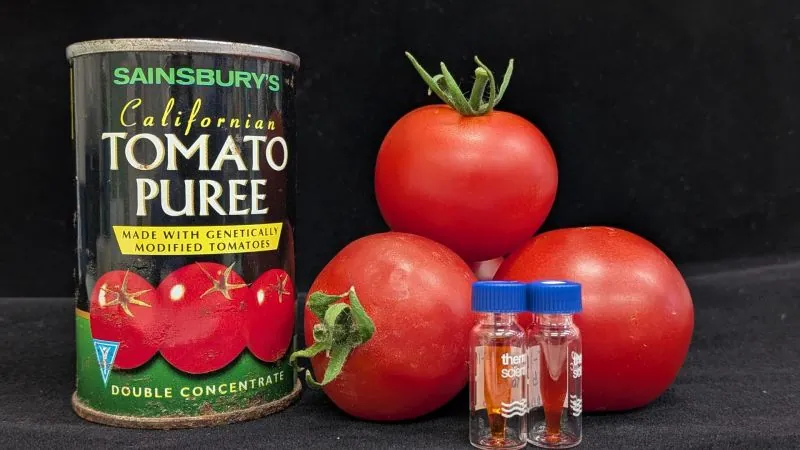
- An original 1996 Sainsbury’s can appeared in the Science Museum’s Future of Food exhibition in 2025–26.
Associated With
Sainsbury’s - retailer; Safeway - retailer; Zeneca Agrochemicals - commercial developer; Professor Don Grierson and the University of Nottingham - research
Defining Feature
Own-brand tomato purées prominently labelled “made with genetically modified tomatoes”
Status
Sainsbury’s supply ended in June 1999
Primary Records
- Memorandum submitted by J Sainsbury plc, 15 November 1999
- Memorandum by Safeway Stores plc
- Press release by Nottingham University, 4 June 1998
- Scientific Committee on Plants: Zeneca TGT7F opinion, 23 June 1998 · Archived copy
- Genetically Modified Foods: UK written answer, 14 June 1999 · Archived copy
Image Sources
Rights Notice
Images are included for historical and archival reference.
Rights holders may contact Forgotten Archive through the publishing account to request a credit correction or removal.
Gallery
Credit
BBC
Licence
Historical Ephemera
Displayed for commentary and research. Fair dealing under the UK CDPA 1988 applies only where its conditions are met. No permission for reuse is granted.
Caption
Label close-up showing the declaration “made with genetically modified tomatoes.”
Credit
bgf / biotech-gm-food.com
Licence
Historical Ephemera
Displayed for commentary and research. Fair dealing under the UK CDPA 1988 applies only where its conditions are met. No permission for reuse is granted.
Caption
Sainsbury’s and Safeway launched Britain’s first clearly labelled genetically modified supermarket food in February 1996.
Credit
Chemistry World
Licence
Historical Ephemera
Displayed for commentary and research. Fair dealing under the UK CDPA 1988 applies only where its conditions are met. No permission for reuse is granted.
Caption
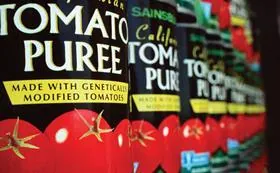
Sainsbury’s California Tomato Purée tins carrying a prominent genetically modified tomato declaration.
Credit
Johnathan Napier
Licence
Historical Ephemera
Displayed for commentary and research. Fair dealing under the UK CDPA 1988 applies only where its conditions are met. No permission for reuse is granted.
Caption
A surviving Sainsbury’s can photographed for the product’s thirtieth anniversary, alongside tomatoes and research vials.