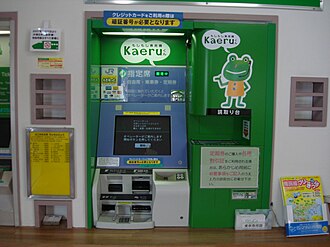
Kaeru-kun was JR East’s frog-branded ticket machine, connecting passengers to remote sales staff.
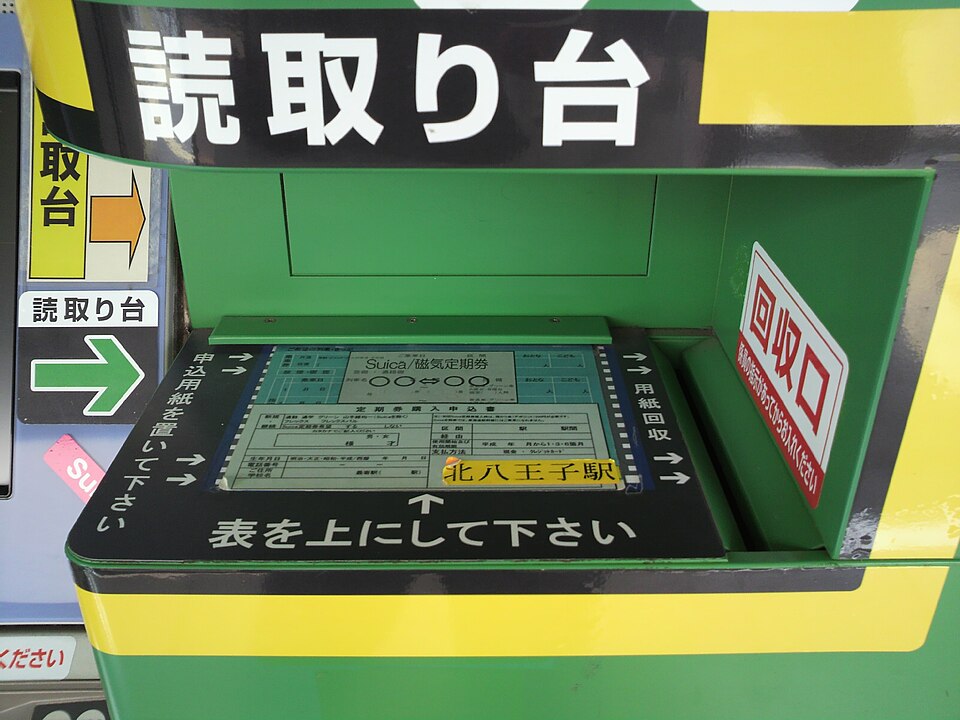
Introduced at seven Ōme Line stations in March 2005, it displayed each transaction while an operator prepared tickets and used a camera-equipped table to inspect supporting documents.
The system expanded in 2006 and was withdrawn station by station in early 2012. All original installations had gone by around that year; JR East’s later Talkable Reserved-Seat Ticket Machine is a redesigned successor, not a surviving Kaeru-kun.
History
Introduced at seven Ōme Line stations in March 2005, it displayed each transaction while an operator prepared tickets and used a camera-equipped table to inspect supporting documents.
History
The system expanded in 2006 and was withdrawn station by station in early 2012. All original installations had gone by around that year; JR East’s later Talkable Reserved-Seat Ticket Machine is a redesigned successor, not a surviving Kaeru-kun.
Significance
Kaeru-kun put a human voice behind an automated station counter. Its document camera let remote staff check certificates and handle purchases that ordinary self-service machines of the period could not, bringing some staffed-counter capability to smaller stations.
Its rollout also became part of a dispute over closures of Midori-no-madoguchi counters, local staffing and accessibility. The later Talkable Reserved-Seat Ticket Machine revived the remote-assistance idea in a design that passengers can also use independently.
Ticketing Workflow
- Passengers pressed the Start control and spoke to a sales-centre operator, who prepared the transaction remotely while its details appeared on the terminal screen.
- The documented functions included ordinary and reserved tickets, season tickets, selected discounted products, payment collection, some changes and refunds, and collection of certain reservations.
- A camera-equipped reading table allowed staff to inspect supporting documents such as student-discount and Zipangu Club certificates.
Rollout Across JR East
- Service began at 11:00 on 25 March 2005 at Nishi-Tachikawa, Higashi-Nakagami, Nakagami, Fussa, Hamura, Ozaku and Higashi-Ōme stations.
- The system expanded during 2006 into the Hachiōji, Takasaki, Mito, Chiba and Akita branch areas; Hachirōgata Station received it on 16 March.
- Published totals differ between 54 implemented or planned conversions, a 55-station wider deployment and 56 installations overall, so no single exact count is established.
Withdrawal and Successor
- JR East scheduled nine Akita-area Kaeru-kun terminals for replacement between February and March 2012.
- Futtsu City records service ending at Aohori and Ōnuki stations on 23 March 2012; all installations had been removed by around that year, although no uncontested system-wide final operating day is established.
- Introduced in March 2020, the redesigned Talkable Reserved-Seat Ticket Machine supports both self-service use and assistance from a remote operator.
Key facts
**Region:** Japan
**Associated With:** East Japan Railway Company (JR East) - developer and operator
**Defining Feature:** Remote operator-assisted ticket sales with document checking
**Status:** Discontinued - all original installations removed by around 2012
Region
Japan
Associated With
East Japan Railway Company (JR East) - developer and operator
Defining Feature
Remote operator-assisted ticket sales with document checking
Status
Discontinued - all original installations removed by around 2012
Images are included for historical and archival reference.
Rights holders may contact Forgotten Archive through the publishing account to request a credit correction or removal.
See the licence terms for attribution, reuse and any other conditions.
Caption
A JR East Kaeru-kun remote ticket machine at Yokokawa Station, photographed on 3 March 2007. Its green cabinet carried the service's frog mascot and branding.