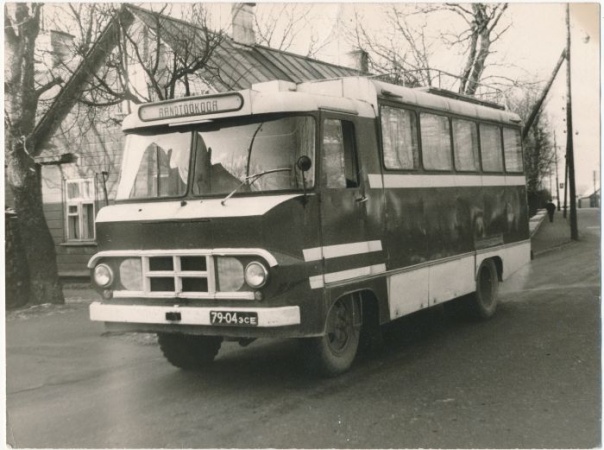
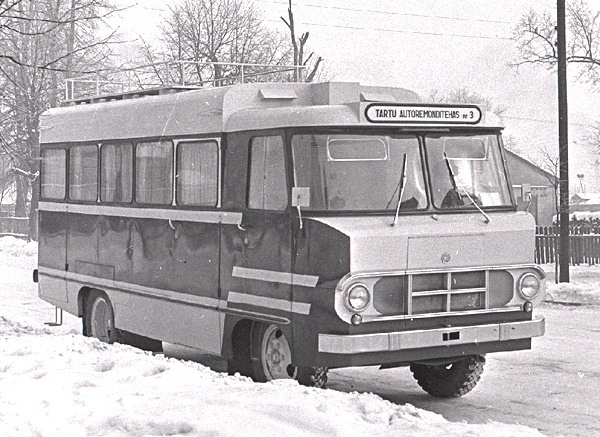
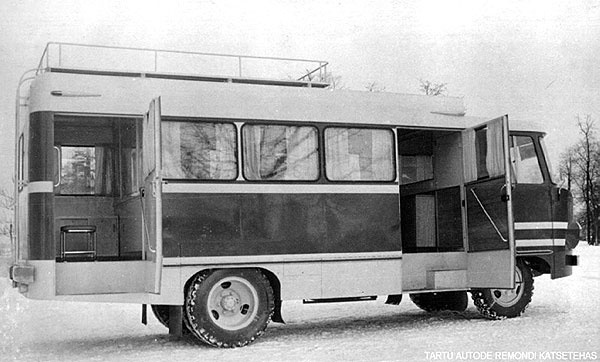
The TA-942T rändtöökoda put a heated hairdressing salon and cobbler’s bench inside a road vehicle.
Developed at Tartu Autoremonditehas, its insulated body sat on an extended GAZ-53F chassis. A 1964 newsreel showed an early Tartu-built service bus working at Rahva Võit collective farm in Estonia.
By 1965, four mobile workshops served 60 points across Harju district, though not every vehicle was identified as this model. Tartu district’s last service bus ran in autumn 1975; the TA-942T’s wider final operating date is unknown.
History
Developed at Tartu Autoremonditehas, its insulated body sat on an extended GAZ-53F chassis. A 1964 newsreel showed an early Tartu-built service bus working at Rahva Võit collective farm in Estonia.
History
By 1965, four mobile workshops served 60 points across Harju district, though not every vehicle was identified as this model. Tartu district’s last service bus ran in autumn 1975; the TA-942T’s wider final operating date is unknown.
Significance
For people living in rural Estonia, everyday services were not always available nearby. Mobile workshops brought haircuts and shoe repairs directly to collective farms and smaller settlements, reducing the need to travel to larger towns.
The TA-942T reflected a wider Soviet approach to rural service provision, adapting vehicles to bring skilled trades into communities without permanent facilities.
Body and Interior
- The TA-13 service-bus prototype was probably completed in spring 1963; a photograph caption gives 1962, leaving the exact chronology unresolved.
- The TA-942T used a metal-framed, insulated and heated body on an extended GAZ-53F chassis.
- Men’s and women’s hairdressing stations occupied the front, while a partitioned cobbler’s workshop filled the rear; ventilation, work lighting and separate access supported both trades inside.
Service Network and Production
- Specialist histories report nine mobile workshops completed late in 1964 and 120 new service buses in 1965, but the latter figure may cover several interior configurations.
- By November 1965, Harju district had four mobile workshops: three followed schedules, one answered calls or substituted, and together they served 60 points. The article does not identify every vehicle as a TA-942T.
- The specialist model history reports manufacture beginning in Orenburg, Kemerovo, Borisov, Brovary and Alma-Ata in 1966, though the factories, quantities and interior configurations remain uncorroborated.
Operation, Withdrawal and Survival
- A 1964 newsreel directed by Valeria Anderson showed the first Tartu-built service bus serving customers at Rahva Võit collective farm in Harju district.
- A 1969 Edasi article discussed replacing difficult-to-operate service buses with permanent pavilions or reception points.
- Tartu district’s last service bus ran in autumn 1975 after fixed service points were preferred there; this was a local endpoint, not the model’s final journey everywhere.
- Historical photographs and deteriorated remains survive, but no complete restored TA-942T is securely established.
Key facts
**Region:** Estonia
**Associated With:** Tartu Autoremonditehas - developer and manufacturer
**Defining Feature:** A heated, partitioned hairdressing salon and cobbler’s workshop on an extended GAZ-53F chassis
**Status:** Discontinued - Tartu district service ended in autumn 1975; the wider final operating date is unknown
Region
Estonia
Associated With
Tartu Autoremonditehas - developer and manufacturer
Defining Feature
A heated, partitioned hairdressing salon and cobbler’s workshop on an extended GAZ-53F chassis
Status
Discontinued - Tartu district service ended in autumn 1975; the wider final operating date is unknown
Images are included for historical and archival reference.
Rights holders may contact Forgotten Archive through the publishing account to request a credit correction or removal.
Photographer unresolved; Haapsalu and Läänemaa Museums Foundation collection attribution requires asset-level confirmation; hosted by minevikumasin.ee.
Licence
Historical Ephemera
Displayed for commentary, criticism, research and historical documentation where permitted by applicable law. No permission for reuse is granted.
Caption
In 1968, Haapsalu’s travelling workshop brought men’s and women’s hairdressing, tailoring and sewing services directly to communities.