The Frankenstein Project
Blackpool’s Neon Killer-Whale Chamber
Forgotten Places · 2001–2022
Archived on
Region
United Kingdom
Associated With
Tony Stallard - artist
Defining Feature
Portholes intended to reveal a pulsing dark-blue neon killer-whale display
Status
Discontinued - decommissioned and removed in 2022
Overview
The Frankenstein Project was Tony Stallard’s steel, glass and neon chamber on Blackpool’s South Promenade.
Installed in 2001 for the Great Promenade Show, its portholes were meant to reveal a pulsing dark-blue killer-whale display inside an industrial-looking shell for promenade visitors to peer into.
After damage and a reported renovation in 2003, it remained by the sea. In 2022, its contractor described corrosion as making the exterior unsightly before the work was decommissioned and removed.
Why It Mattered
The chamber made looking inside part of the attraction, drawing promenade visitors towards an enclosed spectacle. Academic writers and a public-art case study connected it with Blackpool’s older sideshow traditions, suggesting how contemporary public art could draw on the seaside’s history of curiosity and theatrical display.
Commissioning the Promenade Work
- Blackpool’s arts service approached more than fifty artists and designers in 1999, then exhibited twenty-nine proposals in May 2000.
- Visitors could vote for their favourites, but the record does not show that voting alone determined which ten proposals were selected for development.
- The Great Promenade Show was conceived as an outdoor gallery or visual variety show along approximately two kilometres of reconstructed South Shore sea defences.
- The Frankenstein Project was among the first commissions installed in 2001; no exact opening date is documented.
Chamber and Whale Display
- Blackpool Council identifies steel, glass and neon as the artwork’s principal materials.
- Public Art Online described a decompression-chamber-like tank whose portholes revealed a pulsing dark-blue neon killer-whale display.
- Descriptions of the interior differ: Public Art Online recorded a complete killer-whale skeleton, while an artist-associated profile and an academic article described a whale skull.
- The decommissioning contractor later described a twenty-four-foot, seven-tonne gas tank donated by British Gas, but original specifications were not located.
Damage, Repair and Removal
- A 2004 case study reported that every porthole was smashed, “Eyesore” was painted on the work, and the chamber was removed, renovated and returned during 2003.
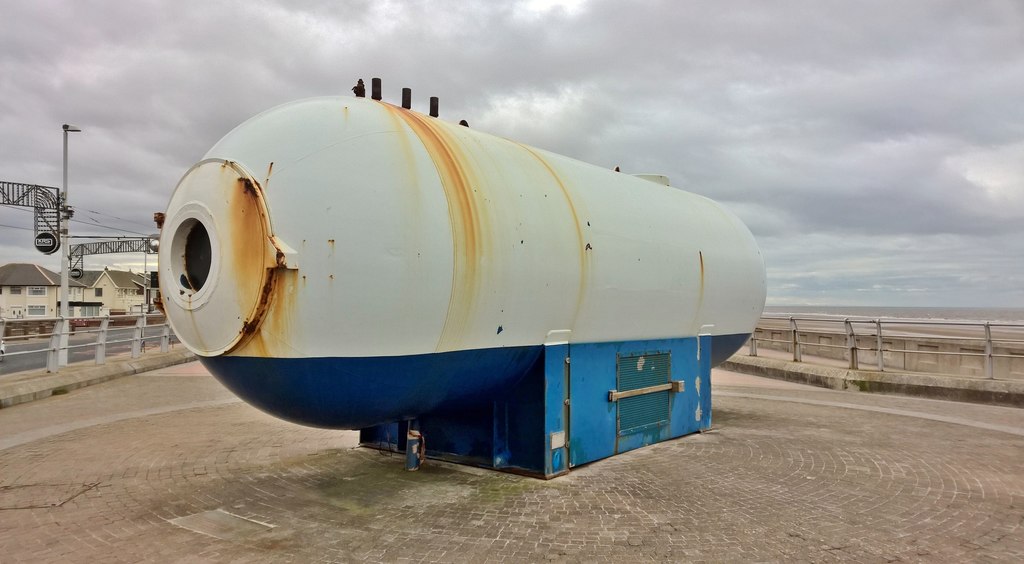
- Chris Morgan’s 2015 photograph documents a rust-marked exterior; Morgan reported seeing no whale while noting that they had not been looking for one.
- Refurbishment or decommissioning remained under discussion in March 2022, and decommissioning was complete by a report published on 16 September that year.
- The contractor attributed removal to corrosion-related unsightliness; the records do not establish structural danger or what happened to the artwork after removal.
Sources & Records
Blackpool Council — The Great Promenade Show
Records Tony Stallard’s 2001 steel, glass and neon commission, the Great Promenade Show setting, and the 1999–2000 proposal and public-voting process.
PTSG — Ending the Frankenstein Story
The decommissioning contractor confirms completion and attributes removal to corrosion-related unsightliness; its construction details are retrospective rather than original specifications.
Chris Morgan’s 2015 Geograph Photograph
Provides Chris Morgan’s 2015 exterior photograph and qualified observation that no whale was seen. The photograph is offered under CC BY-SA 2.0.
The Frankenstein Project, Contemporary Sculpture by Tony Stallard on Blackpool Prom
Shows the artwork’s exterior on 1 October 2020, providing a late-condition comparison before removal. Image reuse terms were not established.
Gallery
Credit
The Frankenstein Project by Tony Stallard, photograph ©ChrisMorgan
Licence
Reuse and sharing, including commercial use, are allowed with attribution. Credit the creator, link the licence and identify any changes. ShareAlike applies to adaptations. Other rights may apply.
Caption
Stallard’s chamber brought an unsettling spectacle to Blackpool’s promenade.