GPO Greetings Telegrams
Celebrations in a Golden Envelope
Forgotten Technology · 1935–1939
Archived on
Region
United Kingdom
Associated With
General Post Office - British postal and telegraph service
Defining Feature
A telegram delivered on a decorated form in a gold-coated brown-paper envelope
Status
Historical event - documented pre-war service
Overview
GPO Greetings Telegrams made a British telegram into a decorated delivery for life’s special occasions.
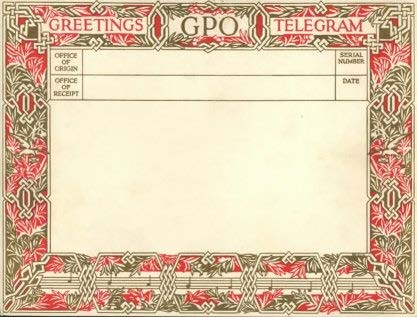
Introduced in July 1935, the service paired an illustrated message form with a gold-coated brown-paper envelope. The first form had a gold-and-scarlet border on cream paper; BT Archives attributes its design to Post Office employee Margaret Calkin James.
On 31 July, the Postmaster-General told Parliament that about 1,200 Greetings Telegrams were being delivered daily in London. He said general figures were not yet available. Surviving late-1930s examples document the service’s use during this pre-war period.
Why It Mattered
The GPO used commissioned artwork and publicity to give telegraphy a ceremonial role and attract special-occasion messages. The form and envelope became part of what the recipient received, extending the service beyond the transmission of words. Witham Museum’s Croxall family examples, preserved with their original gold envelopes, show how some deliveries became keepsakes.
A Telegram with Ceremony
- The service was introduced in July 1935; this record focuses on its pre-war use rather than its full later history.
- The cream Type 1 form carried a gold-and-scarlet border; its envelope was brown paper coated in gold.
Design and Promotion
- BT Archives attributes the first 1935 form to Post Office employee Margaret Calkin James.
- The GPO Public Relations Department promoted the service and commissioned artists for later form designs.
Early Use
- On 31 July 1935, the Postmaster-General told Parliament that about 1,200 Greetings Telegrams were being delivered daily in London.
- The minister said no general figures were yet available; the London figure is not a national total or proof of a causal effect from design.
Sources & Records
Post Office: Publicity Artwork and Designs, GB 0813 POST 109
Dates the Greetings Telegram Service to July 1935 and records the Public Relations Department’s role in publicising it and commissioning form designs, including the luxury golden envelope.
Identifies Margaret Calkin James as designer of the first 1935 form and describes its cream, gold-and-scarlet design and the gold-coated brown-paper envelope.
Collection of Greetings Telegrams – Croxall Family
Documents five original GPO greetings telegrams sent to the Croxall family in the late 1930s, retained in their original gold envelopes and sent from Chelmsford, Epping and Epworth.
New Greetings Telegrams — HC Deb 31 July 1935, vol. 304, col. 2664
Records Major Tryon’s report that about 1,200 Greetings Telegrams were delivered daily in London, while general figures were not yet available. Question 73; a ministerial report rather than an independent measurement.
Gallery
Credit
General Post Office / Margaret Calkin James; BT Archives
Licence
The source records this image as public domain. No copyright licence is required for the photograph; other rights may apply.
Caption
The first Greetings Telegram form gave a fast message a decorative setting for special occasions.