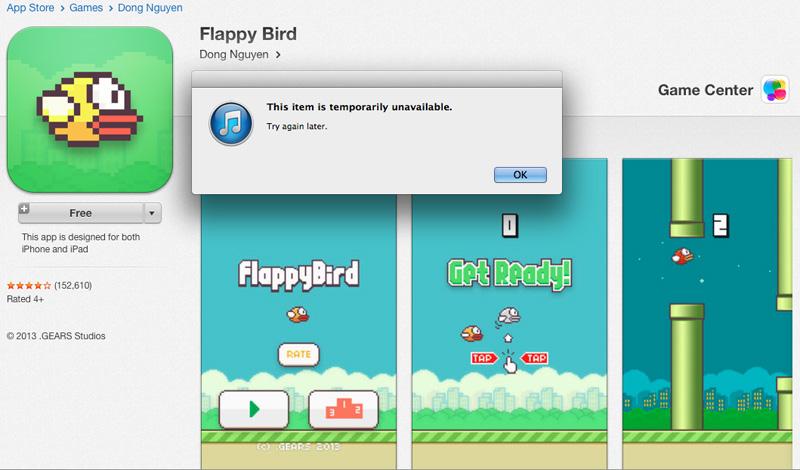
Flappy Bird reduced a mobile game to one repeated action: tap to keep a small bird airborne between green pipes. Created by Vietnamese developer Dong Nguyen and released in 2013, it offered almost no room for error but allowed another attempt within seconds. Its extreme simplicity made every failure feel avoidable and every new attempt immediate.
Why It Mattered
It showed how a tiny game with almost no barrier to restarting could command intense attention on a phone. The cycle of quick failure and instant retry made it easy to understand, frustrating to master and perfectly suited to being compared and discussed online.
Recorded identity
- The Canadian file identifies FLAPPYBIRD with a coloured flying-bird design.
- Dong Nguyen Ha is named as applicant.
Registered goods
- The application covers downloadable electronic games and software for mobile devices.
- It also lists online computer-game services.
Application history
- The Canadian application was filed on 7 April 2014 and claimed use since 24 May 2013.
- The Canadian file records abandonment on 12 February 2020.
- A separate US FLAPPYBIRD application, number 86209920, became the subject of a formal opposition and was abandoned after an inter-partes decision.
Associated With
Dong Nguyen Ha - associated person
Defining Feature
An electronic game identified by the FLAPPYBIRD name and a flying-bird design
Status
Discontinued - The retained Canadian application was abandoned in 2020; a US application was opposed and abandoned
- All one image sources are not yet verified — editorial review required.
Rights Notice
Images are included for historical and archival reference.
Rights holders may contact Forgotten Archive through the publishing account to request a credit correction or removal.
Flappy Bird interface: Dong Nguyen / .GEARS; reproduced by CREATe
Licence
Historical Ephemera
Displayed for commentary and research. Fair dealing under the UK CDPA 1988 applies only where its conditions are met. No permission for reuse is granted.
Caption
Flappy Bird's modest App Store presentation contrasts with the attention the game received, as a simple tapping challenge became an unusually intense mobile-gaming craze.