McLibel
The Libel Case Over a London Greenpeace Leaflet
Forgotten History · 1990–2005
Archived on
Region
United Kingdom
Associated With
London Greenpeace - leaflet publisher
Defining Feature
A 313-day libel hearing over a six-page leaflet
Status
Ended
Overview
McLibel was a UK libel case over a London Greenpeace leaflet, defended by Helen Steel and David Morris.
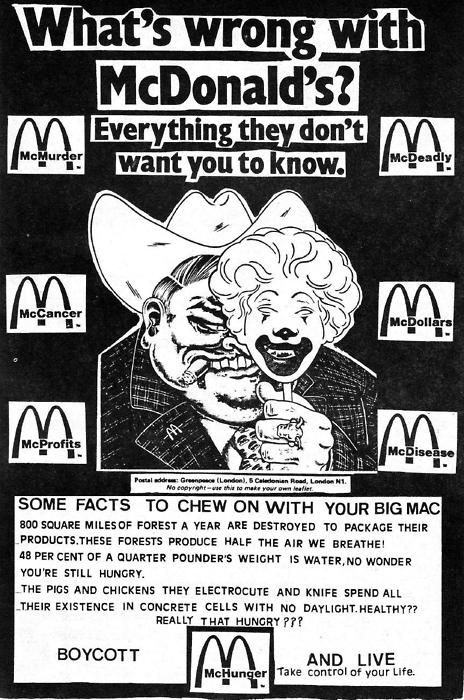
London Greenpeace produced and distributed the six-page “What’s Wrong with McDonald’s?” leaflet in 1986. McDonald’s issued a writ on 20 September 1990, and the substantive High Court hearing ran from 28 June 1994 to 13 December 1996.
Bell J delivered a mixed High Court judgment on 19 June 1997; the Court of Appeal ruled on 31 March 1999. On 15 February 2005, the European Court of Human Rights found violations of Articles 6 §1 and 10 in the UK proceedings.
Why It Mattered
Public-interest criticism came into conflict with a company’s ability to defend itself from defamation. Strasbourg identified food, employment, farming, deforestation and advertising to children among matters of general public concern, while stating that a large multinational could in principle defend itself against defamatory allegations.
The 2005 ruling turned on procedural conditions, not a finding that every leaflet allegation was true. The court held that the denial of legal aid prevented an effective defence and created inequality of arms under Article 6 §1; it also found Article 10 breached in the circumstances, including deficient procedural fairness and damages.
The Leaflet at Issue
- London Greenpeace produced and distributed the six-page “What’s Wrong with McDonald’s?” leaflet in 1986; its final reprint was in early 1987.
- The leaflet credits “THE LONDON GREENPEACE GROUP” and gives a London N1 contact address.
- The European Court recorded a grotesque cartoon figure behind a Ronald McDonald mask on the first page and altered Golden Arches labels on pages 2–5.
Course of the High Court Case
- McDonald’s issued its libel writ on 20 September 1990.
- The substantive High Court hearing ran from 28 June 1994 to 13 December 1996.
- The hearing occupied 313 court days, the duration recorded by both the Court of Appeal and the European Court of Human Rights.
Domestic Judgments and Appeal
- Bell J delivered the High Court judgment on 19 June 1997.
- The outcome was mixed: McDonald’s succeeded on some pleaded defamatory allegations, while Steel and Morris established justification for particular criticisms.
- The Court of Appeal gave judgment on 31 March 1999; after refusal of further domestic leave, the later Strasbourg application was against the United Kingdom rather than a reopening of the libel action.
The Strasbourg Ruling
- On 15 February 2005, the European Court of Human Rights found violations of Articles 6 §1 and 10.
- For Article 6 §1, it held that the lack of legal aid prevented an effective defence and created an unacceptable inequality of arms.
- For Article 10, it considered the proceedings insufficiently fair and the damages disproportionate in the circumstances of public-interest expression.
Metadata context
- Association details: London Greenpeace - producer and distributor of the leaflet at issue
- Geographical context: United Kingdom, with London as the leaflet’s provenance and appeal setting
The full case name is McDonald’s Corporation and McDonald’s Restaurants Ltd v Steel and Morris.
Selected Sources
Steel and Morris v. the United Kingdom — European Court of Human Rights judgment
15 February 2005 — Primary judicial record. The official online judgment records the writ, hearing dates, appeal history and Convention findings; it is the same judgment as the published report above, not independent corroboration.
Steel and Morris v McDonald’s Corporation and McDonald’s Restaurants Ltd — Court of Appeal judgment
31 March 1999 — Primary judicial record. The Court of Appeal transcript identifies the parties, the Royal Courts of Justice setting and the 313-day High Court hearing.
What’s Wrong with McDonald’s? — original London Greenpeace factsheet
1986 — Primary document reproduction. It preserves the leaflet’s title, London Greenpeace attribution and London N1 contact address.
Gallery
Credit
London Greenpeace
Licence
Historical Ephemera
Displayed for commentary, criticism, research and historical documentation where permitted by applicable law. No permission for reuse is granted.
Caption
The cover of London Greenpeace’s 1986 leaflet, the publication at the centre of the McLibel case.