INTERSCAN
The Australian system inside a joint aviation standard
Forgotten Engineering · 1971–1978
Archived on
Region
Australia and United States
Associated With
CSIRO, Department of Transport and AWA - collaborators
Defining Feature
Time-reference scanning beams for precision aircraft approach guidance
Status
Ended
Overview
INTERSCAN was Australia’s entry in the 1970s effort to design a more flexible precision landing system for aircraft.
CSIRO, Australia’s civil-aviation administration and AWA developed a time-reference scanning-beam system. A later Engineering Heritage account places joint testing at Atlantic City in mid-1974, using modified U.S. transmitting equipment with Australian receivers, followed by a Melbourne Airport demonstration in March 1975.
The United States formally chose TRSB as its MLS candidate in February 1975. On 19 April 1978, ICAO’s All-Weather Operations Division selected the joint U.S.–Australian candidate by 39 votes to 24, with eight abstentions. The vote advanced standards work; it did not order airports to replace ILS immediately.
Why It Mattered
Australian engineering helped shape the signal format chosen for a new international aviation standard. By timing microwave beams that swept across the approach, an aircraft could determine its position within a wider guidance area than the single fixed path provided by ILS.
Its victory also exposed the distance between choosing a standard and rebuilding a working system. In 1978, the United States already had about 650 ILS ground systems at 498 civil airports and roughly 50,000 aircraft fitted with ILS avionics. Replacing them required a clear operational benefit as well as a successful design. In 1994, the FAA stopped further Category II/III MLS development and shifted attention towards GPS and WAAS work.
An Australian system, tested with the United States
- The project brought together CSIRO, Australia’s civil-aviation administration and AWA; its core contribution was the time-reference scanning-beam signal technique.
- A later Engineering Heritage account places mid-1974 tests at Atlantic City and a March 1975 ICAO demonstration at Melbourne Airport.
- The reported Melbourne landing within 60 centimetres of the centre line was one demonstration result, not a general accuracy guarantee.
The joint standards decision
- The United States formally selected TRSB as its MLS candidate on 27 February 1975.
- On 19 April 1978, ICAO’s division voted 39–24, with eight abstentions, for the joint U.S.–Australian candidate.
- The choice concerned a shared signal format with different national ground implementations; it was not the worldwide installation of one Australian machine.
Why ILS remained
- ICAO protected ILS at international airports until 1 January 1995 and envisaged a gradual MLS transition based on operational experience.
- New airport equipment and aircraft avionics had to displace a large, reliable installed base, while benefits varied by airport and operator.
- The FAA’s 1994 pivot towards GPS and WAAS was a U.S. programme decision, not proof that satellite navigation instantly replaced MLS or ILS everywhere.
Selected Sources
Chronology of the Federal Aviation Administration
1975–1994 — Official chronology recording the U.S. TRSB selection, the 1978 ICAO vote and the FAA’s 1994 change of direction.
Status of the Federal Aviation Administration’s Microwave Landing System
1978 — Government report explaining the joint international candidate, planned ILS protection and the equipment and transition-cost barriers.
The INTERSCAN Microwave Landing System
1978 — Period technical account describing ILS limitations, INTERSCAN’s guidance geometry and the Australian project partnership.
Gallery
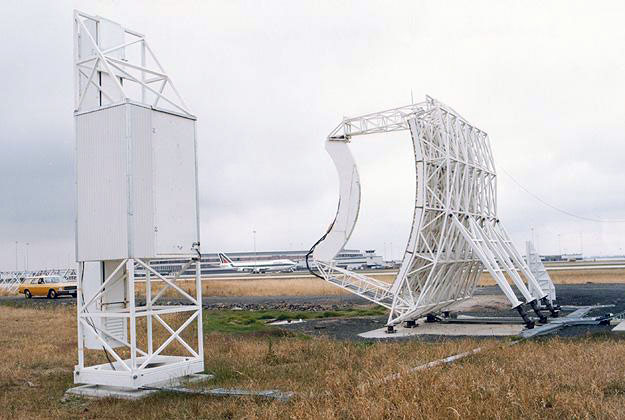
Credit
Civil Aviation Historical Society collection
Licence
Historical Ephemera
Displayed for commentary, criticism, research and historical documentation where permitted by applicable law. No permission for reuse is granted.
Caption
Two experimental INTERSCAN elevation antennas stood beside Melbourne Airport in 1977.