Queen's Messenger Convoys
Feeding the Blitz, Planning for Atomic Attack
Forgotten History · 1941–1952
Archived on
Region
United Kingdom
Associated With
Ministry of Food - emergency-feeding service
Defining Feature
Mobile kitchens and canteens travelling as one unit
Status
Unresolved
Overview
Queen's Messenger Convoys were mobile emergency kitchens built to move as a unit, not isolated canteen vans.
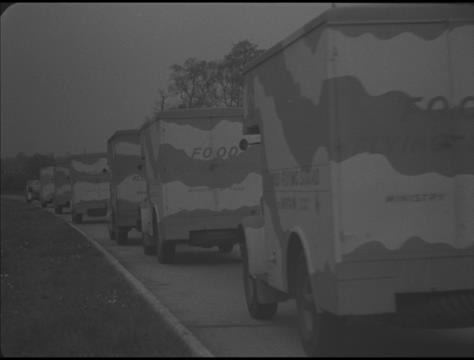
In July 1941, Parliament counted two Scottish convoys, each with eight vehicles, separately from 157 other mobile canteens. An official film showed stores, kitchens, canteens and a water tanker travelling together. Its catalogue said eighteen Flying Squads were planned—not that eighteen operated.
A decade later, the service was being assembled again. In July 1951, eleven complete convoys were on order and the first delivery was expected by the end of August. A 1952 London conference report described a larger formation: an office van, stores and equipment vans, eight canteen vans, water tankers, a welfare van and motorcycles. The surviving records do not say how many of the ordered convoys entered service.
Why It Mattered
Emergency feeding is a logistics problem before it is a meal. Food, water, fuel, equipment, welfare staff and transport all have to arrive together. The convoy turned those dependencies into a portable system that could establish a base and send canteen vans into affected districts.
The records also show why historical counts need care. Parliament documented two Scottish convoys in 1941; the film described a national plan; the postwar statement recorded an order. Planned, ordered, delivered and operational are four different things. The evidence preserves the scale of the ambition without pretending that the full fleet is known.
The 1941 Convoy
- Parliament recorded two Scottish Queen's Messenger Convoys, each with eight vehicles.
- The official film described stores, kitchens, canteens and a water tanker within an eight-vehicle Flying Squad.
- Eighteen squads were planned; that is not a confirmed operating total.
The Postwar Formation
- Eleven complete convoys were on order in July 1951, with first delivery expected by the end of August.
- The 1952 formation included an office van, stores and equipment vans, eight canteen vans, water tankers, a welfare van and motorcycles.
- The conference placed the system within food planning for civil defence and atomic attack.
What Remains Unknown
- The records reviewed here do not establish how many of the eleven postwar convoys were delivered or operated.
- They do not establish one unchanged design between 1941 and 1952.
- They do not establish the precise staffing relationship between every convoy and voluntary organisations.
Selected Sources
Food Supplies — Mobile Canteens, Scotland
23 July 1941 — Parliament records two Scottish Queen's Messenger Convoys of eight vehicles each and counts other mobile canteens separately.
QUEEN'S MESSENGERS — IWM film UKY 356
July 1941 — The official film catalogue describes the eight-vehicle Flying Squad and says eighteen squads were planned, not confirmed as operational.
The London Food Conference — A Summary of Findings
July 1952 — The report describes the postwar convoy's component vehicles, stated feeding capacity and civil-defence purpose.
Gallery
Credit
Imperial War Museums, UKY 356; Ministry of Food and Ministry of Information
Licence
Historical Ephemera
Displayed for commentary, criticism, research and historical documentation where permitted by applicable law. No permission for reuse is granted.
Caption
Queen's Messenger mobile canteen vehicles travel in convoy in the 1941 Ministry of Food and Ministry of Information film.