ImaHima was a Japanese mobile social network launched in 1999, letting users share location, activity and availability.
Users manually posted their current or planned location, activity, availability and mood. They could search those updates, find friends or people with shared interests, exchange messages, apply privacy controls and send time-sensitive invitations.
By March 2001, reports recorded 250,000 members, while imaHima2 added private groups, meeting-time polls and greeting cards. An i-appli chat client followed in May. Founder Neeraj Jhanji later recalled closing the service after a major server failure in 2006.
History
Users manually posted their current or planned location, activity, availability and mood. They could search those updates, find friends or people with shared interests, exchange messages, apply privacy controls and send time-sensitive invitations.
History
By March 2001, reports recorded 250,000 members, while imaHima2 added private groups, meeting-time polls and greeting cards. An i-appli chat client followed in May. Founder Neeraj Jhanji later recalled closing the service after a major server failure in 2006.
Significance
ImaHima made location part of an everyday social update without depending solely on automatically determined coordinates. People could say where they were, what they were doing and whether they were free, then use that context to find friends, nearby activity or a reason to meet.
It brought mobile status, friend presence, local discovery and group coordination together at the turn of the millennium. Ars Electronica recognised its mobile community model with a 2001 Award of Distinction.
How ImaHima Worked
- The patent allowed both present and future status entries, combining a time, activity and self-declared location.
- Contacts were stored as “mates”; the same mate lists later fed the real-time chat client.
- Location was supplied by the user, so the system did not depend solely on GPS or another automatic position fix.
Services, Pricing and Scale
- By March 2001, the free general-site version worked through i-mode, EZweb, J-Sky and desktop web browsers.
- The official-menu imaHima2 edition cost ¥100 per month and added private groups, meeting-time polls and group greeting cards.
- K-Tai Watch recorded 250,000 members and about 800,000 daily page views in March 2001; Ars Electronica later reported over one million daily page requests.
- The May 2001 i-appli chat client was available to ImaHima members; new subscribers received their first month free, followed by a ¥100 monthly fee.
Launch, Recognition and Later History
- ImaHima launched on 15 December 1999, according to a 2003 company announcement; ImaHima Inc. was formally established on 1 May 2000.
- The service received an Award of Distinction in the 2001 Prix Ars Electronica Net Vision / Net Excellence category.
- ImaHima operated in Japan and Switzerland. Founder Neeraj Jhanji later recalled raising approximately $4 million and reaching around 500,000 users.
- Jhanji recalled closing the service after a major server failure in 2006; the exact date remains unverified. Patents later transferred to Facebook in 2013, without proving Facebook used the technology.
**▶️ Watch Related Video**
Key facts
**Region:** Japan
**Associated With:** ImaHima Inc. - service operator
**Defining Feature:** Self-declared mobile location, activity and availability updates
**Status:** Discontinued - core service reportedly ended in 2006
Region
Japan
Associated With
ImaHima Inc. - service operator
Defining Feature
Self-declared mobile location, activity and availability updates
Status
Discontinued - core service reportedly ended in 2006
Images are included for historical and archival reference.
Rights holders may contact Forgotten Archive through the publishing account to request a credit correction or removal.
ImaHima Inc. — interface; ITmedia Mobile — publication
Licence
Historical Ephemera
Displayed for commentary and research. Fair dealing under the UK CDPA 1988 applies only where its conditions are met. No permission for reuse is granted.
Caption
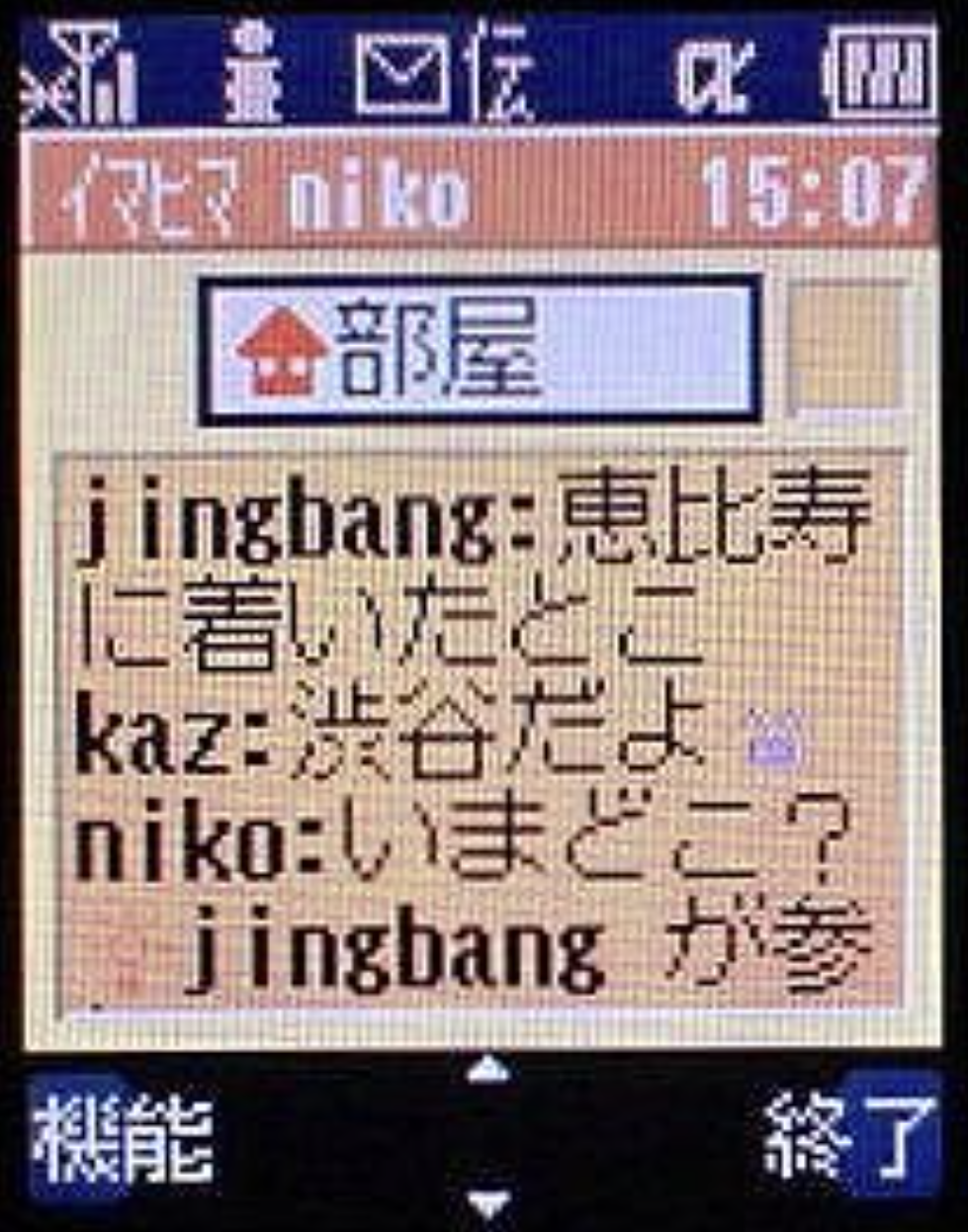
ImaHima Chat displayed a mobile conversation between users discussing locations in Tokyo, as documented by ITmedia Mobile in May 2001.
ImaHima Inc. — interface; K-tai Watch — publication
Licence
Historical Ephemera
Displayed for commentary and research. Fair dealing under the UK CDPA 1988 applies only where its conditions are met. No permission for reuse is granted.
Caption
ImaHima's blue mascot and red wordmark accompanied the March 2001 announcement of ImaHima2, which added group coordination and meeting-time voting.
ImaHima Inc. — interface; K-tai Watch — publication
Licence
Historical Ephemera
Displayed for commentary and research. Fair dealing under the UK CDPA 1988 applies only where its conditions are met. No permission for reuse is granted.
Caption
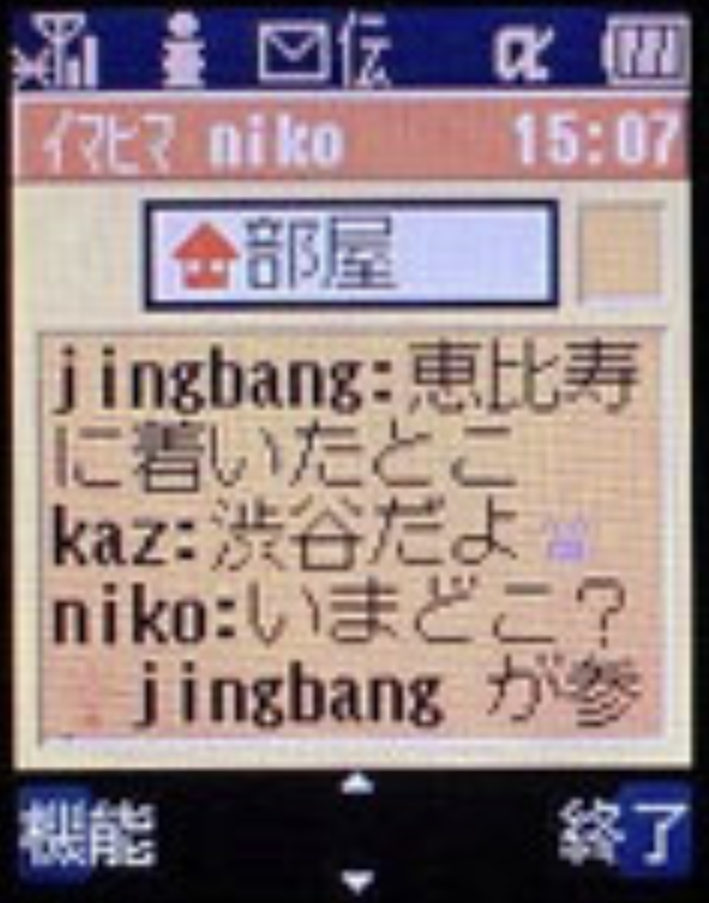
A second surviving copy of the ImaHima Chat interface from 10 May 2001. The same screen appeared in two publications that day; both versions are preserved here to document their separate publication sources.